
Global Whey Protein Market
 |
Author:
Sayali T
|
Pages:
190
|
Author:
Sayali T
|
Pages:
190
Global Whey Protein Market Size, Share By Type (Whey Protein Concentrate, Whey Protein Isolate, Whey Protein Hydrolysate, Native Whey Protein, and Others), By Application (Sports Nutrition, Functional Food & Beverages, Clinical & Medical Nutrition, Infant Nutrition, and Others), By Distribution Channel (Supermarkets & Hypermarkets, Online Retail, Specialty Stores, Direct-to-Consumer), and By Region (North America, Europe, Asia-Pacific, Latin America, Middle East & Africa), Analysis and Forecast 2026-2035
CAGR
7.21%
REVENUE 2025
USD Billion 12.6
FORECAST 2035
USD Billion 25.28
REPORT COVERAGE
Global
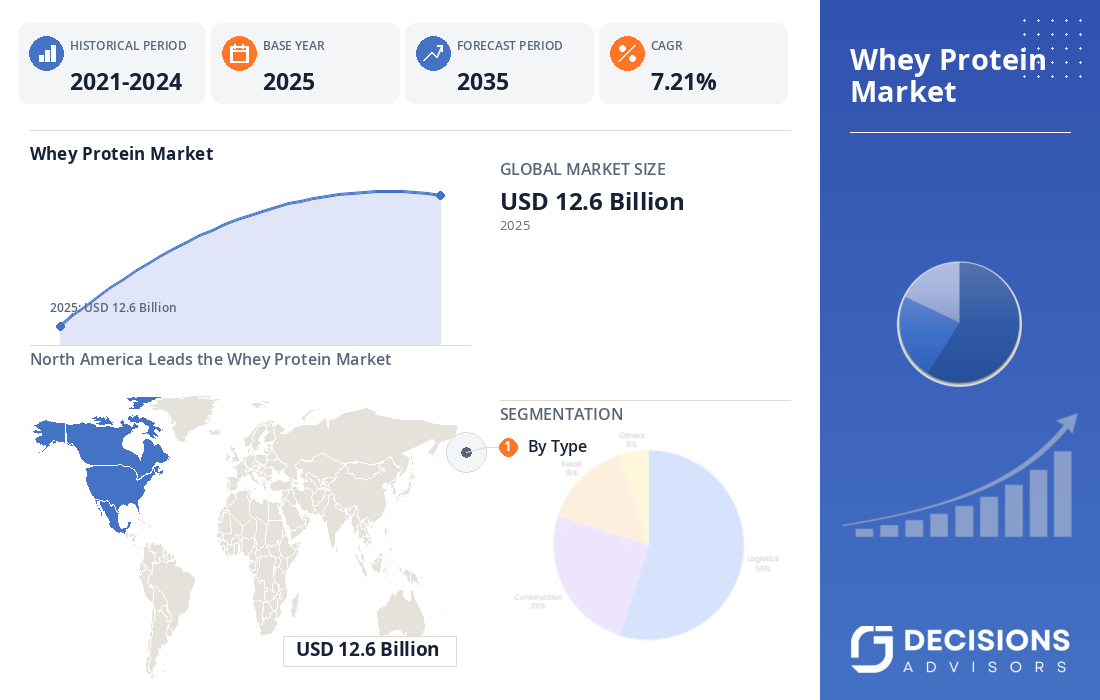
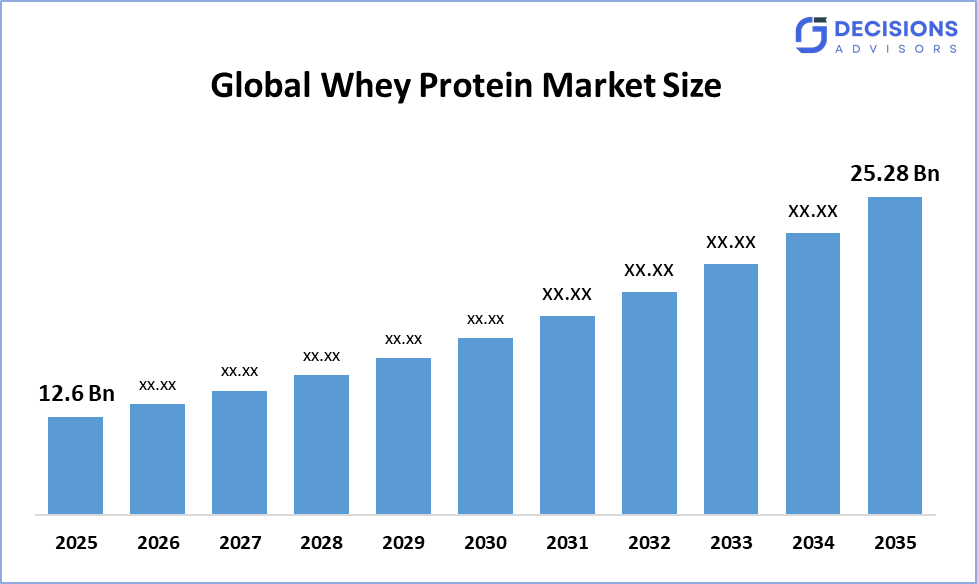
The Global Whey Protein Market Size is predicted to grow from USD 12.6 Billion in 2025 and is likely to reach around USD 25.28 Billion by 2035 with a CAGR of 7.21 %. According to Decision Advisors, a detailed research report on the market reflects that the sports and clinical nutrition adoption trend dominates the Global Whey Protein Market, accounting for approximately 40% of the total share worldwide. Glanbia plc leads the market with a broad ingredient portfolio and a strong global manufacturing footprint, capturing approximately 14% of the global Whey Protein Isolate (WPI) market share through its integrated processing network and flagship sports nutrition brands like Optimum Nutrition.
Market Snapshot
- Global Whey Protein Market Size (2025): USD 12.6 Billion
- Projected Global Whey Protein Market Size (2035): USD 25.28 Billion
- Global Whey Protein Market Compound Annual Growth Rate (CAGR): 7.21 %
- Largest Regional Market: North America
- 2nd Largest Region: Europe
- Fastest Growing Region: Asia Pacific
- Base Year: 2025
- Historical Period: 2021-2024
- Market Forecast Period: 2026-2035
Market Overview/ Introduction
The Global Whey Protein Market refers to the industry that produces and supplies protein derived from milk during the cheese-making process, used across sports nutrition, clinical nutrition, functional foods and beverages, and infant nutrition. The market is experiencing steady growth because of rising protein normalization in everyday diets, increasing fitness and wellness awareness, and expanding use of whey protein as a functional ingredient beyond discretionary supplementation. Government dairy and nutrition programs across the US, New Zealand and India are creating better conditions for dairy processing capacity and protein-fortified food supply chains. Key companies, including Glanbia plc, Arla Foods Ingredients, Fonterra Co-operative Group, Lactalis Ingredients, and FrieslandCampina, are developing high-purity, low-lactose whey protein solutions that use advanced membrane filtration while achieving high protein yield. The market provides customers with products that combine high protein density with clean-label formulation and reliable supply, supporting long-term nutrition and functional food applications. The global market will experience future expansion through the development of ready-to-drink protein beverages, clinical and medical nutrition programs, plant-whey hybrid formulations, and advanced dairy processing technologies.
- New Zealand's government supports dairy export and sustainability initiatives, promoting the adoption of advanced processing technology in whey protein ingredient manufacturing and supply chain expansion.
- Protein-fortification and nutrition security initiatives in India are driving the adoption of whey protein in packaged foods and dietary supplements, supporting the development of a modernized, domestic dairy processing base.
Notable Insights: -
- North America is estimated to hold approximately 35% share of the Global Whey Protein Market over the predicted timeframe.
- Europe is expected to maintain a steady CAGR in the Global Whey Protein Market by holding approximately 24% of the share during the forecast period.
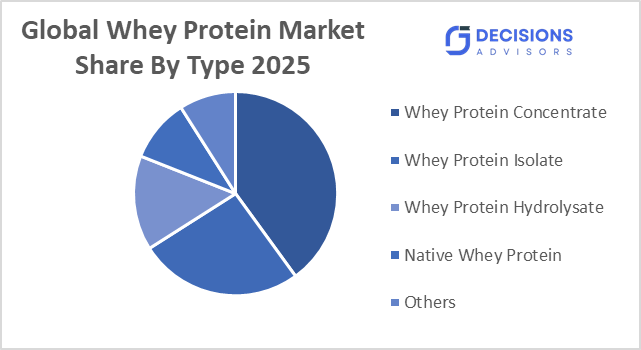
- By type, the Whey Protein Concentrate segment dominated the market and holds approximately 40% share in 2025 and is projected to grow at a substantial CAGR during the forecast period.
- By application, the sports nutrition segment dominated the market and holds approximately 22% share in 2025 and is projected to grow at a substantial CAGR during the forecast period.
- The compound annual growth rate of the Global Whey Protein Market 7.21 %.
- The market is likely to achieve a valuation of USD 25.28 Billion by 2035.
Market Drivers
The Global Whey Protein Market experiences growth because protein intake is migrating from niche athletic use toward mainstream daily consumption. The expansion of sports nutrition, gym culture, and fitness-driven lifestyles drives increased adoption of whey protein powders, ready-to-drink shakes, and protein bars. The growth of functional foods and beverages drives the adoption of whey protein in fortified snacks, bakery products, and dairy alternatives. The clinical and medical nutrition sector shows increasing demand because of aging populations and hospital-based supplementation programs. The market expands because manufacturers use whey protein to deliver texture, emulsification and satiety beyond pure nutritional value. The global dairy industry moves towards clean-label, low-lactose products which drives producers to implement advanced membrane filtration and drying technologies.
Restrain
The Global Whey Protein Market faces challenges such as exposure to dairy input and milk price volatility, along with rising energy costs tied to filtration and drying processes. Regulatory compliance related to nutritional claims, allergen labelling, and food safety across cross-border trade also increases operational complexity and development costs.
Competitive Analysis:
The report offers the appropriate analysis of the key organizations/companies involved within the Global Whey Protein Market along with a comparative evaluation primarily based on their product offerings, business overviews, geographic presence, enterprise strategies, segment market share, and SWOT analysis. The report also provides an elaborative analysis focusing on the current news and developments of the companies, which includes product development, innovations, joint ventures, partnerships, mergers & acquisitions, strategic alliances, and others. This allows for the evaluation of the overall competition within the market.
Top Companies in the Global Whey Protein Market
- Glanbia plc
- Arla Foods Ingredients
- Fonterra Co-operative Group
- Lactalis Ingredients
- FrieslandCampina N.V.
- Hilmar Ingredients Inc.
- Agropur Inc.
- Leprino Foods Company
- DMK Deutsches Milchkontor GmbH
- Milk Specialties Global
Government Initiatives
|
Country |
Key Government Initiatives |
|
US |
The U.S. government, through USDA and FDA dairy and nutrition-labeling programs, supports domestic whey processing capacity and R&D in protein fortification, driving innovation in advanced dairy ingredient technologies and enhancing development of next-generation whey protein solutions. |
|
New Zealand |
Dairy export and sustainability initiatives backed by New Zealand's government are driving the adoption of advanced membrane filtration in whey protein manufacturing, improving processing yield, supply chain traceability, and export competitiveness. |
|
India |
Policies focusing on protein fortification, “Eat Right India”, and dairy processing modernization under national dairy development programs are driving innovation and increasing the adoption of whey protein across packaged food and nutrition applications. |
Market Segmentation
The Global Whey Protein Market share is classified into type, application and distribution channel
- The Whey Protein Concentrate segment dominated the market and holds approximately 40% share in 2025 and is projected to grow at a substantial CAGR during the forecast period.
Based on the type, the Global Whey Protein Market is divided into Whey Protein Concentrate, Whey Protein Isolate, Whey Protein Hydrolysate, Native Whey Protein, and Others. Among these, the Whey Protein Concentrate segment dominates the market and holds approximately 40% share in 2025. This dominance is due to its favorable cost-per-gram economics, wide availability, and strong compatibility with ready-to-drink beverages and mainstream functional foods. These proteins are widely used in sports nutrition, bakery products, and dairy beverages, making them the most preferred choice across everyday protein-fortified applications globally.
- The Sports Nutrition segment accounted for the largest share of approximately 22% in 2025 and is anticipated to grow at a significant CAGR during the forecast period.
Based on the application, the market is divided into Sports Nutrition, Functional Food & Beverages, Clinical & Medical Nutrition, Infant Nutrition, and Others. Among these, Sports Nutrition accounted for the largest share and holds approximately 22% share in 2025. This dominance is due to rising gym memberships, growing fitness participation, and increasing awareness of protein's role in muscle building and recovery. Increasing adoption of functional foods and clinical nutrition products further supports segment growth, making sports nutrition the primary revenue contributor in the Global Whey Protein Market.
- The Supermarkets & Hypermarkets segment accounted for the largest share of approximately 34% in 2025 and is anticipated to grow at a significant CAGR during the forecast period.
Based on distribution channel, the market is divided into Supermarkets & Hypermarkets, Online Retail, Specialty Food Stores, and Direct-to-Consumer. Among these, Supermarkets & Hypermarkets dominate the market and hold approximately 34% share in 2025. This dominance is due to widespread product availability, established consumer trust, and strong in-store visibility for sports nutrition and dairy brands. Online retail continues to expand rapidly, supported by subscription models and direct-to-consumer nutrition brands, driving broader global adoption across multiple purchasing channels.
Regional Segment Analysis of the Global Whey Protein Market
- North America (U.S., Canada, Mexico)?
- Europe (Germany, France, U.K., Italy, Spain, Rest of Europe)
- Asia-Pacific (China, Japan, India, Rest of APAC)
- South America (Brazil and the Rest of South America)?
- The Middle East and Africa (UAE, South Africa, Rest of MEA)
North America is estimated to hold approximately 35% share of the Global Whey Protein Market over the predicted timeframe.
North America holds approximately 35% share of the Global Whey Protein Market due to mature sports nutrition markets, advanced dairy processing infrastructure, and established clinical nutrition channels across the U.S. and Canada. The region benefits from the presence of major dairy processors and ingredient suppliers, which support continuous innovation in filtration and formulation technology. High adoption of protein-fortified foods, ready-to-drink beverages, and clinical nutrition programs further strengthens market growth. Additionally, well-established retail and e-commerce infrastructure contributes to sustained demand. The sports nutrition sector also plays a key role, with increasing integration of whey protein in gyms, wellness programs, and mainstream grocery retail across the region.
Europe is expected to maintain a steady CAGR in the Global Whey Protein Market, holding approximately 24% of the share during the forecast period
Europe is expected to maintain a steady CAGR in the Global Whey Protein Market, holding approximately 24% share during the forecast period due to strong regulatory frameworks and high penetration of functional foods across Germany, France, and the UK. The region benefits from the presence of established dairy ingredient producers, which drive continuous innovation in low-lactose and high-purity whey protein grades. High adoption of clean-label products, clinical nutrition, and premium sports nutrition further supports market expansion. Additionally, the growing integration of whey protein in functional beverages and fortified dairy products contributes to sustained demand across the region, strengthening Europe's position in the global market.
Asia Pacific is the fastest-growing region in the Global Whey Protein Market during the period, holding approximately 19% share.
Asia Pacific is the fastest-growing region in the Global Whey Protein Market during the forecast period, holding approximately 19% share due to rapid urbanization, rising disposable incomes, and expanding fitness culture across China, India, and Japan. The region benefits from increasing adoption of functional beverages and protein-fortified packaged foods, which widely integrate whey protein into everyday consumption. Additionally, growing dietary protein awareness is encouraging the use of sports and clinical nutrition products. Rising demand for infant nutrition and dairy-based functional foods further supports market expansion. Continuous investments in dairy processing infrastructure and retail modernization across countries such as China, India, and South Korea are accelerating the adoption of whey protein solutions across multiple end-use industries.
Future Market Trends in Global Whey Protein Market: -
-
- Expansion of Plant-Whey Hybrid and Clean-Label Formulations
Hybrid formulations blending whey protein with plant-based proteins are increasingly used in beverages, bars, and powders due to improved amino acid profiles, better sustainability positioning, and broader consumer appeal. They enable diversified product portfolios, improved formulation flexibility, and innovative label claims. Growing demand for clean-label and flexitarian nutrition is accelerating adoption globally.
-
- AI-Enabled Personalized Nutrition
AI integration enhances whey protein product development by enabling personalized formulation, adaptive dosing recommendations, and data-driven flavor optimization. It improves consumer engagement, reduces product development cycles, and personalizes user experience across sports nutrition apps, e-commerce platforms, and wellness programs. This trend is driving more responsive, efficient, and consumer-centric nutrition brands worldwide.
-
- Growth in Ready-to-Drink Protein Beverages
Manufacturers are increasingly launching ready-to-drink whey protein beverages and shots to enhance convenience and reduce preparation time for consumers. These formats offer better portability, improved shelf stability, and expanded on-the-go consumption occasions. Rising fitness participation and demand for functional beverages are significantly boosting this trend globally.
-
- Rising Demand for Sustainable and Traceable Dairy Sourcing
Whey protein producers are increasingly investing in sustainable dairy sourcing, waste valorization, and supply chain traceability to meet buyer and regulatory expectations. Their lower environmental footprint and transparent sourcing make them ideal for premium and clinical nutrition brands. Growing sustainability-conscious consumption is accelerating market expansion globally.
Recent Development
- December 2025: Glanbia plc announced the expansion of its ceramic microfiltration capacity in Ireland, launching enhanced whey protein isolate production to scale supply chain capabilities for premium sports nutrition applications.
- In September 2025, Arla Foods Ingredients officially launched a new purification technology across clinical nutrition channels, shifting technology direction toward higher-purity protein isolation and influencing hydrolysate adoption patterns for infant and medical nutrition.
- In May 2025, Fonterra Co-operative Group announced the acquisition of a U.S. spray-drying facility specializing in grass-fed whey protein concentrate, launching new procurement models for clean-label functional food manufacturers.
Market Segment
This study forecasts revenue at global, regional, and country levels from 2020 to 2035. Decision Advisors has segmented the Global Whey Protein Market based on the below-mentioned segments:
Global Whey Protein Market, By Type
- Whey Protein Concentrate
- Whey Protein Isolate
- Whey Protein Hydrolysate
- Native Whey Protein
- Others
Global Whey Protein Market, By Application
- Sports Nutrition
- Functional Food & Beverages
- Clinical & Medical Nutrition
- Infant Nutrition
- Others
Global Whey Protein Market, By Distribution Channel
- Supermarkets & Hypermarkets
- Online Retail
- Specialty Food Stores
- Direct-to-Consumer
Global Whey Protein Market, By Regional Analysis
- North America
- US
- Canada
- Mexico
- Europe
- Germany
- UK
- France
- Italy
- Spain
- Russia
- Rest of Europe
- Asia Pacific
- China
- Japan
- India
- South Korea
- Australia
- Rest of Asia Pacific
- South America
- Brazil
- Argentina
- Rest of South America
- Middle East & Africa
- UAE
- Saudi Arabia
- Qatar
- South Africa
- Rest of the Middle East & Africa
Frequently Asked Questions (FAQ)
Q. How is whey protein improving nutrition outcomes in modern diets?
A. Whey protein delivers a complete amino acid profile with rapid absorption, allowing manufacturers to formulate fortified foods, ready-to-drink beverages, and clinical nutrition products with improved muscle recovery and dietary support benefits.
Q. Why are whey protein isolates preferred over concentrates in premium nutrition segments?
A. They offer higher protein purity, lower lactose content, and better solubility, making them more suitable for premium sports nutrition, clinical formulations, and consumers with lactose sensitivity.
Q. What role does whey protein play in clinical and medical nutrition?
A. It supports patient recovery and healthy aging through high-quality, easily digestible protein supplementation, helping address malnutrition risk and muscle loss in hospital and elderly care settings.
Q. How is dairy processing technology influencing whey protein development?
A. Advances in membrane filtration and spray-drying technology are enabling more compact, energy-efficient, and higher-purity whey protein solutions across sports, clinical, and functional food applications.
Check Licence
Choose the plan that fits you best: Single User, Multi-User, or Enterprise solutions tailored for your needs.
We Have You Covered
- 24/7 Analyst Support
- Clients Across the Globe
- Tailored Insights
- Technology Tracking
- Competitive Intelligence
- Custom Research
- Syndicated Market Studies
- Market Overview
- Market Segmentation
- Growth Drivers
- Market Opportunities
- Regulatory Insights
- Innovation & Sustainability
Report Details
| Scope | Global |
| Pages | 190 |
| Delivery | PDF & Excel via Email |
| Language | English |
| Release | Aug 2026 |
| Access | Download from this page |