
Global Wilsons Disease Market
 |
Pages:
230
|
Pages:
230
Global Wilsons Disease Market Size, Share, and COVID-19 Impact Analysis, By Product Type (Biochemical Tests, Genetic Testing, and Liver Biopsy), By Treatment Type (Chelating Agents, Zinc Preparations, and Liver Transplantation), By Indication (Hepatic, Neurological and psychiatric, and Other indications), and By Region (North America, Europe, Asia-Pacific, Latin America, Middle East, and Africa), Analysis and Forecast 2025-2035
REPORT COVERAGE
Global
Global Wilsons Disease Market Size Insights Forecasts to 2035
- The Global Wilsons Disease Market Size Was Estimated at USD 637.45 Million in 2024
- The Market Size is Expected to Grow at a CAGR of around 6.11 % from 2025 to 2035
- The Worldwide Wilsons Disease Market Size is Expected to Reach USD 1224.42 Million by 2035
- Europe is expected to grow the fastest during the forecast period.
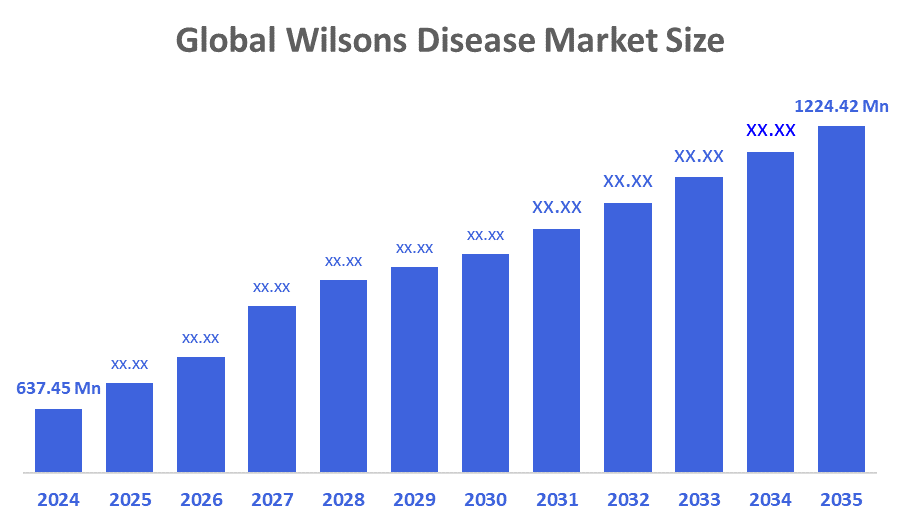
According to a research report published by Decisions Advisors and Consulting, The Global Wilsons Disease Market Size Was Worth Around USD 637.45 Million In 2024 And Is Predicted To Grow To Around USD 1224.42 Million By 2035 With A Compound Annual Growth Rate (CAGR) Of 6.11 % From 2025 To 2035. Increased access to speciality care and multidisciplinary clinics, growing use of chelation therapy and zinc-based treatments, advances in novel drug development, and improved understanding of the disease are all factors contributing to the high market growth.
Market Overview
Wilson's disease is a rare genetic disorder that results in the buildup of copper in the body, specifically in the liver, brain, and eyes. The gene that is affected in Wilson's disease is the ATP7B gene, which controls the metabolism of copper in the body. The symptoms of Wilson's disease include "fatigue, loss of appetite, stomach pain, yellow whites of the eyes, golden-brown discolouration of the eyes, fluid buildup in the legs or stomach, difficulty speaking, swallowing, or physical coordination, uncontrolled movements of the body, muscle stiffness, etc." The people suffering from Wilson's disease may also face other mental health problems, such as depression and anxiety. The diagnosis of Wilson's disease depends on the analysis of the symptoms, medical history, and eyes of the patient by using a slit lamp. The physician may also perform different diagnostic tests to find the possible causes of the patient's symptoms of the patient. The diagnostic tests may include blood workups, urinalysis, genetic tests, etc.
WD primarily affects young people (mean age 19.9 years), with 72% of cases involving the liver and 31% involving acute liver failure. 14% of people died overall. Anxiety accounted for 40% and depression for 47.7% of mental health issues.
Washington State will become the first in the world to introduce newborn screening for Wilson disease, following decades of pioneering research by Dr Sihoun Hahn at Seattle Children’s. The state’s Board of Health approved the addition in 2025, with rollout expected in 2026–2027, pending budget approval. This landmark move aims to detect the rare copper metabolism disorder early, preventing irreversible organ damage and setting a global precedent in newborn screening.
Report Coverage
This research report categorizes the Wilsons disease market based on various segments and regions, forecasts revenue growth, and analyzes trends in each submarket. The report analyses the key growth drivers, opportunities, and challenges influencing the Wilsons disease market. Recent market developments and competitive strategies, such as expansion, product launch, development, partnership, merger, and acquisition, have been included to draw the competitive landscape in the market. The report strategically identifies and profiles the key market players and analyzes their core competencies in each sub-segment of the Wilsons disease market.
Driving Factors
The wilson's disease market has been witnessing significant changes in its trajectory with developments in the diagnosis and treatment of the condition. It has been observed that the level of awareness about wilson's disease among medical practitioners and patients has led to a more positive and active approach to dealing with the condition. The awareness may be contributing to the earlier diagnosis of wilson's disease, which is considered essential in managing the condition effectively. In addition to this, it has been observed that the integration of genetic testing in managing wilson's disease has led to a better understanding of the aetiology of the condition, which may be useful in managing it in a personalised manner. The wilson's disease market has been witnessing significant developments in research activities to develop newer forms of treatment for patients with wilson's disease. The collaboration between academic institutions and stakeholders has led to a rich environment for innovation in drug formulations.
Prime Medicine has announced a strategic restructuring to sharpen its focus on large genetic liver diseases, cystic fibrosis, and partnered programs, alongside a CEO leadership transition. The company plans to streamline operations and prioritise therapeutic areas with broad patient impact, while continuing to advance collaborations that leverage its gene-editing platform. The leadership change at the CEO level signals a new phase of execution strategy, aiming to optimise resources, accelerate clinical development, and strengthen long-term growth potential.
Restraining Factors
Wilson's disease market growth is hampered by high therapy costs, low awareness, delayed diagnosis, restricted access, a shortage of experts, inadequate infrastructure, adherence problems, and regulatory obstacles; these must be addressed with more cheap therapies, awareness campaigns, and robust healthcare systems. among other variables that contribute.
Market Segmentation
The Wilsons disease market share is classified into product type, treatment type, and indication.
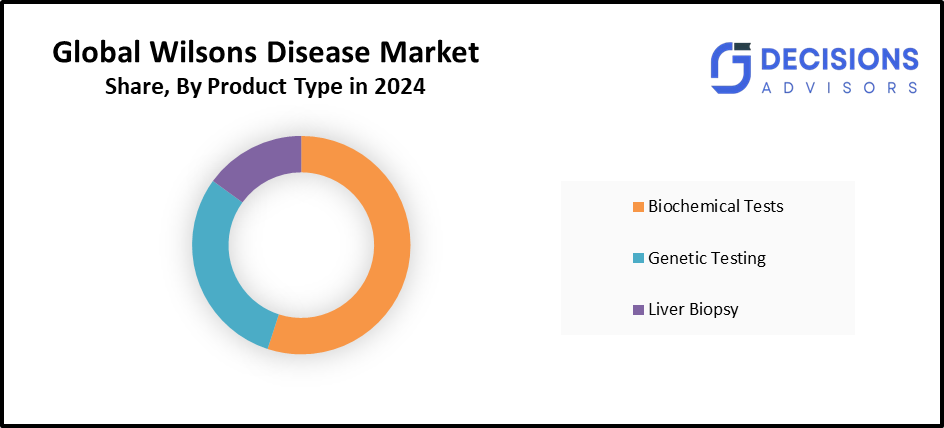
- The biochemical tests segment accounted for the largest share in 2024 and is anticipated to grow at a significant CAGR during the forecast period.
Based on the product type, the Wilsons disease market is divided into biochemical tests, genetic testing, and liver biopsy. Among these, the biochemical tests segment accounted for the largest share in 2024 and is anticipated to grow at a significant CAGR during the forecast period. This is due to their common use because of their dependability and well-established procedures. They enable prompt clinical decisions by offering crucial preliminary insights into diseases of copper metabolism.
For instance, Relative Exchangeable Copper (REC) has an improved function as a highly sensitive and specific indicator in biochemical testing for Wilson's Disease (WD). Major 2025 clinical guidelines have established this, and additional validation studies have backed it up.
- The chelating agents segment accounted for the highest saw market revenue in 2024 and is anticipated to grow at a remarkable CAGR during the forecast period.
Based on the treatment type, the Wilsons disease market is divided into chelating agents, zinc preparations, and liver transplantation. Among these, the chelating agents segment accounted for the highest market revenue in 2024 and is anticipated to grow at a remarkable CAGR during the forecast period. This is because of their proven ability to mobilise and eliminate extra copper from the body. These substances are crucial to the treatment of the illness since they are well known for their ability to stop serious neurological damage. Moreover, chelating agents are frequently the first line of treatment for individuals with symptoms, which gives a strong segment position in the overall market growth.
For instance, Researchers developed a novel nanoplatform using d-penicillamine-loaded MIL-100(Fe) for targeted copper chelation in Wilson’s disease. This innovation leverages a metal-organic framework to deliver the chelating agent precisely in oxidative stress environments, improving copper removal while reducing systemic toxicity. The approach could transform treatment by offering safer, more effective therapy compared to conventional chelation drugs.
- The hepatic segment accounted for the highest market share in 2024 and is anticipated to grow at a significant CAGR during the forecast period.
Based on the indication, the Wilsons disease market is divided into hepatic, neurological and psychiatric, and other indications. Among these, the hepatic segment accounted for the highest market share in 2024 and is anticipated to grow at a significant CAGR during the forecast period. Patients with severe hepatic symptoms need supportive care, extensive copper-removal therapy, and potential transplant consideration. This increases the need for hepatoprotective methods, zinc supplements, and clinically established chelators.
For instance, Liver fibrosis in Wilson’s disease develops due to copper metabolism dysregulation, which causes hepatocyte injury, oxidative stress, and inflammatory signalling that progressively remodels liver tissue. Recent reviews highlight how copper overload directly damages hepatocytes and indirectly activates fibrogenic pathways, leading to scarring and chronic liver dysfunction.
Regional Segment Analysis of the Wilsons Disease Market
- North America (U.S., Canada, Mexico)
- Europe (Germany, France, U.K., Italy, Spain, Rest of Europe)
- Asia-Pacific (China, Japan, India, Rest of APAC)
- South America (Brazil and the Rest of South America)
- The Middle East and Africa (UAE, South Africa, Rest of MEA)
Asia Pacific is anticipated to hold the largest share of the Wilsons disease market over the predicted timeframe.
Asia Pacific is anticipated to hold the largest share of the Wilsons disease market over the predicted timeframe. The growth is fueled by rising healthcare expenditure, increased awareness of rare diseases, and improved healthcare infrastructure. Japan and Australia are at the forefront of the charge in the region. Regulators are working to speed up the approval process for innovative therapies. Additionally, the region's diverse population is an opportunity for developing personalized treatments. Japan is the largest market in the region and is focused on R&D. Australia is close behind in terms of clinical trials and pharmaceutical company collaboration. Companies in the region include local players and international players such as Wilson Therapeutics and Sobi, who are working hard to fill the unmet needs of patients with Wilson's Disease.
Researchers in India have reported the country’s first case of Wilson’s disease linked to a Chinese-specific ATP7B gene variant, offering new insights into the genetic diversity of this rare copper metabolism disorder. The identification of a Chinese-specific ATP7B variant in an Indian Wilson’s disease patient highlights the need for comprehensive genetic screening across diverse populations. Early genetic diagnosis enables personalised treatment such as chelation or zinc therapy, preventing irreversible damage. This discovery also expands India’s catalogue of ATP7B mutations, supporting future diagnostic panels and newborn screening initiatives.
Europe is expected to grow at a rapid CAGR in the Wilsons disease market during the forecast period. The region's growth is fueled by increasing awareness, diagnostic capabilities, and favourable regulations. Countries like Germany and France are leaders in this field, with initiatives to improve patient access to treatments. The European Medicines Agency (EMA) plays an important role in facilitating the approval of innovative therapies, and this will have a positive effect on the growth of the market. The key countries in this region are Germany, France, and the UK, where healthcare systems have increasingly recognised the importance of rare diseases. The presence of specialised healthcare services and patient advocacy groups has also contributed to the accessibility and awareness of treatments, creating a stronger market development.
Scientists in Guildford developed a faster, simpler, and more accurate test for Wilson disease, a rare genetic disorder that affects copper metabolism. The breakthrough was achieved by the Royal Surrey NHS Foundation Trust’s Supra-Regional Assay Service (SAS) Trace Elements Laboratory, offering improved diagnosis and monitoring for patients worldwide. The team at Royal Surrey, a centre of excellence for Wilson's disease, collaborated with clinical specialists from Aarhus Hospital in Denmark and Yale Medical School in the United States to develop the test.
Competitive Analysis:
The report offers the appropriate analysis of the key organizations/companies involved within the Wilsons disease market, along with a comparative evaluation primarily based on their product offering, business overviews, geographic presence, enterprise strategies, segment market share, and SWOT analysis. The report also provides an elaborative analysis focusing on the current news and developments of the companies, which includes product development, innovations, joint ventures, partnerships, mergers & acquisitions, strategic alliances, and others. This allows for the evaluation of the overall competition within the market.
List of Key Companies
- Bausch Health
- Biophore
- Breckenridge Pharmaceutical
- Dr Reddy’s Laboratories
- Eton Pharmaceuticals
- GRANULES
- Invagen Pharmaceuticals
- Nobelpharma
- Optimus Pharma
- Orphalan
- TAJ PHARMA
- Teva Pharmaceutical
- TSUMURA
- Zydus Group
- Others
Key Target Audience
- Market Players
- Investors
- End-users
- Government Authorities
- Consulting and Research Firm
- Venture capitalists
- Value-Added Resellers (VARs)
Recent Development
- In September 2025, Monopar Therapeutics would present new long-term neurological efficacy and safety data for ALXN1840 (tiomolybdate choline) in Wilson disease at the 150th American Neurological Association Annual Meeting. The investigational therapy aims to improve neurological outcomes by more selectively binding copper, offering potential advantages over traditional chelation treatments.
Market Segment
This study forecasts revenue at global, regional, and country levels from 2020 to 2035. Decisions Advisors has segmented the Wilsons disease market based on the below-mentioned segments:
Global Wilsons Disease Market, By Product Type
- Biochemical Tests
- Genetic Testing
- Liver Biopsy
Global Wilsons Disease Market, By Treatment Type
- Chelating Agents
- Zinc Preparations
- Liver Transplantation
Global Wilsons Disease Market, By Indication
- Hepatic
- Neurological and psychiatric
- Other indications
Global Wilsons Disease Market, By Regional Analysis
- North America
- US
- Canada
- Mexico
- Europe
- Germany
- UK
- France
- Italy
- Spain
- Russia
- Rest of Europe
- Asia Pacific
- China
- Japan
- India
- South Korea
- Australia
- Rest of Asia Pacific
- South America
- Brazil
- Argentina
- Rest of South America
- Middle East & Africa
- UAE
- Saudi Arabia
- Qatar
- South Africa
- Rest of the Middle East & Africa
Frequently Asked Questions (FAQ)
1. What are the major challenges in developing new therapies for Wilson’s disease?
Developing new therapies for Wilson’s disease is challenging due to the rarity of the condition, limited patient populations for clinical trials, and the complexity of copper metabolism regulation. Additionally, ensuring long-term safety and effectiveness of treatments such as chelation therapy or gene-based therapies requires extensive research and regulatory approval.
2. How could gene therapy impact the future treatment landscape of Wilson’s disease?
Gene therapy has the potential to correct mutations in the ATP7B gene, which is responsible for impaired copper metabolism. If successful, gene therapy could offer a long-term or potentially curative solution, reducing the need for lifelong chelation therapy and improving patient outcomes.
3. What role do patient advocacy groups play in the Wilson’s disease market?
Patient advocacy groups help increase awareness, promote early diagnosis, support patient education, and influence healthcare policies related to rare diseases. They also collaborate with pharmaceutical companies and researchers to support clinical trials and accelerate treatment development.
4. How does early diagnosis influence the long-term outcomes for Wilson’s disease patients?
Early diagnosis significantly improves patient outcomes by enabling timely treatment with chelating agents or zinc therapy before irreversible liver or neurological damage occurs. Early intervention can prevent disease progression and reduce the need for liver transplantation.
5. What technological innovations are improving Wilson’s disease diagnosis?
Advances in molecular diagnostics, high-throughput genetic sequencing, and biomarker identification are improving diagnostic accuracy. Emerging biochemical markers and automated laboratory technologies also allow faster detection and monitoring of copper metabolism abnormalities.
6. Why is personalised medicine becoming important in Wilson’s disease management?
Personalised medicine is becoming important because patients may respond differently to treatments based on genetic mutations, disease severity, and organ involvement. Tailored treatment strategies based on genetic and clinical profiles can improve treatment effectiveness and reduce adverse effects.
7. How could newborn screening programs affect the Wilson’s disease market in the future?
Newborn screening programs could significantly increase early detection rates of Wilson’s disease. Earlier diagnosis would lead to earlier treatment, potentially reducing severe complications and increasing the demand for diagnostic tests and preventive therapies.
Check Licence
Choose the plan that fits you best: Single User, Multi-User, or Enterprise solutions tailored for your needs.
We Have You Covered
- 24/7 Analyst Support
- Clients Across the Globe
- Tailored Insights
- Technology Tracking
- Competitive Intelligence
- Custom Research
- Syndicated Market Studies
- Market Overview
- Market Segmentation
- Growth Drivers
- Market Opportunities
- Regulatory Insights
- Innovation & Sustainability
Report Details
| Scope | Global |
| Pages | 230 |
| Delivery | PDF & Excel via Email |
| Language | English |
| Release | Mar 2026 |
| Access | Download from this page |