
Global Winding Wire Market
 |
Author:
Pranali P
|
Pages:
240
|
Author:
Pranali P
|
Pages:
240
Global Winding Wire Market Size, Share, By Type (Copper Winding Wire, Aluminium Winding Wire) By Shape (Round Winding Wire, Rectangular Winding Wire, Flat Winding Wire) By Application (Motors, Transformers, Generators, Solenoids, Sensors, and Others) By End User (Electrical & Electronics, Automotive, Industrial, Aerospace & Defense, and Healthcare) and By Region (North America, Europe, Asia-Pacific, Latin America, Middle East and Africa), Analysis and Forecast 2026-2035
CAGR
7.06%
REVENUE 2025
USD Billion 15.9
FORECAST 2035
USD Billion 31.44
REPORT COVERAGE
Global
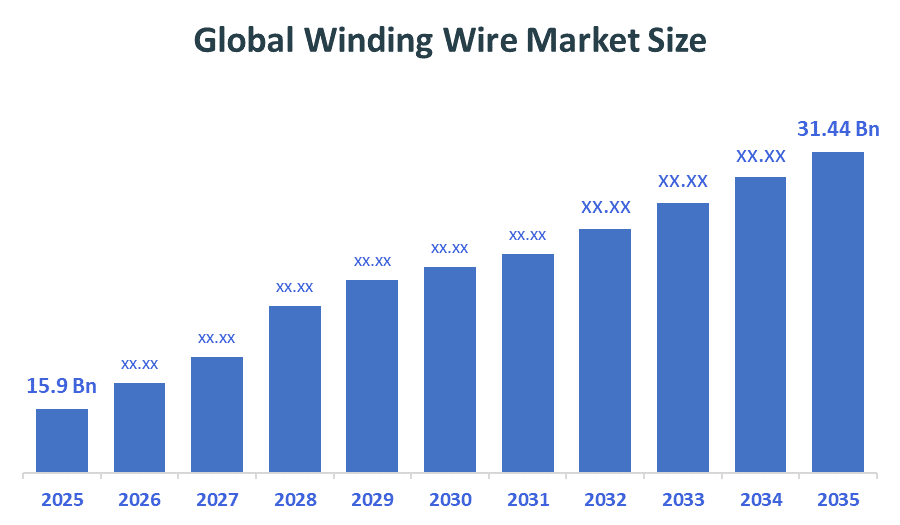
The Global Winding Wire Market Size was predicted to grow from USD 15.9 Billion in 2025 and is projected to reach around USD 31.44 Billion by 2035. According to Decision Advisors, a detailed research report on the winding wire market shows that the copper winding wire segment dominates the global winding wire market, holding approximately 50-60% of the total share worldwide. Sumitomo Electric Industries leads the market with approximately USD 31 billion in annual revenue in 2025, making it one of the major market drivers for shaping the industry.
Market Snapshot
- Global Winding Wire Market Size (2025): USD 15.9 Billion
- Global Winding Wire Projected Market Size (2035): USD 31.44 Billion
- Global Winding Wire Compound Annual Growth Rate (CAGR): 7.06%
- Largest Regional Market: Asia-Pacific
- Fastest Growing Region: North America
- 3rd Largest Region: Europe
- Base Year: 2025
- Historical Period: 2021 - 2024
- Forecast Period: 2026 - 2035
Market Overview / Introduction
The winding wires are an assembly of conductors that function in the creation of electromagnetic fields in electrical machinery and electronic appliances. The winding wires act as crucial intermediaries between pure metal conductors and the final electromagnetic coils, using cutting-edge enamel coating methods and drawing techniques to attain maximum voltage capacity in a small amount of space used. The modern winding wires have various characteristics, including high thermal rating and chemical resistance, so as to perform optimally and minimise chances of short circuits. The winding wires have evolved from being simple cotton-insulated conductors to advanced high-tech enamelled wires that are equipped with special coatings, high heat tolerance, and used in high-frequency power electronics. The increase in the use of winding wires can be attributed to the increasing need for electric transportation and power grids within modernising cities and industries. This is because winding wires provide protection to electrical equipment from loss of efficiency and wear-and-tear caused by lack of insulation, since there is no need for thick protective coverings.
- The industrial and electrical utilities segments contribute to approximately 58% of the application-based use in the market, driven by the increasing demand for transformer upgrades, renewable energy grid connections, and the maintenance of essential power distribution networks.
- There is an exponential rise in the development of high-tech copper wires in the automotive industry, and the CAGR is predicted to exceed 7% because of the growing application of electrical traction motors in next-generation electric cars due to their ability to offer optimised torque and efficiency.
Notable Insights: -
- Copper winding wire modules make up about 50-60% of the total market share of this sector. They have gained a reputation for high-conductivity requirements, particularly in industrial motors, residential appliances, and heavy-duty power transformers.
- Applications of winding wire in the sphere of renewable energy generation account for almost 38.5% of all demand. The rapid development of wind turbines.
- Rectangular winding wire systems show an annual increase above 6.2%. The rise in high-power density motors and frequent occurrences of equipment miniaturisation create the conditions that encourage enterprises to invest more money in space-efficient winding wire solutions.
What is the Role of Technology in Shaping the Market?
The advancements in technology have made some major changes in the conductor industry regarding conductive efficiency, insulative strength, and space saving. Winding wire technology of the current generation has evolved beyond being mere metal wires to electromagnetic devices that can operate in high temperatures because they are able to use nano-composite insulation, oxygen-free copper, and polymers for coating.
How are Recent Developments Helping the Market?
They involve the use of triple-insulated wiring systems, high-temperature PEEK coatings, and very fine wire drawing techniques. These innovations have played an important role in facilitating growth and development within the market. There have been innovations involving the development of wires that are able to resist corona, and which are able to protect all types of motors that are fed by inverters, from those used in household goods to fully developed industrial motor systems. Such innovations would facilitate the production of tightly packed coils using the mechanical properties of the modern-day wires, without breaking down due to cracking or electrical fault.
Market Drivers
The market demand for global winding wire is on the rise due to higher investments in energy companies and governments into renewable energy infrastructure and efficient motors capable of meeting climate goals in the current era. Modern winding wire has enjoyed significant market popularity because of its advantages of combining multiple properties in one durable system, such as good thermal stability, high dielectric strength, and effective winding capability. On the other hand, the establishment of electric car charging stations has brought about greater demands for winding solutions to address the trend of shifting from conventional fuel engines to electric motors, which require highly efficient copper windings.
Restraints
However, the development of the global market for the winding wire industry is limited by the complexities involved in maintaining the stability of the price of inputs such as copper and aluminium, considering that the market may be characterised by fluctuations that may lead to cost overrun problems.
Competitive Analysis:
The report offers the appropriate analysis of the key organisations/companies involved within the air winding wire market, along with a comparative evaluation primarily based on their product offerings, business overviews, geographic presence, enterprise strategies, segment market share, and SWOT analysis. The report also provides an elaborate analysis focusing on the current news and developments of the companies, which includes product development, innovations, joint ventures, partnerships, mergers & acquisitions, strategic alliances, and others. This allows for the evaluation of the overall competition within the market.
Top 10 Companies in the Global Winding Wire Market
- Sumitomo Electric Industries, Ltd.
- Furukawa Electric Co., Ltd.
- Superior Essex Inc.
- LS Cable & System Ltd.
- Fujikura Ltd.
- Rea Magnet Wire Company Inc.
- Samdong Co., Ltd.
- Magnekon
- Von Roll Holding AG
- Irce S.p.A.
Government Initiatives
|
Country |
Key Government Initiatives |
|
China |
Under the 15th Five-Year Plan (2026-2030), the Ministry of Industry and Information Technology (MIIT) has prioritised New Quality Productive Forces. The government has targeted an annual research and development spending growth of over 7%, focusing on breakthroughs in integrated circuits and advanced industrial mother machines. |
|
India |
The PM E-DRIVE Scheme, notified with an outlay of ?10,900 crore through 2026, mandates a strict Phased Manufacturing Programme (PMP) for electric vehicle components. |
|
US |
The CHIPS for America program has expanded its scope in 2026 with a USD 277 million funding award to secure the domestic Mine-to-Magnet supply chain. securing the supply of materials for high-efficiency motor windings |
Study on the Supply, Demand, Distribution, and Market Environment
It is necessary for the winding wire market to strike a balance between operating at optimal electrical efficiency and the increased demand for insulation that is both effective and inexpensive. The production of winding wires involves the manufacture of metal alloys and polymers that can offer sustained thermal stability without the risk of insulation breakdown inherent to older winding wires.
Price Analysis and Consumer Behaviour Analysis
The cost of wiring is influenced by the quality of the metal, the thickness of the insulation, and the level of rating associated with the thermal class. The more sophisticated materials, such as the use of Litz wire, which is specifically designed for high frequency, are expensive due to their inclusion of advanced insulation made from PEEK or polyimide. On the other hand, ordinary enamelled round wires used in small motors and consumer electronics can be considered cheap and provide an excellent chance for local repairing and electrical usage in smaller plants. Consumers have shown interest in durability and energy-saving devices; thus, manufacturers should aim at providing long-lasting and easily windable products.
Market Segmentation
The Global Winding Wire Market share is classified into type, shape, application, and end user.
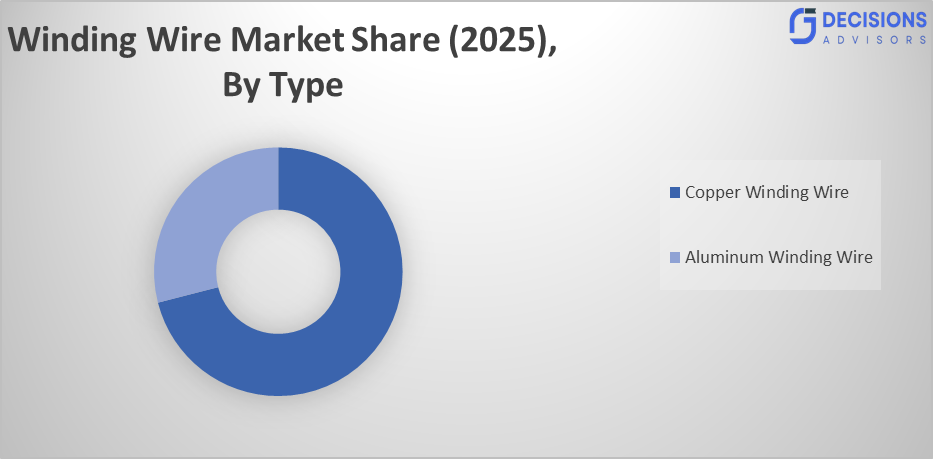
The Copper Winding Wire segment holds the largest share, contributing approximately 50-60% of the market in 2025.
Based on the Type, the global winding wire market is divided into Copper Winding Wire and Aluminium Winding Wire. Among these, the Copper Winding Wire segment holds the largest share, contributing approximately 50-60% of the market in 2025. The reason for this dominance lies in their superior electrical conductivity and mechanical strength in compact motor designs and their ability to minimise energy loss in power transformers without requiring the larger physical footprint required by aluminium alternatives.
The Round Winding Wire segment accounts for the largest share, representing over 65% of the global market in 2025.
Based on the Shape, the global winding wire market is divided into Round Winding Wire, Rectangular Winding Wire, and Flat Winding Wire. Among these, the Round Winding Wire segment accounts for the largest share, representing over 65% of the global market in 2025. These wires are critical for general-purpose motor windings, providing ease of handling and high-speed production capability through the adoption of standard automated winding equipment. On the other hand, the Rectangular Winding Wire segment has emerged as a rapidly growing sector, thanks to the increasing adoption of high-fill-factor coils in EV traction motors and large-scale power generators.
Motors dominate the global market, accounting for approximately 45% of the total revenue in 2025.
Based on the Application, the global winding wire market is divided into Motors, Transformers, Generators, Solenoids, Sensors, and Others. Among these, Motors dominate the global market, accounting for approximately 45% of the total revenue in 2025. This segment is preferred by manufacturers who require reliable performance and high efficiency for industrial automation and appliance applications. The Transformer category is seeing a steady increase in use, especially in the expansion of renewable energy grids, where high-voltage winding wire is required to maintain power quality and safety.
The Electrical & Electronics segment dominates the global market, accounting for approximately 40% of the total revenue in 2025.
Based on the End User, the global winding wire market is divided into Electrical & Electronics, Automotive, Industrial, Aerospace & Defense, and Healthcare. Among these, the Electrical & Electronics segment dominates the global market, accounting for approximately 40% of the total revenue in 2025. This segment is preferred by designers who require miniaturised components and high-reliability conductors for consumer gadgets and home appliances. The Automotive segment is seeing a sharp increase in use, especially by manufacturers in the electric vehicle industry who value the high-temperature resistance and efficiency of advanced winding wires for drivetrain components.
Strategies to Implement for Growth of the Market in Non-Leading Regions
The possibilities of growth for the winding wire industry in the emerging regions can be enhanced through the creation of efficient localised wire drawing facilities for the use of local machinery manufacturers, as well as local bodies responsible for managing the electrification process of the rural regions. The initiatives from the government focused on self-sufficiency for the industries, together with an increase in the manufacture of appliances, play a major role in creating a demand in those regions that face difficulties regarding the importation of high-quality magnet wires. The additional assistance of investment in the training of local metallurgical engineers, together with regional quality control labs, will help achieve this.
Regional Segment Analysis of the Global Winding Wire Market
- North America (U.S., Canada, Mexico)
- Europe (Germany, France, U.K., Italy, Spain, Rest of Europe)
- Asia-Pacific (China, Japan, India, South Korea, Rest of APAC)
- Latin America (Brazil and the Rest of Latin America)
- The Middle East and Africa (UAE, South Africa, Rest of MEA)
Asia-Pacific is projected to be the largest region over the forecast period. This region is anticipated to witness a growth rate of around 6.15% CAGR, maintaining a dominant market share within the global industry. In 2025, the Asia-Pacific region will already account for approximately 52.3% of global revenue. This is owing to the fast-developing electronics manufacturing hubs, coupled with the growing demand for industrial machinery in countries such as China, India, and Vietnam. Other reasons for the same include greater investments made toward infrastructure development in the region, state-supported indigenous manufacturing projects for electrical equipment, and widespread adoption of high-efficiency motor standards.
North America is expected to hold a significant share of the winding wire market during the forecast period. This region holds approximately 18.5% share of global revenue in 2025, thanks to its highly sophisticated aerospace sector, along with the extensive adoption of energy-efficient technology in both national energy goals and high-value industrial applications. The largest part of this region’s revenues comes from the United States, as there is a lot of spending at the corporate level in modernisation programs for the ageing power grid, along with local research related to advanced conductor materials.
Europe is anticipated to hold a substantial share, contributing approximately 22.4% of the global market share. There is a competitive advantage in the region owing to clusters of automotive engineering innovation and financing for sustainable industrial transitions, as well as electrical efficiency research. There is also a comparative advantage with countries like Germany and Italy, which are highly skilled at precision manufacturing for high-performance motors and generators. Moreover, the rigorous environmental standards regarding material recyclability and energy waste further give them a competitive advantage.
Recent Developments
- In February 2026, Hammond Power Solutions announced a definitive agreement to acquire AEG Power Solutions in an all-cash transaction valued at approximately USD 263 million (CAD 365 million).
- In October 2025, Premier Energies approved the acquisition of a 51% stake in Transcon Industries. This strategic investment signifies the company's diversification into power transformer manufacturing.
- In May 2024, Superior Essex successfully completed the full buyout of the Essex Furukawa joint venture from Furukawa Electric. This consolidation allows Superior Essex to unify its global winding wire production assets and streamline R&D for sustainable, corona-resistant conductor materials.
- In November 2021, Furukawa Electric launched the BRACE X blue-IR hybrid laser system, a technological breakthrough that improves the welding efficiency of copper winding wires in EV motors. The system reduces manufacturing power consumption by 30%.
Market Segmentation
This study forecasts revenue at global, regional, and country levels from 2021 to 2035. The Global Winding Wire Market is segmented based on the following categories:
Global Winding Wire Market, By Type
- Copper Winding Wire
- Aluminum Winding Wire
Global Winding Wire Market, By Shape
- Round Winding Wire
- Rectangular Winding Wire
- Flat Winding Wire
Global Winding Wire Market, By Application
- Motors
- Transformers
- Generators
- Solenoids
- Sensors
- Others
Global Winding Wire Market, By End User
- Electrical & Electronics
- Automotive
- Industrial
- Aerospace & Defense
- Healthcare
Global Winding Wire Market, By Regional Analysis
- North America
- United States
- Canada
- Mexico
- Europe
- Germany
- United Kingdom
- France
- Italy
- Spain
- Russia
- Rest of Europe
- Asia Pacific
- China
- Japan
- India
- South Korea
- Australia
- Rest of Asia Pacific
- Latin America
- Brazil
- Argentina
- Rest of Latin America
- Middle East & Africa
- United Arab Emirates
- Saudi Arabia
- Qatar
- South Africa
- Rest of Middle East & Africa
Frequently Asked Questions (FAQ)
What is the significance of corona-resistant insulation in modern winding wires?
Inverter-fed motors commonly face problems associated with voltage spikes and overshoots, which can create a corona discharge effect. The effect leads to the quick deterioration of ordinary insulation materials. Insulating materials for windings that are resistant to corona discharge effects come with unique enamel coatings made up of organic compounds or inorganic additives. The technique is necessary for extending the service life of motors applied in industrial automation systems and frequency-controlled drive applications.
How does the transition to 800V EV architectures affect winding wire specifications?
Although increasing the voltage from 400 volts to 800 volts in electric cars decreases the amount of current and thus minimises the weight of the cables, it increases the dielectric pressure on the motor windings. The adoption of the high voltage systems will require the use of special wire designs that can withstand partial discharges and have high thermal class ratings, such as H or C. One solution that car manufacturers have adopted is the use of rectangular copper wires with high precision of enamelled layers.
What role does oxygen-free copper (OFC) play in high-performance winding wire manufacturing?
Oxygen-free copper is manufactured in such a way that there is very little presence of impurities or oxygen in it, thus leading to improved conductivity and increased ductility. In the case of manufacturing wires for high-frequency operations or for very thin wires (less than 0.1 mm), oxygen-free copper offers the necessary mechanical strength to avoid damage during rapid winding operations.
What are the primary differences in the application of copper versus aluminium winding wires in 2026?
While copper remains the standard for high-efficiency and space-constrained applications due to its superior conductivity, aluminium winding wire is seeing increased adoption in dry-type distribution transformers and certain aerospace components. Aluminium's significantly lower density (nearly 39% less than copper) makes it ideal for weight-sensitive or cost-driven projects where a larger physical footprint can be accommodated to offset its lower conductivity.
Check Licence
Choose the plan that fits you best: Single User, Multi-User, or Enterprise solutions tailored for your needs.
We Have You Covered
- 24/7 Analyst Support
- Clients Across the Globe
- Tailored Insights
- Technology Tracking
- Competitive Intelligence
- Custom Research
- Syndicated Market Studies
- Market Overview
- Market Segmentation
- Growth Drivers
- Market Opportunities
- Regulatory Insights
- Innovation & Sustainability
Report Details
| Scope | Global |
| Pages | 240 |
| Delivery | PDF & Excel via Email |
| Language | English |
| Release | Apr 2026 |
| Access | Download from this page |