
Global Wireless Gas Detection Market
 |
Author:
Aditya G
|
Pages:
210
|
Author:
Aditya G
|
Pages:
210
Global Wireless Gas Detection Market Size, Share By Technology (Wi-Fi, Bluetooth, Cellular, License-Free ISM Band), By Application (Industrial Safety, Environmental Monitoring, Healthcare, Transportation, Oil and Gas), By Gas Type (Toxic Gases, Combustible Gases, Oxygen, Refrigerants, Specialty Gases), and By Region (North America, Europe, Asia-Pacific, Latin America, Middle East & Africa), Analysis and Forecast 2026-2035
CAGR
4.86%
REVENUE 2025
USD Billion 1.81
FORECAST 2035
USD Billion 2.91
REPORT COVERAGE
Global
Market Snapshot
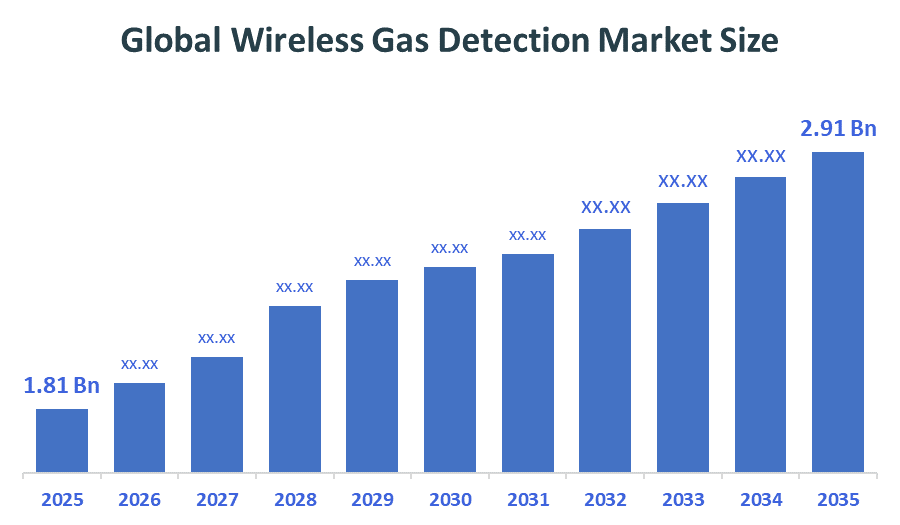
- Global Wireless Gas Detection Market Size (2025): USD 1.81 Billion
- Projected Global Wireless Gas Detection Market Size (2035): USD 2.91 Billion
- Global Wireless Gas Detection Market Compound Annual Growth Rate (CAGR): 4.86%
- Largest Regional Market: North America
- 2nd Largest Region: Asia Pacific
- Fastest Growing Region: Europe
- Base Year: 2025
- Historical Period: 2021–2024
- Market Forecast Period: 2026–2035
Market Overview/ Introduction
The Global Wireless Gas Detection Market consists of advanced detection systems that use wireless communication technologies to monitor hazardous gases in industrial and commercial environments. These systems include portable and fixed gas detectors that use wireless connectivity through Wi-Fi Bluetooth, cellular networks and ISM bands. The market is expanding because industrialization is increasing, safety concerns are rising, and there is a need for real-time toxic gas and combustible gas monitoring. Wireless systems eliminate complex wiring that decreases installation costs while enabling better operational flexibility. The system provides predictive maintenance together with remote monitoring capabilities and enhanced incident response through its integration with cloud platforms and analytics tools. The worldwide adoption of these systems is being driven by increasing regulatory requirements, which demand workplace safety and environmental monitoring compliance.
Notable Insights: -
- North America is anticipated to hold approximately 39% share of the global wireless gas detection market over the predicted timeframe.
- Asia Pacific is expected to grow at a rapid CAGR in the global wireless gas detection market by holding approximately 25% of the share during the forecast period.
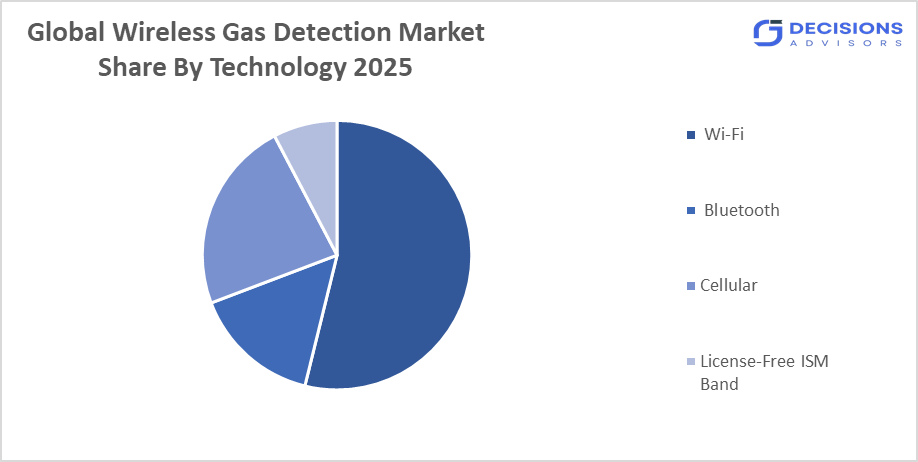
- By technology, the Wi-Fi segment dominated the market and holds approximately 38% share in 2025 and is projected to grow at a substantial CAGR during the forecast period.
- By gas type, the toxic gases segment dominated the market and holds approximately 46% share in 2025 and is projected to grow at a substantial CAGR during the forecast period.
- The compound annual growth rate of the global wireless gas detection market is 4.86%.
- The market is likely to achieve a valuation of USD 2.91 Billion by 2035.
What is the role of technology in grooming the market?
Technology plays a critical role in shaping the wireless gas detection market. IoT-enabled sensors allow real-time gas monitoring and data transmission. Cloud-based platforms support remote access and predictive analytics. AI and machine learning enhance detection accuracy and enable early warning systems. Low-power wireless communication improves battery life and operational efficiency. Additionally, integration with industrial automation systems enhances safety compliance and operational reliability
Market Drivers
The Global Wireless Gas Detection Market is driven by stringent industrial safety regulations across oil & gas, chemicals, and mining sectors, along with rising adoption of IoT and Industry 4.0 technologies. Increasing demand for real-time monitoring and remote operations is enhancing system deployment across industrial facilities. Additionally, the expansion of hazardous industries globally and growing awareness regarding worker safety and environmental protection are significantly contributing to market growth. These factors collectively support the adoption of advanced wireless gas detection systems, ensuring improved operational efficiency, regulatory compliance, and risk mitigation across diverse industrial environments worldwide.
Restrain
High initial installation and deployment costs limit adoption, particularly for small and medium enterprises. Connectivity challenges in remote or hazardous industrial locations can affect system reliability. Data security concerns related to wireless communication pose risks of breaches and unauthorized access. Additionally, maintenance difficulties in harsh environments, including extreme temperatures and corrosive conditions, can reduce equipment lifespan and increase operational costs, thereby restraining overall market growth.
Competitive Analysis:
The report offers the appropriate analysis of the key organizations/companies involved within the global wireless gas detection market, along with a comparative evaluation primarily based on their product offerings, business overviews, geographic presence, enterprise strategies, segment market share, and SWOT analysis. The report also provides an elaborative analysis focusing on the current news and developments of the companies, which includes product development, innovations, joint ventures, partnerships, mergers & acquisitions, strategic alliances, and others. This allows for the evaluation of the overall competition within the market.
Top Companies in the Global Wireless Gas Detection Market
- Honeywell International Inc.
- Dragerwerk AG & Co. KGaA
- MSA Safety Incorporated
- Industrial Scientific Corporation
- RAE Systems (Honeywell)
- Yokogawa Electric Corporation
- Siemens AG
- Emerson Electric Co.
- ABB Ltd.
- Schneider Electric SE
Government Initiatives
|
Country |
Key Government Initiatives |
|
US |
OSHA safety regulations and EPA emission control standards drive demand for advanced gas detection systems, ensuring workplace safety and environmental compliance across industrial operations through continuous and reliable monitoring solutions. |
|
UK |
IIoT-based smart safety systems enable predictive maintenance, improving operational efficiency and real-time monitoring across industrial environments through connected and automated safety infrastructure. |
|
China |
Strict environmental regulations and safety standards such as ISO requirements and RoHS compliance are driving industries toward continuous monitoring systems to ensure safety, regulatory adherence, and reduced environmental risk. |
Study on the Supply, Demand, Distribution, and Market Environment of the Global Wireless Gas Detection Market
Demand in the global wireless gas detection market is primarily driven by industries such as oil & gas, chemicals, mining, and manufacturing, where the risk of hazardous gas exposure is high. Increasing emphasis on workplace safety and regulatory compliance is accelerating adoption. The growing use of connected safety systems and IoT-enabled monitoring further supports demand growth. On the supply side, advancements in sensor technologies, wireless communication, and cloud-based platforms are enhancing product capabilities. Distribution is facilitated through direct sales, industrial equipment suppliers, and system integrators, ensuring wider accessibility and efficient deployment across industrial environments.
Price Analysis and Consumer Behaviour Analysis
Prices in the global wireless gas detection market vary depending on system complexity, connectivity options, and sensor capabilities. Advanced systems integrated with IoT, cloud platforms, and analytics are priced higher due to enhanced functionality and scalability. Around 70% of industrial buyers prioritize reliability, accuracy, and regulatory compliance over upfront costs. Additionally, long-term savings from reduced wiring, lower installation expenses, and minimized maintenance requirements significantly influence purchasing decisions. The shift toward smart, connected solutions further supports premium pricing, as companies focus on safety efficiency, operational continuity, and overall cost optimization in hazardous industrial environments.
Market Segmentation
The global wireless gas detection market share is classified into type, distribution channel and end-user.
- The Wi-Fi segment dominated the market and holds approximately 38% share in 2025 and is projected to grow at a substantial CAGR during the forecast period.
Based on the technology, the global wireless gas detection market is divided into Wi-Fi, Bluetooth, Cellular, and License-Free ISM Band. Among these, the Wi-Fi segment dominated the market and holds approximately 38% share in 2025. This dominance is attributed to its high data transmission reliability, wide network availability, and seamless integration with industrial monitoring systems, enabling real-time gas detection and alerts.
- The Industrial Safety segment accounted for the largest share of approximately 42% in 2025 and is anticipated to grow at a significant CAGR during the forecast period.
Based on the application, the wireless gas detection market is divided into Industrial Safety, Environmental Monitoring, Healthcare, Transportation, and Oil and Gas. Among these, Industrial Safety segment dominated the market and holds approximately 42% share in 2025. This dominance is due to stringent workplace safety regulations, increasing demand for hazard prevention systems, and rising adoption of wireless monitoring solutions in high-risk industrial environments.
- The Toxic Gases segment accounted for the largest share of approximately 46% in 2025 and is anticipated to grow at a significant CAGR during the forecast period.
Based on the gas type, the global wireless gas detection market is divided into Toxic Gases, Combustible Gases, Oxygen, Refrigerants, and Specialty Gases. Among these, Toxic Gases segment dominated the market and holds approximately 46% share in 2025. This dominance is due to strict environmental regulations, high safety risks in industrial operations, and increasing deployment of sensors for early detection of hazardous gas leaks.
Strategies to Implement for Growth of the Market in Non-Leading Regions
Companies should prioritize cost-effective wireless gas detection solutions tailored to price-sensitive emerging markets while maintaining essential safety standards. Expanding distribution networks through partnerships with local industrial firms, distributors, and system integrators can enhance market reach. Increasing awareness via safety training programs, regulatory alignment, and industry collaborations is critical for adoption. Localization of manufacturing and supply chains can significantly reduce costs and improve availability. Additionally, leveraging cloud-based monitoring platforms and scalable IoT solutions can enhance accessibility, operational efficiency, and long-term sustainability, supporting market growth in non-leading regions.
Regional Segment Analysis of the Global Wireless Gas Detection Market
- North America (U.S., Canada, Mexico)?
- Europe (Germany, France, U.K., Italy, Spain, Rest of Europe)
- Asia-Pacific (China, Japan, India, Rest of APAC)
- South America (Brazil and the Rest of South America)?
- The Middle East and Africa (UAE, South Africa, Rest of MEA)
North America is anticipated to hold approximately 39% share of the global Wireless Gas Detection market over the predicted timeframe.
North America is expected to hold approximately 39% share of the global wireless gas detection market during the forecast period. This dominance is supported by stringent regulatory frameworks, strong enforcement of workplace safety standards, and widespread adoption of advanced industrial automation technologies. The region benefits from well-established oil & gas, chemical, and manufacturing industries that require continuous gas monitoring systems. Additionally, the presence of leading market players, ongoing technological advancements, and early adoption of IoT-enabled safety solutions further strengthen market growth. High awareness regarding worker safety and environmental compliance also contributes significantly to sustained demand.
Asia Pacific is expected to grow at a rapid CAGR in the global Wireless Gas Detection market, holding approximately 25% of the share during the forecast period
Asia Pacific is expected to account for approximately 25% share of the global wireless gas detection market during the forecast period. Growth is driven by rapid industrialization, expanding manufacturing activities, and increasing investments in infrastructure and energy sectors. Countries such as China, India, and Japan are witnessing rising adoption of safety monitoring systems due to stricter regulations and growing awareness of workplace hazards. Additionally, improving industrial safety standards, rising deployment of IoT-enabled technologies, and expanding oil & gas and chemical industries are further supporting strong market growth across the region.
Europe is the fastest-growing region in the global Wireless Gas Detection market during the period, holding approximately 28% share.
Europe is expected to hold approximately 28% share of the global wireless gas detection market during the forecast period. Growth is driven by stringent environmental and workplace safety regulations, along with strong enforcement across industrial sectors. The region benefits from advanced technological adoption, including IoT-enabled monitoring systems and smart industrial solutions. Additionally, the presence of well-established manufacturing, chemical, and energy industries, coupled with increasing investments in industrial safety infrastructure, supports sustained market expansion and positions Europe as the fastest-growing regional market.
Future Market Trends in Global Wireless Gas Detection Market: -
1. IoT Integration
IoT integration enables wireless gas detection systems to transmit real-time data to centralized platforms, improving visibility and control. Cloud connectivity supports predictive maintenance, remote monitoring, and faster decision-making. This enhances operational efficiency, ensures regulatory compliance, and minimizes risks by providing early alerts for hazardous gas leaks.
2. AI & Analytics
AI and advanced analytics improve gas detection accuracy by analyzing large volumes of sensor data in real time. These technologies enable early identification of potential leaks, pattern recognition, and risk prediction. This reduces false alarms, enhances safety measures, and supports proactive maintenance strategies across industrial environments.
3. Miniaturization of Sensors
Miniaturization of sensors allows development of compact, lightweight, and portable gas detection devices. These devices improve ease of deployment in confined and hazardous spaces. Smaller sensors consume less power, extend battery life, and enhance operational efficiency, making them suitable for wearable and remote monitoring applications.
Recent Development
- In April 2025, MSA Safety launched the ALTAIR 5X wireless multi-gas detector with Bluetooth connectivity, enhancing data logging, real-time monitoring, and industrial safety in hazardous environments.
- In March 2025, Emerson launched the Rosemount 928 Wireless Gas Detector, designed for hazardous industrial environments, enhancing real-time gas monitoring, safety compliance, and wireless connectivity in critical industrial operations.
- In February 2025, Honeywell launched the Sensepoint XCL gas detector, offering enhanced connectivity and real-time data monitoring, improving industrial safety, operational efficiency, and wireless-enabled gas detection capabilities.
How is Recent Developments Helping the Market?
Recent innovations in the wireless gas detection market are significantly enhancing system performance, reliability, and adoption. Advanced sensor technologies and AI integration are improving detection accuracy while reducing false alarms. IoT-enabled connectivity allows real-time monitoring and remote access, enabling faster response to hazardous situations. Cloud-based platforms support predictive maintenance and data-driven decision-making, improving operational efficiency. Additionally, integration with industrial automation systems ensures better safety compliance and streamlined operations. These developments collectively reduce risks, optimize costs, and strengthen workplace safety, thereby supporting sustained market growth across industries such as oil & gas, chemicals, and manufacturing.
Market Segment
This study forecasts revenue at global, regional, and country levels from 2020 to 2035. Decision Advisors has segmented the global wireless gas detection market based on the below-mentioned segments:
Global Wireless Gas Detection Market, By Technology
- Wi-Fi
- Bluetooth
- Cellular
- License-Free ISM Band
Global Wireless Gas Detection Market, By Gas Type
- Toxic Gases
- Combustible Gases
- Oxygen
- Refrigerants
- Specialty Gases
Global Wireless Gas Detection Market, By Application
- Industrial Safety
- Environmental Monitoring
- Healthcare
- Transportation
- Oil and Gas
Global Wireless Gas Detection Market, By Regional Analysis
- North America
- US
- Canada
- Mexico
- Europe
- Germany
- UK
- France
- Italy
- Spain
- Russia
- Rest of Europe
- Asia Pacific
- China
- Japan
- India
- South Korea
- Australia
- Rest of Asia Pacific
- South America
- Brazil
- Argentina
- Rest of South America
- Middle East & Africa
- UAE
- Saudi Arabia
- Qatar
- South Africa
- Rest of the Middle East & Africa
Frequently Asked Questions (FAQ)
Q. How does wireless gas detection support emergency response planning?
Wireless gas detection systems enable centralized alerting and real-time data sharing across multiple facilities. This allows faster coordination with emergency teams, improves evacuation procedures, and minimizes response time during hazardous incidents, enhancing overall industrial safety management.
Q. What role does interoperability play in wireless gas detection systems?
Interoperability ensures seamless integration of gas detection systems with existing industrial control systems, SCADA, and safety platforms. This improves data consistency, enhances monitoring capabilities, and allows organizations to build unified safety ecosystems without replacing legacy infrastructure.
Q. How do battery advancements impact wireless gas detection performance?
Advancements in battery technology improve device longevity, reduce maintenance frequency, and ensure continuous monitoring in remote locations. Long-life batteries also support uninterrupted operations in critical environments, reducing downtime and operational risks.
Q. How is data analytics shaping long-term safety strategies?
Data analytics helps organizations identify recurring risk patterns, optimize safety protocols, and improve predictive maintenance strategies. This supports long-term planning, reduces operational hazards, and enhances regulatory compliance through data-driven decision-making.
Check Licence
Choose the plan that fits you best: Single User, Multi-User, or Enterprise solutions tailored for your needs.
We Have You Covered
- 24/7 Analyst Support
- Clients Across the Globe
- Tailored Insights
- Technology Tracking
- Competitive Intelligence
- Custom Research
- Syndicated Market Studies
- Market Overview
- Market Segmentation
- Growth Drivers
- Market Opportunities
- Regulatory Insights
- Innovation & Sustainability
Report Details
| Scope | Global |
| Pages | 210 |
| Delivery | PDF & Excel via Email |
| Language | English |
| Release | Apr 2026 |
| Access | Download from this page |