
Global Zinc-Air Battery Market
 |
Author:
Mayuri S
|
Pages:
210
|
Author:
Mayuri S
|
Pages:
210
Global Zinc-Air Battery Market Size, Share By Form Factor (Button Cells, Coin Cells, Cylindrical Cells, Pouch Cells, Prismatic Cells), By Electrode Material (Zinc-Manganese Dioxide, Zinc-Iron Oxide, Zinc-Nickel Oxide, Zinc-Silver Oxide, Other Advanced Electrodes), By Application (Consumer Electronics, Medical Devices, Military & Defense, Automotive, Aerospace, Industrial), and By Region (North America, Europe, Asia-Pacific, Latin America, Middle East & Africa), Analysis and Forecast 2026-2035
CAGR
31.86%
REVENUE 2025
USD Billion 3.07
FORECAST 2035
USD Billion 48.8
REPORT COVERAGE
Global
Market Snapshot
- Global Zinc-Air Battery Market Size (2025): USD 3.07 Billion
- Projected Global Zinc-Air Battery Market Size (2035): USD 48.8 Billion
- Global Zinc-Air Battery Market Compound Annual Growth Rate (CAGR): 31.86%
- Largest Regional Market: North America
- 2nd Largest Region: Europe
- Fastest Growing Region: Asia Pacific
- Base Year: 2025
- Historical Period: 2021-2024
- Market Forecast Period: 2026-2035
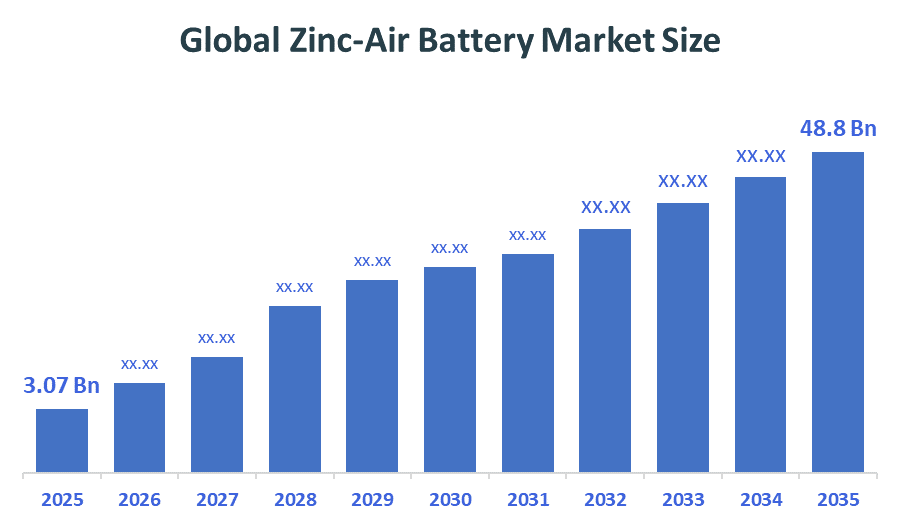
According to Decision Advisors, the Global Zinc-Air Battery Market Size is expected to grow from USD 3.07 Billion in 2025 to USD 48.8 Billion by 2035, at a CAGR of 31.86% during the forecast period 2026-2035. The Global Zinc-Air Battery Market is expected to witness steady growth due to rising demand for eco-friendly energy storage, increasing adoption in hearing aids, expanding renewable energy integration, and advancements in rechargeable battery technologies.
Market Overview/ Introduction
The Global Zinc-Air Battery Market consists of energy storage systems that use zinc and oxygen from the air to create electrical power providing both high energy density and cost-effective operation. The market is experiencing strong growth because of rising demand for environmentally friendly battery solutions, increased use of electric vehicles and growing need for renewable energy storage systems. Hearing aids use zinc-air batteries as their primary power source, while researchers now investigate their potential for electric vehicles and grid-scale storage solutions because of their lightweight design and environmental benefits. Market growth is supported by developments in rechargeable zinc-air technologies, their new electrode materials and improved product durability. The global market is experiencing rapid expansion because organizations now focus on decreasing carbon emissions and reducing their use of lithium-based battery systems.
Notable Insights: -
- North America is anticipated to hold approximately 35% share of the Global Zinc-Air Battery Market over the predicted timeframe.
- Asia Pacific is expected to grow at a rapid CAGR in the Global Zinc-Air Battery Market by holding approximately 25% of the share during the forecast period.
- By form factor, the button cells segment dominated the market and holds approximately 52% share in 2025 and is projected to grow at a substantial CAGR during the forecast period.
- By electrode material, the zinc-manganese dioxide segment dominated the market and holds approximately 48% share in 2025 and is projected to grow at a substantial CAGR during the forecast period.
- The compound annual growth rate of the Global Zinc-Air Battery Market is 31.86%.
- The market is likely to achieve a valuation of USD 48.8 Billion by 2035.
What is the role of technology in grooming the market?
Technology plays a crucial role in advancing the zinc-air battery market by improving performance, rechargeability, and lifecycle efficiency. Innovations in air cathodes, electrolytes, and nanomaterials enhance energy density and stability. The development of rechargeable zinc-air batteries is a key breakthrough, enabling their use in electric vehicles and large-scale energy storage. Integration with smart energy systems and IoT platforms supports efficient energy management and monitoring. Additionally, advancements in corrosion resistance and electrode design reduce degradation, making zinc-air batteries more reliable and commercially viable across multiple applications.
Market Drivers
The Global Zinc-Air Battery Market is forecasted to expand steadily because of increasing demand for sustainable battery solutions that can be recycled and that help organizations achieve their environmental objectives. The market continues to grow because electric vehicles and renewable energy storage systems gain more users who prefer zinc-air batteries over traditional lithium-ion battery systems. The batteries provide better performance across different uses because their energy density exceeds that of standard batteries. The market maintains steady growth because healthcare facilities especially demand hearing aid devices. Government programs that promote clean energy and sustainable technologies create an environment where multiple industries develop and implement zinc-air battery technology.
Restrain
The Global Zinc-Air Battery Market faces restraints due to limited rechargeability in traditional systems, restricting long-term usage. Lower power output compared to lithium-ion batteries impacts performance in high-drain applications. Additionally, technical challenges related to air electrode stability reduce efficiency and lifespan. Limited awareness and adoption in emerging markets further hinder overall market growth and penetration.
Competitive Analysis:
The report offers the appropriate analysis of the key organizations/companies involved within the Global Zinc-Air Battery Market, along with a comparative evaluation primarily based on their product offerings, business overviews, geographic presence, enterprise strategies, segment market share, and SWOT analysis. The report also provides an elaborative analysis focusing on the current news and developments of the companies, which includes product development, innovations, joint ventures, partnerships, mergers & acquisitions, strategic alliances, and others. This allows for the evaluation of the overall competition within the market.
Top Companies in the Global Zinc-Air Battery Market
- Duracell Inc.
- Energizer Holdings Inc.
- Panasonic Corporation
- Rayovac (Spectrum Brands)
- GP Batteries International Limited
- Phinergy Ltd.
- Zinc8 Energy Solutions Inc.
- NantEnergy Inc.
- Arotech Corporation
- Renata SA
Government Initiatives
|
Country |
Key Government Initiatives |
|
US |
US clean energy policies support safer energy storage development and indirectly encourage zinc-air battery adoption by funding advanced, low-toxicity battery research and reducing dependence on conventional lithium-ion technologies. |
|
Europe |
Europe’s market growth is driven by strict carbon emission regulations and substantial investments in renewable energy storage infrastructure, supporting adoption of clean, efficient, and sustainable energy storage technologies across industries |
|
China |
Government policies supporting green energy storage are driving demand for stationary applications, encouraging the development and deployment of zinc-air batteries for efficient, safe, and long-duration grid energy storage systems. |
Study on the Supply, Demand, Distribution, and Market Environment of the Global Zinc-Air Battery Market
The zinc-air battery market is driven by increasing demand from healthcare devices, renewable energy storage, and electric mobility sectors, where efficient and sustainable power solutions are essential. Supply growth is supported by continuous advancements in battery chemistry, electrode design, and manufacturing technologies, improving performance and durability. Distribution channels are expanding through OEM partnerships, authorized distributors, and online platforms, enhancing product accessibility across regions. Additionally, stringent environmental regulations and rising sustainability goals are encouraging industries to adopt zinc-air batteries due to their low environmental impact, cost-effectiveness, and high recyclability, thereby supporting long-term market growth.
Price Analysis and Consumer Behaviour Analysis
Approximately 48% of healthcare device manufacturers rely on zinc-air batteries due to their cost efficiency, stable performance, and suitability for compact medical devices such as hearing aids. These batteries provide consistent voltage output, making them highly reliable for continuous usage. Primary zinc-air batteries dominate the market, accounting for around 65% of total usage. This dominance is driven by strong and consistent demand in hearing aids and portable electronic devices, where long battery life and lightweight design are critical factors supporting widespread adoption.
Market Segmentation
The Global Zinc-Air Battery Market share is classified into product type, application and end-user.
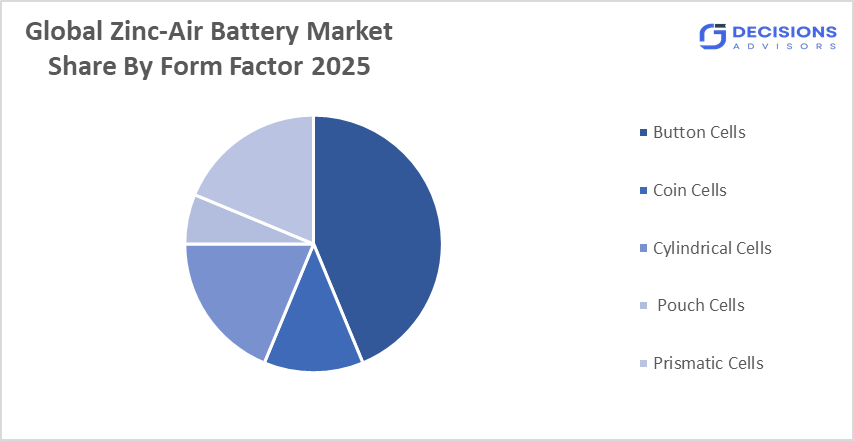
• The button cells segment dominated the market and holds approximately 52% share in 2025 and is projected to grow at a substantial CAGR during the forecast period.
Based on the form factor, the Global Zinc-Air Battery Market is divided into button cells, coin cells, cylindrical cells, pouch cells, and prismatic cells. Among these, the button cells segment dominated the market and holds approximately 52% share in 2025 and is projected to grow at a substantial CAGR during the forecast period. This dominance is attributed to their compact size, lightweight design, and widespread use in hearing aids and small electronic devices. These cells provide reliable and long-lasting power, making them highly preferred for applications requiring stable performance in limited space.
• The zinc-manganese dioxide segment accounted for the largest share of approximately 48% in 2025 and is anticipated to grow at a significant CAGR during the forecast period.
Based on the electrode material, the Global Zinc-Air Battery Market is divided into zinc-manganese dioxide, zinc-iron oxide, zinc-nickel oxide, zinc-silver oxide, and other advanced electrodes. Among these, the zinc-manganese dioxide segment accounted for the largest share of approximately 48% in 2025 and is anticipated to grow at a significant CAGR during the forecast period. This dominance is due to its cost-effectiveness, stable electrochemical performance, and widespread availability. It offers a balanced combination of energy density and durability, making it suitable for both consumer and industrial applications.
• The consumer electronics segment accounted for the largest share of approximately 36% in 2025 and is anticipated to grow at a significant CAGR during the forecast period.
Based on the application, the Global Zinc-Air Battery Market is divided into consumer electronics, medical devices, military & defense, automotive, aerospace, and industrial. Among these, the consumer electronics segment accounted for the largest share of approximately 36% in 2025 and is anticipated to grow at a significant CAGR during the forecast period. This growth is driven by increasing demand for compact and energy-efficient power sources in devices such as hearing aids, wearable electronics, and portable gadgets. Rising consumer adoption of smart devices further supports the expansion of this segment.
Strategies to Implement for Growth of the Market in Non-Leading Regions
To drive growth of the zinc-air battery market in non-leading regions, companies should focus on developing cost-effective and efficient battery solutions tailored for price-sensitive markets. Expanding distribution networks through regional partnerships and local suppliers can significantly improve accessibility and market penetration. Investing in local manufacturing facilities helps reduce production and logistics costs while enhancing supply chain efficiency. Additionally, promoting awareness through training programs and technical workshops can improve user adoption and understanding. Collaborating with governments and energy agencies to support clean energy initiatives and policies will further accelerate market growth and long-term sustainability in emerging regions.
Regional Segment Analysis of the Global Zinc-Air Battery Market
- North America (U.S., Canada, Mexico)?
- Europe (Germany, France, U.K., Italy, Spain, Rest of Europe)
- Asia-Pacific (China, Japan, India, Rest of APAC)
- South America (Brazil and the Rest of South America)?
- The Middle East and Africa (UAE, South Africa, Rest of MEA)
North America is anticipated to hold approximately 35% share of the Global Zinc-Air Battery Market over the predicted timeframe.
North America holds approximately 35% share of the global zinc-air battery market, driven by strong adoption of advanced energy storage technologies and the presence of key manufacturers. The region benefits from well-established healthcare infrastructure, supporting high demand for hearing aid batteries. Additionally, increasing investments in renewable energy storage and electric mobility are contributing to market expansion. Government support for clean energy initiatives and research in alternative battery technologies further accelerates growth. High consumer awareness, technological advancements, and robust distribution networks continue to strengthen North America’s leading position in the global zinc-air battery market.
Asia Pacific is expected to grow at a rapid CAGR in the global refrigeration leak detector market, holding approximately 25% of the share during the forecast period
Asia Pacific is expected to grow at a rapid CAGR in the global refrigeration leak detector market, holding approximately 25% share during the forecast period. The region’s growth is driven by rapid industrialization, increasing adoption of HVAC and refrigeration systems, and expansion of cold chain logistics across emerging economies such as China, India, and Southeast Asian countries. Rising investments in infrastructure development and growing demand from pharmaceutical and food storage sectors further support market expansion. Additionally, increasing awareness regarding environmental regulations and energy efficiency is encouraging industries to adopt advanced leak detection technologies, thereby contributing to sustained regional market growth.
Europe is the fastest-growing region in the Global Zinc-Air Battery Market during the period, holding approximately 22% share.
Europe is the fastest-growing region in the Global Zinc-Air Battery Market during the forecast period, holding approximately 22% share. This growth is driven by strong environmental regulations, increasing focus on sustainable energy storage solutions, and rising investments in renewable energy infrastructure. Countries such as Germany, France, and the UK are actively promoting alternative battery technologies to reduce carbon emissions. Additionally, growing demand from healthcare and electric mobility sectors, along with supportive government policies and technological advancements, is further accelerating the adoption of zinc-air batteries across the region.
Future Market Trends in Global Refrigeration Leak Detector Market: -
1. Development of rechargeable zinc-air batteries
Rechargeable zinc-air batteries are gaining attention due to their potential to overcome limitations of primary systems. Advancements in electrode stability, electrolyte composition, and cycle life are improving performance. These innovations enable repeated usage, reduce replacement costs, and expand applications across electric mobility and large-scale energy storage solutions.
2. Increasing use in electric vehicles
Zinc-air batteries are being explored for electric vehicles due to their high energy density and lightweight properties. They offer a cost-effective alternative to lithium-ion batteries. Ongoing research focuses on improving power output and rechargeability, making them increasingly suitable for long-range and sustainable transportation solutions.
3. Integration with renewable energy storage systems
Zinc-air batteries are increasingly integrated with renewable energy systems such as solar and wind to provide long-duration energy storage. Their ability to store excess energy efficiently supports grid stability and reliability. This integration helps address intermittency issues and enhances overall utilization of clean energy sources.
4. Advancements in nanotechnology for improved efficiency
Nanotechnology is enhancing zinc-air battery performance by improving electrode conductivity, catalytic activity, and energy efficiency. Advanced nanomaterials enable better oxygen reactions and reduce degradation. These improvements increase battery lifespan, stability, and overall performance, making zinc-air technology more competitive in commercial and industrial applications.
Recent Development
- In 2026, industry trends show increasing adoption of AI-driven manufacturing to reduce high upfront production costs, improve efficiency, and enhance scalability in advanced battery production processes.
- In March 2024, ZincFive launched high-power rechargeable zinc-based backup systems for data centers and industrial applications, strengthening reliable and efficient energy storage solutions for critical infrastructure.
- In 2024, GP Energy Tech (Gold Peak) announced a nickel-zinc battery manufacturing facility in Dongguan, China, with an initial capacity of 20 million cells annually to support industrial and data center energy storage demand.
How is Recent Developments Helping the Market?
Recent developments are significantly improving the efficiency, scalability, and application scope of zinc-air batteries. Advancements in rechargeability and durability are enabling their use beyond traditional applications such as hearing aids, expanding into electric vehicles and grid storage. Integration with renewable energy systems supports long-duration energy storage, improving reliability and addressing intermittency challenges. Additionally, progress in materials science, including enhanced electrode design and corrosion resistance, is reducing performance degradation. These innovations contribute to lower operational costs, improved lifecycle performance, and increased adoption across multiple industries, thereby strengthening the overall growth potential of the global zinc-air battery market.
Market Segment
This study forecasts revenue at global, regional, and country levels from 2020 to 2035. Decision Advisors has segmented the global zinc-air battery market based on the below-mentioned segments:
Global Zinc-Air Battery Market, By Form Factor
- Button Cells
- Coin Cells
- Cylindrical Cells
- Pouch Cells
- Prismatic Cells
Global Zinc-Air Battery Market, By Electrode Material
- Zinc-Manganese Dioxide
- Zinc-Iron Oxide
- Zinc-Nickel Oxide
- Zinc-Silver Oxide
- Other Advanced Electrodes
Global Zinc-Air Battery Market, By Application
- Consumer Electronics
- Medical Devices
- Military Defense
- Automotive
- Aerospace
- Industrial
Global Zinc-Air Battery Market, By Regional Analysis
- North America
- US
- Canada
- Mexico
- Europe
- Germany
- UK
- France
- Italy
- Spain
- Russia
- Rest of Europe
- Asia Pacific
- China
- Japan
- India
- South Korea
- Australia
- Rest of Asia Pacific
- South America
- Brazil
- Argentina
- Rest of South America
- Middle East & Africa
- UAE
- Saudi Arabia
- Qatar
- South Africa
- Rest of the Middle East & Africa
Frequently Asked Questions (FAQ)
Q. How does supply chain availability of zinc impact market dynamics?
A. Zinc availability plays a critical role in pricing and production scalability. Stable supply chains ensure cost efficiency, while fluctuations in raw material sourcing can influence manufacturing costs and market competitiveness.
Q. What role do zinc-air batteries play in long-duration energy storage (LDES)?
A. Zinc-air batteries are increasingly considered for LDES due to their ability to provide extended discharge durations at relatively low cost, supporting grid stability and renewable energy integration over longer periods.
Q. What opportunities exist for zinc-air batteries in off-grid energy solutions?
A. Zinc-air batteries offer reliable and low-maintenance energy storage for remote areas, supporting microgrids, rural electrification, and backup power systems where conventional infrastructure is limited.
Q. What is the potential of zinc-air batteries in hybrid energy storage systems?
A. Zinc-air batteries can be combined with other storage technologies to balance energy density and power output, improving overall system efficiency and enabling broader application across energy networks.
Check Licence
Choose the plan that fits you best: Single User, Multi-User, or Enterprise solutions tailored for your needs.
We Have You Covered
- 24/7 Analyst Support
- Clients Across the Globe
- Tailored Insights
- Technology Tracking
- Competitive Intelligence
- Custom Research
- Syndicated Market Studies
- Market Overview
- Market Segmentation
- Growth Drivers
- Market Opportunities
- Regulatory Insights
- Innovation & Sustainability
Report Details
| Scope | Global |
| Pages | 210 |
| Delivery | PDF & Excel via Email |
| Language | English |
| Release | Apr 2026 |
| Access | Download from this page |