
Amul Becomes India’s First ₹1 Trillion Brand: Growth, Strategy & Market Impact
Published on: April 2026
Amul Crosses ₹1 Lakh Crore Turnover Milestone in FY26
Amul has emerged as India’s first FMCG (Fast-Moving Consumer Goods) brand to surpass the INR 1 trillion, i.e., 1 lakh crore, turnover milestone in FY26, registering a robust 11.40% year-on-year growth. Amul's achievement is underpinned by its sustained expansion across domestic, rural, and international markets. Managed by the Gujarat Cooperative Milk Marketing Federation (GCMMF), the cooperative reported a turnover of INR 73450 crores, while the overall brand turnover exceeded the INR 1 lakh crore mark, reflecting its growing scale and market leadership.
Amul has strengthened its market presence through a diversified portfolio of over 1200 products, which is enabling it to cater to a varied consumer segment. Concurrently, its expansion into the United States and Europe has supported revenue growth by leveraging diaspora demand and entering new markets.
The company’s strategies are driven by the company’s aggressive expansion of its distribution network across rural and semi urban markets, which has significantly enhanced the product's accessibility, thereby deepening market penetration and driving volume growth. Crucially, Amul’s cooperative ownership model, administered by the Gujarat Cooperative Milk Marketing Federation, provides a robust supply chain backbone by directly linking millions of dairy farmers to the market. This structure not only ensures consistent raw material availability but also enhances operational efficiency and scalability, reinforcing its competitive positioning.
Leadership Perspective
Dr. Jayen Mehta, Managing Director of GCMMF, emphasized the broader vision behind the milestone:
“We are not just expanding globally; we are redefining what a farmer-owned institution can achieve in the modern economy, ensuring that the benefits of growth and technology reach the producers.”
Strengthening India’s Cooperative Ecosystem
In July 2025, Amit Shah, Union Minister of Home and Cooperation, launched the Sardar Patel Cooperative Dairy Federation Limited (SPCDF). The initiative aims to integrate dairy cooperatives beyond Gujarat into a national cooperative network, further strengthening India’s dairy infrastructure.
Background of Amul and GCMMF
The origin of Amul can be traced to 1946 in Anand, Gujarat, where a group of dairy farmers, under the leadership of Tribhuvandas Kishibhai Patel, who established a cooperative framework to counter the exploitative procurement practices and ensure fair remuneration for the milk producers. Under the corporate leadership of Verghese Kurien the organisations evolved in a professionally managed dairy enterprise and played a pivotal role in India’s White Revolution.
In 1973, the Gujrat Cooperative Milk Marketing Federation (GCMMF) was constituted to consolidate multiple district unions under a unified marketing entity. This structural integration enabled scale efficiencies, strengthened brand development, and enhanced market access under the Amul brand.
Over the decades, Amul has evolved into a diversified dairy enterprise with the broad portfolio of value added products spanning the multiple consumer segments, this transformation has been driven by a robust cooperative framework that ensures seamless integration between procurement, processing, and distribution. It has well established supply chain infrastructure enables efficient sourcing large scale processing and timely market delivery.
Amul's Distribution Supply Chain Management
Amul is one of the cooperative dairy brand in India owned by dairy cooperatives in Gujarat. The company produces and distributes milk and dairy products, Amul has one of the large distribution channel or network that sources milk from village level cooperatives societies. After these procedures the milk is then processed and manufactured into various dairy products at Amul plants. Amul has over 3500 distributors serving over 500,000 retail outlets across India. These products are distributed through a three-tier system from manufacturing plant to depots to wholesale distributor to retail outlet. Its supply chain is designed for efficient procurement of milk from farmers and delivery of products to customers through coordination between different level of the cooperative network.
Key Highlights: Amul FY26 Performance
- Total Brand Revenue: ₹1 lakh crore+
- GCMMF Turnover: ₹73,450 crore
- Growth Rate: 11.4% YoY
- Farmer Base: 3.6 million+
- Village Network: 18,600+ villages
- Product Portfolio: 1,200+ SKUs
Anchored in a robust cooperative model, the company has built a scalable and resilient growth engine.
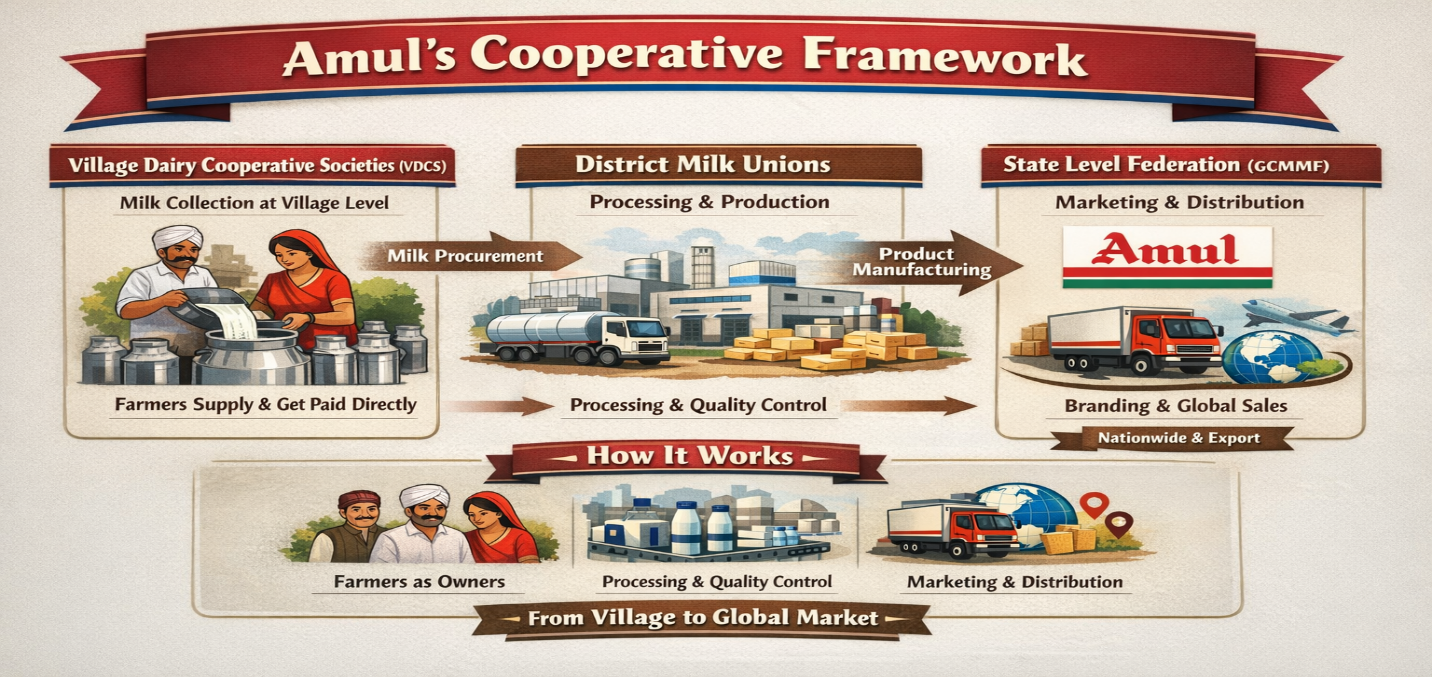
Amul’s Operational Framework
1. Village-Level Dairy Cooperative Societies (VDCS)
At the grassroots level, individual milk producers supply to village cooperatives, which manage procurement, primary quality assessment, and prompt payments. This helps to ensure liquidity, transparency, and trust within the ecosystem.
- Ashokbhai Chaudhary noted that the milestone reflects the sustained trust of millions of consumers, alongside the pivotal contribution of over 3.6 million to the dairy farmers. In parallel, the Gordhanbhai Dhameliya described the achievement as the compelling validation of the cooperative model’s structural strength and long term scalability.
2. District Milk Unions
Milk sourced from the multiple village societies is consolidated at the district level, where unions undertake processing activities including the pasteurization and the production of value added dairy products such as butter, cheese, and milk powder, while adhering to stringent quality standard.
- Jayen Mehta has highlighted the pivotal role of district milk unions in enabling value addition, ensuring the best quality standardization, and facilitating efficient large-scale processing within the cooperative framework, thereby reinforcing the
3. State-Level Federation
The apex body, Gujarat Cooperative Milk Marketing Federation, is responsible for brand management, marketing, distribution, and sales under the Amul brand. It also oversees nationwide logistics and spearheads strategic expansion across domestic and international markets.
- Currently, GCMMF comprises 18 member unions, representing over 3.6 million dairy farmers across approximately 18,600 villages in Gujarat, reflecting the extensive scale and depth of the cooperative network.
Strengthening Global Distribution While Tapping International Growth Opportunities
In global market, Amul follows a multi-channel distribution strategy tailored to local demand dynamics. The company primarily leverages ethnic retail stores and Indian diaspora-focused outlets as the entry points, ensuring the immediate brand recall and study demand. As time gone it expands into mainstream supermarket chain and large retail network, enhancing the visibility among the broader consumer segment. Moreover, Amul partners with local distributors and importers to navigate regulatory requirements cold chain logistics and the supply efficiencies.
Amul has established a structured export and distribution network which is spanning over 50 countries, including the key regions like United States, Europe, the Middle East, Southeast Asia, and Australia. The company exports the wide range of products including, UHT milk, butter, cheese, ghee, milk powder, and ready to eat dairy products, catering to both retail and institutional demand.
- India, led by Amul exports has recorded over approximately 35.71 million units of dairy products shipment in global trade data.
- The global shipments data indicates 5800+ export consignment of Amul milk products across 130+ international buyers, this is highlighting the consistent demand across the market.
Market Impact and Industry Significance
Amul’s ₹1 trillion milestone marks a defining moment for India’s FMCG and dairy sectors. It highlights:
- The success of the cooperative business model
- The increasing scale of India’s dairy industry
- The growing global competitiveness of Indian brands
The achievement also reinforces Amul’s position as a market leader, while setting a benchmark for other FMCG players in terms of inclusive growth and supply chain efficiency.
Conclusion
Amul’s emergence as India’s first INR 1 trillion FMCG brands marks a significant milestone for the country’s dairy and consumer goods sector. The achievements reflect the strength of its cooperative model, efficient supply chain, and consistent expansion across the domestic and international markets.
The brand is backed by the Gujarat Cooperative Milk Marketing Federation (GCMMF), Amul continues to demonstrate a rare balance of scale and inclusivity, linking millions of farmers to a strong commercial ecosystem. The milestone further reinforces its leadership in the dairy industry and strengthen India’s positon in the global agri food market