
From Feeding to Sustainable: India's Eyes on Carbonised Agriculture
Published on: December 2025
From Feeding to Sustainable: India's Eyes on Carbonised Agriculture
India’s agricultural lands have historically been the foundation of the country, nourishing more than a billion individuals, supporting rural economies, and influencing cultural customs. However, agriculture faces a pivotal moment today. Climate change, limited resources, and evolving consumer preferences are compelling farmers to reevaluate traditional methods. From low-carbon farming projects to digital agricultural technology solutions, India is experiencing a silent transformation that merges tradition with modernity. As government reforms, private investments, and community innovations align, the narrative of Indian agriculture is transforming into one characterised by climate-friendly methods, market-oriented strategies, and global competitiveness.
Industry Revenue and other key insights:
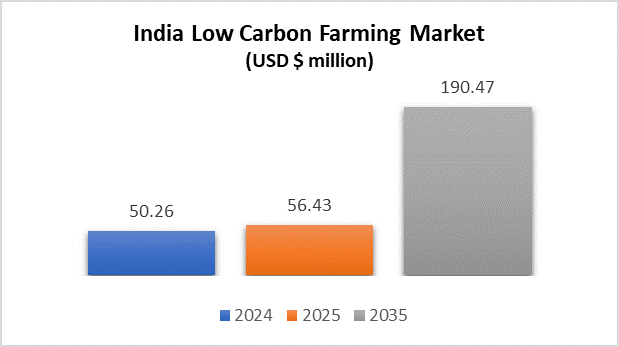
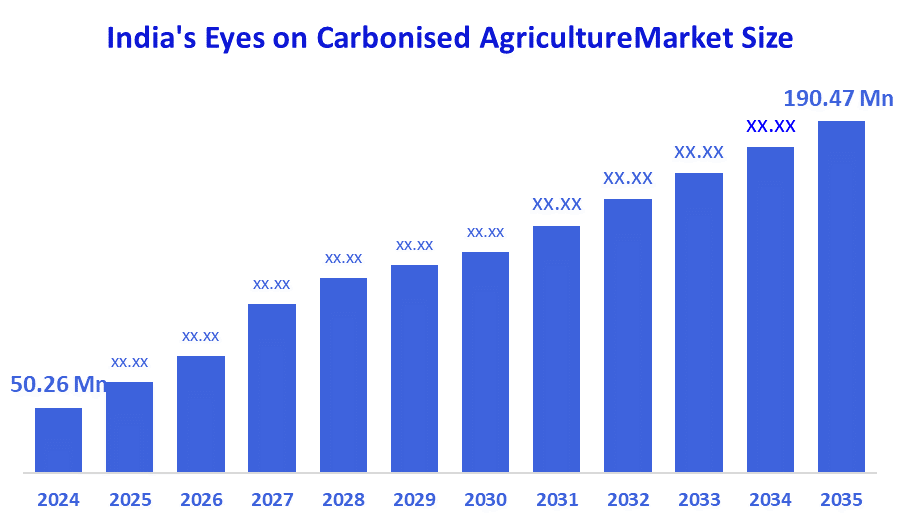
- India Low Carbon Farming Market is Expected To Grow from USD 50.26 Million in 2024 to USD 190.47 Million by 2035, Growing at a CAGR of 12.88% during the forecast period 2025-2035.
- The voluntary carbon market in India was valued at more than Rs 10,201 crores (US$1.2 billion) were reported, with 1,451 projects either registered or in different stages of evaluation.
- The carbon credits have generated revenues of Rs. 5,525.65 crore (US650 million). It is clear that the nation plays a crucial role in the worldwide carbon offset framework and is increasingly focused on climate-aware advancement.
- Their support nearly 46% of the workforce and accounting for 16% (FY24) of the Gross Domestic Product (GDP), this sector has consistently served as the foundation of India’s rural economy and national strength.
- Agriculture produced approximately 2,959 million tonnes CO2e, factoring in land use changes, with net emissions totalling 2,437 million tonnes after absorbing 522 million tonnes CO2 (22% offset).
- Carbon farming has the potential to sequester 0.3–0.6 tC/ha/year, reducing emissions by 0.1–0.21 GtCO2e each year and as much as 2.15–4.3 GtCO2e over two decade
Concept Snapshot:
What is meant by Low Carbon Farming?
The Fair Climate Network leads in Low Carbon Agriculture. In simple terms, this involves incentivising or rewarding Sustainable Agriculture practices adopted by small, marginal, and drought-affected farmers through Carbon Revenues. At first, LCF was simply a means to motivate small and marginal farmers through Carbon Revenues, encouraging them to move away from High External Input Destructive Agriculture (HEIDA) and embrace Sustainable Agriculture with Carbon Revenues. Subsequently, we identified three additional Economic Drivers that support SA: Enhanced Yield, Reduced Input Costs, and Better Prices for SA Produce.
Moreover, Low Carbon Farming is equivalent to a low-carbon development path across all areas of agricultural economics, meeting the energy requirements of farms and families. In this way, LCF enhances the conventional view of Sustainable Agriculture as a harmonious equilibrium among crops, trees, animals, and humans.
Why this farming need so much today?
Agriculture is crucial for providing food, but it also emits greenhouse gases from numerous widely used farming methods, exacerbating global warming. Agriculture contributes significantly, accounting for about 13–14% of the nation's total greenhouse gas (GHG) emissions, making it essential to embrace low-carbon strategies. These reductions in carbon emissions would assist India in meeting its national climate objectives and fostering a sustainable economy, while also protecting the livelihoods of countless farmers.
Below are several agricultural reasons that contribute to these emissions.
Rice cultivation
In conventional techniques, rice paddies remain submerged for extended durations. This establishes situations in which a gas known as methane is emitted. Methane (CH4) is a potent greenhouse gas that plays a major role in climate change.
Creatures on agricultural land
Cattle, bison, and other farm animals emit methane during their digestive process. If not managed correctly, their manure generates methane along with another gas known as nitrous oxide (N₂O), which is even more detrimental to the environment.
Burning of soil and crops
Excessive fertiliser use and incinerating remaining crop residues post-harvest release additional GHG into the atmosphere. These gases originate from the ground and the combustion smoke, and they play a role in pollution and climate change.
Electricity consumption
Farmers commonly utilise electricity to operate water pumps and various machinery. If this electricity is generated from coal or other fossil fuels, it also contributes carbon dioxide to the atmosphere.
How Indian agri sector come out of such a challenge?
Low-Emission Agriculture (LEA) Approach
LCF promotes sustainable agriculture by motivating farmers to implement practices that lessen the use of synthetic fertilisers while concurrently enhancing soil carbon levels. This is achieved by minimising tillage, employing anaerobic composting, utilising organic fertilisers, applying mulch, practising intercropping, engaging in multi-cropping, and a variety of methods tailored for specific regions, communities, and climate conditions. Further, growing various crops in the same field enhances biodiversity and effective crop combinations, grounded in research and proven outcomes, enhance resilience by establishing equilibrium in the farm ecosystem and diminishing the crop failures from pest infestations.
Configuring the Methodology for LCF
There is a set-up for 3 months into the execution of this initial FCN-LCF Pilot Project; it became evident from an assessment of current tools and methods that none were directly relevant to Low Carbon Farming. An LCF Specialist was designated to investigate the creation of a completely new LCF Methodology.
For unlocking the quantitative emissions and setting baselines, in each sub–Agro Ecological Zone (AEZ), the primary crop(s) cultivated by small and marginal farmers were determined. Mainstream (HEIDA) and SA Reference Plots were created for every Main Crop(s), and GHG Labs were established. After emissions of CH4 and N2O for every Main Crop(s) in each AEZ began to be recorded every week. After documenting emissions for each Main Crop(s) over 3 cropping seasons, a process that will span 5-6 years, there will be reliable data to determine Emission Reductions for different Main crops cultivated by small and marginal farmers across India.
Plan for the Indian farming sector:
India LCF Coalition
NGO participants took a bold step by coming together to establish the 1st FCN-LCF Coalition. It was a persistent resolve that has brought the idea to its current state. There’s no doubt that the experimental aspect of the initiative, lacking solutions, exploration, and testing, has resulted in significant strain. Everything has been out of sync, with real and imagined doubts and uncertainties, leading to a decrease in performance. Ultimately, it is an indisputable reality that LCF has positioned itself as an international approach to tackle the challenges faced by small, impoverished farmers while also providing a viable solution for preserving climate integrity. In addition, all three FCN-LCF Coalition members will need to apply their newly learned skills and abilities to effectively execute SA Practices across thousands of Discrete Plots/acres that have been marked. The 1st FCN-LCF and 2nd FCN-LCF Coalitions have recently merged to create a single Pan India LCF Coalition. The 3rd FCN-LCF Coalition will be joining them in the middle.
The role of farmers who contribute to the sustainable growth.
- Intelligent Methods for Rice Cultivation
Alternate Wetting and Drying (AWD): Rather than maintaining rice fields perpetually inundated, this technique entails regulated drying phases. It greatly reduces methane emissions and conserves water.
Direct Seeding of Rice (DSR) and the Rice System Intensification (SRI): These techniques decrease the necessity for transplanting and excessive watering. They reduce the carbon footprint, enhance water efficiency, and need less input, such as fertilisers and labour.
- Sustainable Animal Farming Methods
Improved Animal Feed: Offering more balanced nutrition and incorporating natural feed supplements aids in better digestion for animals, leading to lower methane emissions during the digestive process.
Enhanced Waste Management: Rather than allowing manure to remain untreated, farmers are employing strategies that trap emissions or utilise manure as organic fertiliser.
- More Nutritious Soil, Reduced Emissions
Agricultural Precision: Employing technology such as satellites and sensors. Through mapping, farmers utilise the precise quantity of fertiliser at the exact time and location it is required.
Slow-Release Fertilisers and Fertigation: These techniques guarantee Nutrients are supplied in a manner that enhances uptake by plants and reduces runoff into the ecosystem
Conclusion
India stands at the crossroads of tradition and change. India, currently the globe's most populated country with a deep agricultural heritage, is redefining its growth story, emphasising sustainability, innovation, and climate response as fundamental elements. Low-carbon agriculture isn't a possibility for the far-off future; it is a national necessity. Further, more efficient rice cultivation and improved livestock care, Indian farmers demonstrate that it is feasible to achieve environmental sustainability alongside economic development.
Moreover, strong policy frameworks, a growing carbon market, and grassroots innovation, India is actively addressing the climate challenge rather than merely adapting. This challenge is creating a route to upcoming opportunities, knocking its message on the strength of its farmers and an eco-friendly future. India is set to lead the globe toward climate-smart agriculture.