
India's Kamikaze Drone Technology Updates and Why India Import More Drones: Insights Analysis Study by 2026
Published on: April 2026
India's Kamikaze Drone Technology Updates and Why India Import More Drones: Insights Analysis Study by 2026
With an Emphasis on AI enabled autonomous systems and the long range, affordable choices, India is quickly developing its own kamikaze (the loitering munition) drone technology to improve deep-penetration strike capabilities. The Indian Army’s AI powered, high altitude drones as well as the initiatives like the “project KAL” (3 to 5 hours Endurance) and the range of 1000 kilometers, also the “sheshnag-150” swarm drone are among the major and latest advancements.
What is meant by a kamikaze drone in modern warfare?
Kamikaze drones sometimes referred as a suicide drones or loitering munition, are the unmanned aerial vehicle intended for a single use mission that involves locating and destroying targets by colliding with them while carrying an explosive payload. They may linger over a target region and modify their trajectory before detonating upon contact because to their combination of strike and the surveillance capabilities.
The Kamikaze drones uses hybrid technology to combine surveillance and the missile function. They deliver precise, low cost strikes with real time targeting, costing around $20,000 and are widely used in warfare.
India’s drone industry has expanded rapidly, with the number of manufactures of drones and unmanned aerial system reaching approximately 250 across the country. This growing ecosystem highlights India’s increasing focus on advanced drone technology, innovation, and defence application.
In India, the drone ecosystem is regulated by the government through the Directorate General of Civil Aviation under the ministry of Civil Aviation. The regulatory framework for drone’s operation is governed by the Aircraft Act Rules, 1937, which together established legal oversight, safety standard, and operational guidelines for unmanned aerial vehicle in India.
How Low-Cost Kamikaze Drones Are Changing 21st-Century Warfare Tactics?
Kamikaze unmanned aerial vehicle are rapidly transforming modern warfare by increasing the speed, precision, and intensity of 21st century conflicts. These low cost yet highly effective systems are reshaping military strategies across the global battlefields.
In the Ukraine-Russia war, Russia deployed Iranian-made Shahed -136 drones to overwhelm the air defense system and strikes critical infrastructure. During the prolonged 2023 Hamas-Israel conflict, Hamas used modified commercial FPV drones and improvised loitering munitions to penetrate the Israeli defence system.
- In January 2024, an explosive laden drone attack on Tower-22 in Jordan resulted in death of U.S troops stationed in the region, which was highlighting the growing threat of unmanned aerial vehicle.
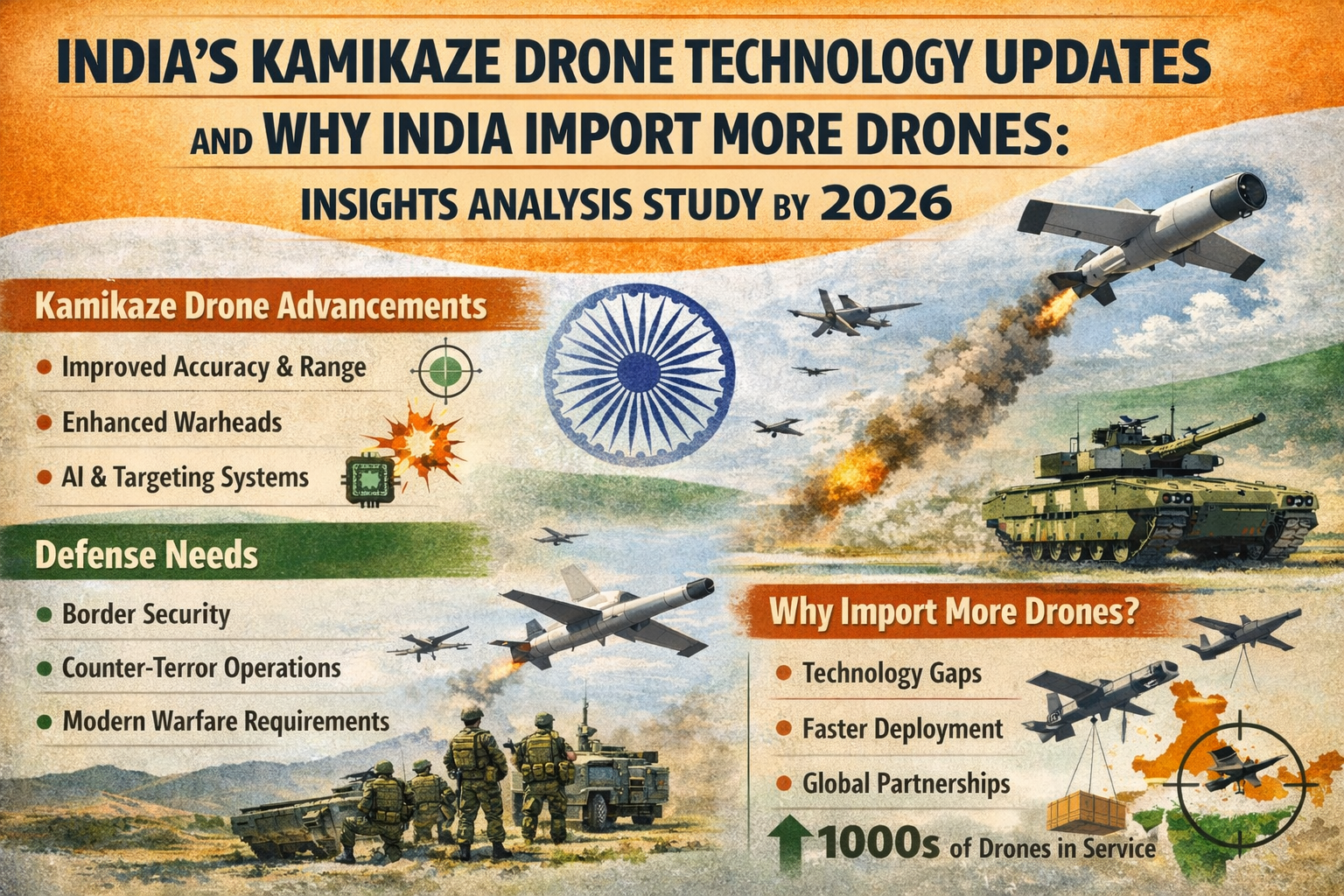
India’s Use of Kamikaze Drones in Operation SINDOOR and Modern Warfare Strategy
India is significantly advancing its defence capabilities by integrating kamikaze drones also known as the loitering munitions, into both strategic military operations and domestic defense manufacturing. This development reflects India’s growing focus on modern warfare technologies, precision strike systems, and indigenous defense innovation under the broader framework of self-reliant security infrastructure.
A key operational highlight is Operation SINDOOR in April 2025, where India responded to cross-border terrorist attack in Pahalgam by executing precession strikes using kamikaze drones on strategic Pakistani airbases, including Noor Khan and Rahimyar Khan. The operation is described as highly coordinated and precise successfully neutralizing radar system and missile defence network while reportedly avoiding any loses of Indian Military assets. The mission also incorporated advanced electronics warfare tactics, including jamming and disabling Chinese-supplied air defence system, and was completed within an exceptionally short operational window of approximately 23 minutes, demonstrating the rapid response drone warfare capability.
India’s Kamikaze Drone Technology Development (2026 Update)
India is rapidly developing indigenous kamikaze drone systems and integrating them into defence operations under the Atmanirbhar Bharat initiative.
Key developments include:
- Increased deployment of loitering munitions for precision strikes
- Integration of AI-based targeting and surveillance systems
- Expansion of FPV (First Person View) drone warfare capability
- Domestic production of low-cost tactical drones for battlefield use
Indian defence forces are also focusing on combining drones with electronic warfare systems for enhanced battlefield dominance.
Why India Is Increasing Drone Imports in 2026?
Despite rapid growth in India’s indigenous drone industry, the country continues to increase drone imports in 2026 due to evolving defence requirements, modern warfare demands, and the needs for advanced unmanned aerial capabilities. This strategy supports India’s broader focus on strengthening national security, enhancing battlefield readiness, and accelerating drone warfare modernization.
- Technological Gap in Domestic Manufacturing
Although India has made progress in drone development, domestic capabilities still lag in:
- AI-enabled targeting system`
- Autonomous swarm drone technology
- High End Sensors and imaging payloads
This gap compels India to import drones from technologically advanced countries to maintain strategic parity. Additionally, limited access to advanced semiconductor technology and defense grade electronics further slows indigenous innovation and scalability.
- Faster Deployment and Urgent Defense Need
Indigenous drone production is increasing but often faces delay due to:
- R&D timelines
- Certification Processes
- Limited large-scale manufacturing infrastructure
Imports allow rapid deployment, especially during emergencies or the border tension. This is particularly crucial in dynamic conflicts scenario where real-time operational readiness is more important than long term development cycle.
- Strategic global Partnership
India is strengthening defense ties with countries like:
- United States
- Israel
- France
These collaborations enable access to cutting edge drone technologies, including precision strike drones and surveillance UAVs. They also support technology transfer, joint ventures, and co-development programs that strengthen India’s long term defense ecosystem.
- Increase in Counter-Terrorism and Border Surveillance Operations
Drones are critical for:
- Real time intelligence gathering
- Monitoring infiltrations along borders
- Counter- terrorism operations
Imported drones often provide superior endurance, accuracy and night vision capabilities, making them essential for mission – critical operations. Their integration with AI and satellite system further enhances situational awareness and the response time.
- Expansion of Commercial and Industrial Drone Use
Beyond Defense, drone imports are also rising due to growing application in it:
- Agriculture
- Infrastructure inspection
- Mining and Logistics
- Disaster Management
The private sectors increasing adoption of drones for efficiency and cost optimization is accelerating demand for advanced ready to use imported system.
- Limited Availability of High End Components
Even when drones are assembled domestically key component such as:
- LiDAR Sensors
- Thermal Cameras
- Advanced Chipsets
Are largely imported, contributing to overall import growth. The absence of a strong domestic semiconductor and electronics manufacturing ecosystem further reinforces this depend\ency, limiting full localization of drone’s production.
Conclusion:
India’s Kamikaze drone technology in 2026 highlights a strategic balance between indigenous innovation and rising drone imports to meet advanced warfare demands. While domestic capabilities are expanding under self-reliance initiatives, imports remain essential for AI enabled systems, precision strike drones and high end components. This dual approaches ensures rapid deployment, strengthen national security, and enhances battlefield efficiency. With growing adoption across defense and commercial sectors, India’s drone market growth is set to accelerate positioning the country as a key player in the global unmanned system landscape.