
Global B-Cell Non-Hodgkin Lymphoma Market Size to Exceed USD 19.58 Billion by 2035 | CAGR of 8.11%
Global B-Cell Non-Hodgkin Lymphoma Market Size to Exceed USD 19.58 Billion by 2035
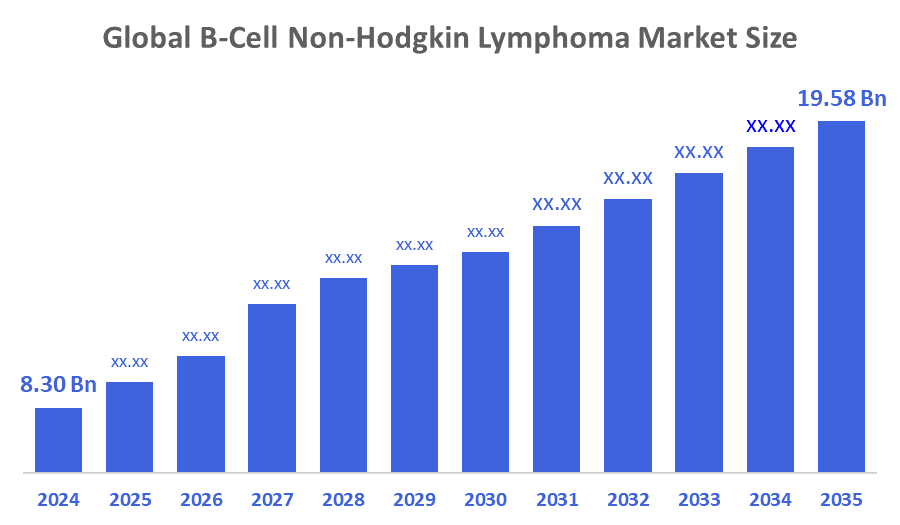
According to a Research Report Published by Decisions Advisors and Consulting, The Global B-Cell Non-Hodgkin Lymphoma Market Size is expected to Grow from USD 8.30 Billion in 2024 to USD 19.58 Billion by 2035, at a CAGR of 8.11% during the forecast period 2025-2035.
Browse 210 Market Data Tables And 45 Figures Spread Through 190 Pages and In-Depth TOC On the Global B-Cell Non-Hodgkin Lymphoma Market Size, Share, and COVID-19 Impact Analysis, By Treatment Type (Chemotherapy, Immunotherapy, Targeted Therapy, Radiation Therapy, and Stem Cell Transplantation), By Drug Class (Monoclonal Antibodies, Chemotherapeutic Agents, and Tyrosine Kinase Inhibitors), By Administration Route (Intravenous (IV), Subcutaneous, and Oral), and By Region (North America, Europe, Asia-Pacific, Latin America, Middle East, and Africa), Analysis and Forecast 2025 – 2035. Get Detailed Report Description Here: https://www.decisionsadvisors.com/reports/b-cell-non-hodgkin-lymphoma-market
The B-Cell non-Hodgkin lymphoma (B-NHL) market encompasses the worldwide industry focused on the identification, treatment, and management of B-cell subtypes of non-Hodgkin lymphoma, which includes approved drugs, emerging therapies, epidemiological statistics, and regional development patterns. B-cell non-Hodgkin lymphoma (NHL) is a type of cancer that originates in B cells, a type of white blood cell that helps the immune system combat pathogens. Symptoms may vary depending on the specific subtype, the progression of the disease, and the organs or tissues affected. Frequent signs consist of sweating at night, fever, itchiness, ongoing fatigue, unexplained weight reduction, and non-painful swelling of lymph nodes in the neck, groin, or armpits. Abdominal pain or bloating, chest discomfort, trouble breathing, bone pain, etc. The rising rates of B-cell non-Hodgkin's lymphoma (NHL), which have consistently grown in recent decades, are the main factor driving the B-cell NHL treatment industry. The expansion of the industry is driven by a growing global population of seniors, who are more susceptible to the disease. However, patients are often unable to acquire cutting-edge medicines due to the high cost of B-cell non-Hodgkin lymphoma treatments, a lack of financial aid, and strict payment options, which hinder market expansion and accessibility.
The radiation therapy segment dominated the market in 2024 and is projected to grow at a substantial CAGR over the forecast period.
Based on the treatment type, the B-cell non-Hodgkin lymphoma market is divided into chemotherapy, immunotherapy, targeted therapy, radiation therapy, and stem cell transplantation. Among these, the radiation therapy segment dominated the market in 2024 and is projected to grow at a substantial CAGR over the forecast period. This is because radiation treatment is effective in treating localised disease and can be combined with other modalities; it is an essential therapeutic approach for B-cell non-Hodgkin lymphoma. Additionally, it has a well-established role in treatments and is widely accessible.
The monoclonal antibodies segment dominated the market in 2024 and is projected to grow at a substantial CAGR during the forecast period.
Based on the drug class, the B-cell non-Hodgkin lymphoma market is differentiated into monoclonal antibodies, chemotherapeutic agents, and tyrosine kinase inhibitors. Among these, the monoclonal antibodies segment dominated the market in 2024 and is projected to grow at a substantial CAGR during the forecast period. These medications are essential to treatment processes because of their efficacy and generally acceptable safety profiles when compared to more modern tyrosine kinase inhibitors and traditional chemotherapy agents.
The intravenous (IV) segment accounted for the highest market revenue in 2024 and is anticipated to grow at a significant CAGR during the forecast period.
Based on the administration route, the B-cell non-Hodgkin lymphoma market is segmented into intravenous (IV), subcutaneous, and oral. Among these, the intravenous (IV) segment accounted for the highest market revenue in 2024 and is anticipated to grow at a significant CAGR during the forecast period. Monoclonal antibodies and other targeted medications that need direct vascular infusion are often administered intravenously (IV). Furthermore, its dominance is due to its greatest effectiveness and dispersion throughout the body.
Asia Pacific is expected to hold the majority share of the global B-cell non-Hodgkin lymphoma market during the forecast period.
Asia Pacific is expected to hold the majority share of the global B-cell non-Hodgkin lymphoma market during the forecast period. Regulations have been improved, and new treatments like CAR-T and bispecific antibodies have been approved more quickly. Government initiatives to promote early detection and reimbursement for lymphoma treatment. China, Japan, India, South Korea, and Australia are the major countries impacting the APAC B-cell non-Hodgkin lymphoma market; China is the market leader in terms of both size and growth.
North America is projected to grow at the fastest pace in the global B-cell non-Hodgkin lymphoma market during the forecast period. The United States has the largest patient pool for B-cell NHL and leads the globe in both market size and therapeutic innovation. The market is expanding due to favourable reimbursement policies, more awareness, and an increase in disease incidence.
Major vendors in the global B-cell non-Hodgkin lymphoma market are AbbVie, AstraZeneca, Bayer AG, Bristol Myers Squibb Company, Genentech Inc., Janssen Pharma, Kite Pharma, Kyowa Kirin Co., Merck & Co., Novartis, Sanofi, Spectrum Pharma, Takeda Pharma, Teva Pharma, and others.
Key Target Audience
- Market Players
- Investors
- End-users
- Government Authorities
- Consulting and Research Firm
- Venture capitalists
- Value-Added Resellers (VARs)
Recent Development
- In December 2025, for adult patients with relapsed or refractory follicular lymphoma (FL, Grade 1-3a) following at least one previous systemic therapy, the European Commission formally approved Incyte's Minjuvi® (tafasitamab), in combination with lenalidomide and rituximab. This is a significant turning point because it offers Europe's first chemotherapy-free choice.
Market Segment
This study forecasts revenue at global, regional, and country levels from 2020 to 2035. Decisions Advisors and Consulting has segmented the B-cell non-Hodgkin lymphoma market based on the below-mentioned segments:
Global B-Cell Non-Hodgkin Lymphoma Market, By Treatment Type
- Chemotherapy
- Immunotherapy
- Targeted Therapy
- Radiation Therapy
- Stem Cell Transplantation
Global B-Cell Non-Hodgkin Lymphoma Market, By Drug Class
- Monoclonal Antibodies
- Chemotherapeutic Agents
- Tyrosine Kinase Inhibitors
Global B-Cell Non-Hodgkin Lymphoma Market, By Administration Route
- Intravenous (IV)
- Subcutaneous
- Oral
Global B-Cell Non-Hodgkin Lymphoma Market, By Regional Analysis
- North America
- US
- Canada
- Mexico
- Europe
- Germany
- UK
- France
- Italy
- Spain
- Russia
- Rest of Europe
- Asia Pacific
- China
- Japan
- India
- South Korea
- Australia
- Rest of Asia Pacific
- South America
- Brazil
- Argentina
- Rest of South America
- Middle East & Africa
- UAE
- Saudi Arabia
- Qatar
- South Africa
- Rest of the Middle East & Africa
Company Profile
| Decisions Advisors | |
|---|---|
| Industry | Healthcare |
| Website | https://www.decisionsadvisors.com/ |
| Date | January 2026 |
Connect with us
- USA - +1 303 800 4326
- APAC - +91 9028926100
- [email protected]