
Global Agar Resin Market
 |
Author:
David J
|
Pages:
210
|
Author:
David J
|
Pages:
210
Agar Resin Market Size, Share, By Product Type (Food Grade Agar, Bacteriological Grade Agar, Technical Grade Agar), By Application (Food & Beverages, Pharmaceuticals, Microbiology and Biotechnology, Cosmetics), By End User (Food Industry, Research Laboratories, Pharmaceutical Company), and By Region (North America, Europe, Asia-Pacific, Latin America, Middle East & Africa), Analysis and Forecast 2025?2035
CAGR
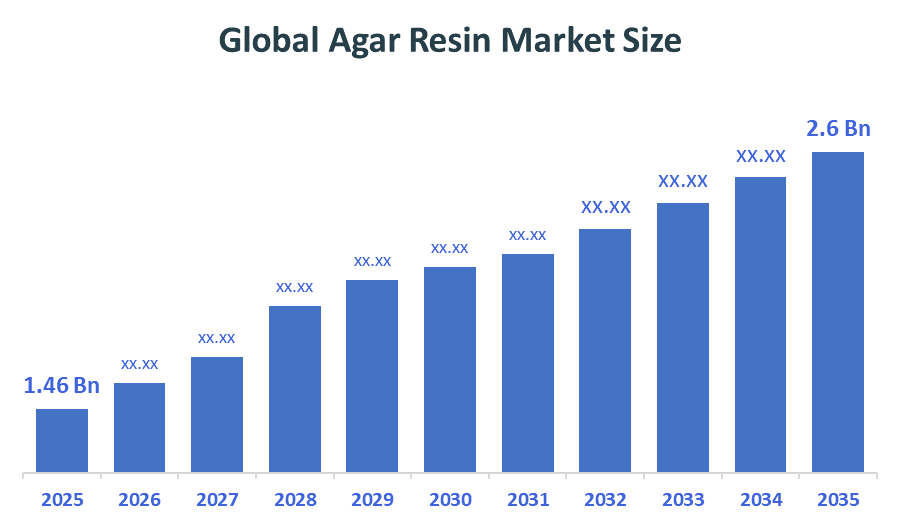
5.94%
REVENUE 2025
USD Billion 1.46
FORECAST 2035
USD Billion 2.6
REPORT COVERAGE
Global
Market Snapshot
- Global Agar Resin Market Size (2025): USD 1.46 Billion
- Projected Global Agar Resin Market Size (2035): USD 2.6 Billion
- Global Agar Resin Market Compound Annual Growth Rate (CAGR): 5.94%
- Fastest Growing Region: Asia-Pacific
- 2nd Largest Regional Market: North America
- 3rd Largest Region: Europe
- Base Year: 2025
- Historical Period: 2021–2024
- Forecast Period: 2026–2035
Market Overview/ Introduction
H1ealth authorities like the EFSA and FDA are keeping a close watch, setting strict safety standards to ensure these additives remain healthy for consumers while also The Agar Resin market encompasses two primary parts that are industrial agar, a hydrocolloid extracted from red seaweed used as a gelling agent, and high-purity agarose resins, which are specialized media used in laboratory chromatography for protein and DNA purification. The market is serving as a critical plant-based alternative to animal gelatin. Its definition has recently expanded to include the high-value Agarwood (Oud) resin sector, which is seeing a surge in organized cultivation and trade, particularly in the Asia-Pacific region, due to its scarcity and high demand in luxury perfumery and traditional medicine. The growth isn't just about food, it’s being supercharged by the global move toward cleaner ingredients and a massive boom in medical research. In the specialized world of lab-grade resins, growth is exploding at over approximately 21% because pharmaceutical companies are racing to develop new biotherapies. major companies like Hispanagar and Agargel are moving away from just selling a product to securing the future. They are investing heavily in sustainable seaweed farming, essentially underwater gardening, to protect their supply from climate change. Looking ahead, the future of agar resin is moving toward high-tech customisation.
- The India government aims for a ?2,000 crore annual turnover in Tripura alone within the next 3–4 years.
- The High-quality chips formulated with agar ranges from ?5 lakh to ?10 lakh+ per kg.
Notable Insights: -
- Asia Pacific is the fastest-growing region in the global agar resin market during the forecast period, holding approximately 38% share.
- North America is anticipated to hold approximately 30% share of the global agar resin market over the predicted timeframe.
- By product type, the food grade agar segment dominated the market and holds approximately 52% share in 2025, and is projected to grow at a substantial CAGR during the forecast period.
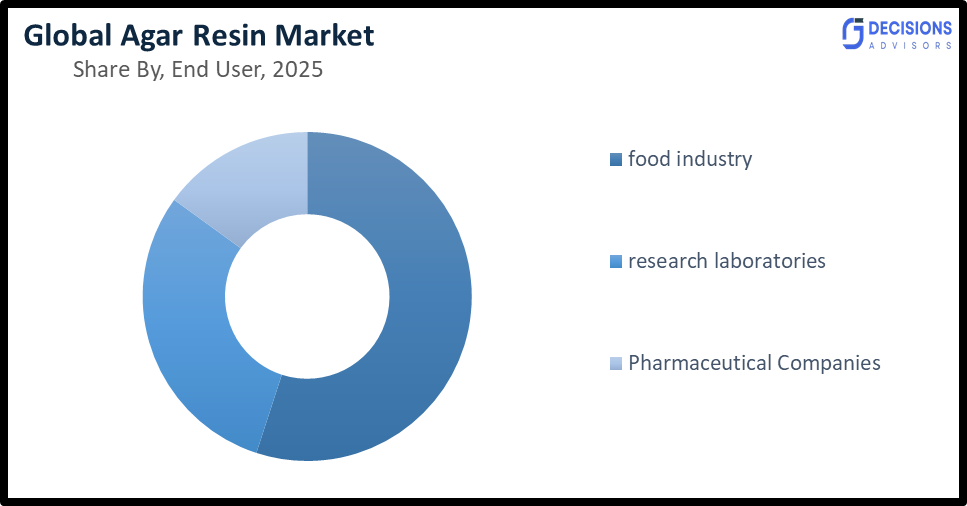
- By end user, the food industry segment dominated the market and holds approximately 55% share in 2025 and is projected to grow at a substantial CAGR during the forecast period.
- The compound annual growth rate of the Global Agar Resin Market is 5.94%.
6. The market is likely to achieve a valuation of USD 2.6 Billion by 2035.
What is the role of technology in grooming the market?
Technological advancements are improving agar extraction efficiency and product purity. Modern processing techniques enhance gel strength, clarity, and consistency, making agar more suitable for high-end food and pharmaceutical applications. In biotechnology, innovations in agar-based culture media are enabling precise microbial growth, supporting advancements in diagnostics and research. Automation in extraction and processing is also reducing production costs and improving scalability.
Market Drivers
The agar resin market is finding a new rhythm, fuelled by our collective return to nature and a push for smarter medicine. A huge part of this is the clean label movement, as more of us swap animal-based products for plant-powered ones, agar has stepped up as the go-to vegan alternative to gelatin. It’s more than just a passing food trend, it’s a lifestyle shift that’s making seaweed-based agar a must have in both home kitchens and local pharmacies. In the fast-paced world of biotech, things get even more interesting. Scientists now treat specialized agarose resins like high-tech microscopic filters to help clean and purify life-saving vaccines. As the race for personalised medicine heats up, these resins have evolved from simple extracts into essential tools that help doctors get treatments to patients much faster. Then, there’s the liquid gold that is Agarwood (Oud) resin. Famous for its role in luxury perfumes and ancient healing, this rare resin can actually be worth more than gold. What used to be a somewhat mysterious, backyard trade is finally becoming a professional industry. government support and subsidies, especially in places like India, farmers are now being encouraged to grow agarwood as a serious, high-value crop. This mix of old-world luxury, modern veganism, and cutting-edge science is what’s really moving this market into an exciting new chapter.
Restrain
The market faces challenges such as fluctuating raw material supply due to dependence on marine resources, particularly red algae. Seasonal availability and environmental concerns can impact production. High production costs and competition from alternative hydrocolloids like carrageenan and gelatin may also restrain market growth.
Competitive Analysis:
The report offers the appropriate analysis of the key organizations/companies involved within the global agar resin market, along with a comparative evaluation primarily based on their product of offering, business overviews, geographic presence, enterprise strategies, segment market share, and SWOT analysis. The report also provides an elaborative analysis focusing on the current news and developments of the companies, which includes product development, innovations, joint ventures, partnerships, mergers & acquisitions, strategic alliances, and others. This allows for the evaluation of the overall competition within the market.
Top Companies in the Global Agar Resin Market
- Cytiva
- Ecolab Inc.
- Merck KGaA
- Thermo Fisher Scientific Inc.
- Bio-Rad Laboratories, Inc.
- Takara Bio Inc.
- Agarose Beads Technologies
- Cube Biotech Inc.
- Bio-Works Technologies
- Tosoh Bioscience LLC
Government Initiatives
|
Country |
Key Government Initiatives |
|
India |
The government allocated ?80 crore to develop a complete agarwood value chain, specifically focusing on Tripura as a processing hub for "liquid gold" (agar oil).
|
|
Vietnam |
The Vietnamese government set a target to increase agarwood exports to $1 billion by 2025
|
|
Europe |
EU-backed projects (some involving German partners) with a total value exceeding €1.4 million to scale up regenerative seaweed farming and address bottlenecks in the algae value chain, such as bioprocessing for specialized resins
|
Study on the Supply, Demand, Distribution, and Market Environment of the Global Agar Resin Market
The supply side is heavily dependent on seaweed harvesting and processing industries, primarily concentrated in Asia-Pacific countries such as Indonesia, China, and Japan. Demand is driven by food manufacturers, pharmaceutical companies, and research laboratories. Distribution channels include direct supply contracts, distributors, and exports. The market environment is favorable due to increasing investments in marine biotechnology and sustainable aquaculture practices.
Price Analysis and Consumer Behaviour Analysis
The price of agar resin varies depending on its grade, purity, and application, with food grade agar typically ranging between USD 18–35 per kg, while bacteriological-grade agar can reach USD 80–200+ per kg due to its high purity and strict quality standards required for laboratory and pharmaceutical use. Technical-grade agar is comparatively lower priced, usually between USD 10–20 per kg. Price fluctuations are strongly influenced by the availability of raw materials, particularly seaweed, with recent industry trends indicating fluctuations of around 15–25% due to climate conditions, supply chain disruptions, and seasonal harvesting patterns in major producing countries such as Indonesia and China, which together contribute over 70% of global supply. Additionally, premium agar products with higher gel strength and consistency can command 20–30% higher prices, especially in specialized applications.
Market Segmentation
- The food grade agar segment dominated the market and holds approximately 52% share in 2025, and is projected to grow at a substantial CAGR during the forecast period.
Based on the product type, the global agar resin market is divided into food grade agar, bacteriological-grade agar, and technical-grade agar. Among these, the food-grade agar segment dominated the market and holds approximately 52% share in 2025, and is projected to grow at a substantial CAGR during the forecast period. This dominance is attributed to its widespread use as a natural gelling, thickening, and stabilizing agent in food and beverage products such as confectionery, bakery, dairy, and plant-based foods. The increasing global shift toward vegan and clean-label products has significantly boosted demand for agar as a plant-based alternative to gelatin.
Recent developments further support this dominance, as food manufacturers are actively reformulating products to meet plant-based and sustainable consumption trends. For instance, in 2025, several global food brands expanded their vegan product portfolios, increasing the adoption of agar as a key ingredient. Additionally, rising consumer awareness regarding natural additives and stringent food safety regulations in regions like Europe and North America are accelerating the demand for high-quality food-grade agar.
- The food & beverages segment accounted for the largest share of approximately 48% in 2025 and is anticipated to grow at a significant CAGR during the forecast period.
Based on the application, the global agar resin market is divided into food & beverages, pharmaceuticals, microbiology & biotechnology, and cosmetics. Among these, the food & beverages segment accounted for the largest share of approximately 48% in 2025 and is anticipated to grow at a significant CAGR during the forecast period. This is primarily due to the increasing demand for natural hydrocolloids in processed foods, along with the rising popularity of plant-based diets and functional foods. Agar is extensively used in jellies, desserts, beverages, and dairy alternatives due to its superior gel strength and thermal stability.
Supporting this trend, recent industry insights indicate a surge in demand for plant-based ingredients, with the global vegan food market witnessing strong growth in recent years. Furthermore, the expansion of convenience food consumption and clean-label product trends is driving manufacturers to replace synthetic additives with natural alternatives like agar. Additionally, increasing usage of agar in microbiological applications for culture media especially in pharmaceutical and biotechnology research is further strengthening the overall application segment growth.
- The food industry segment dominated the market and holds approximately 55% share in 2025 and is projected to grow at a substantial CAGR during the forecast period.
Based on end user, the global agar resin market is divided into food industry, research laboratories, and pharmaceutical companies. Among these, the food industry segment dominated the market and holds approximately 55% share in 2025 and is projected to grow at a substantial CAGR during the forecast period, owing to the high consumption of agar in processed foods, confectionery, and plant-based product formulations. The increasing demand for natural, safe, and multifunctional ingredients has made agar a preferred choice among food manufacturers.
Recent industry trends also support this dominance, as global food companies are increasingly investing in plant-based innovation and clean-label formulations. Moreover, the rapid expansion of food processing industries in emerging economies such as India, China, and Southeast Asia is boosting agar consumption. Additionally, innovations in product formulation and the rising popularity of vegan desserts and alternative protein products are enabling food manufacturers to expand agar usage, thereby strengthening the growth of this segment.
Strategies to Implement for Growth of the Market in Non-Leading Regions
Growth in non-leading regions of the global agar resin market can be accelerated by focusing on affordability, supply chain development, and awareness expansion. Companies should prioritize the introduction of cost-effective and locally produced agar products to cater to price-sensitive markets in regions such as Latin America, the Middle East, and parts of Africa. Establishing local processing units near seaweed cultivation areas can significantly reduce transportation costs and ensure a stable supply of raw materials, thereby improving overall market accessibility.
Regional Segment Analysis of the Global Agar Resin Market
- North America (U.S., Canada, Mexico)
- Europe (Germany, France, U.K., Italy, Spain, Rest of Europe)
- Asia-Pacific (China, Japan, India, Rest of APAC)
- South America (Brazil and the Rest of South America)
- The Middle East and Africa (UAE, South Africa, Rest of MEA)
Asia Pacific is the fastest-growing region in the global agar resin market during the forecast period, holding approximately 38% share.
Asia Pacific is the fastest-growing region in the global agar resin market during the forecast period, holding approximately 38% share. This growth is driven by abundant availability of raw materials (seaweed), expanding food processing industries, and increasing exports of agar products from countries such as China, Indonesia, Japan, and India. The region benefits from low production costs and strong supply chain networks, making it the global hub for agar manufacturing.
Recent developments indicate strong government support, particularly in countries like Indonesia and India, where initiatives promoting seaweed cultivation under blue economy programs are boosting raw material supply. Additionally, the rapid growth of the food and beverage industry, along with increasing demand for processed and convenience foods, is accelerating agar consumption. The expansion of biotechnology research, pharmaceutical manufacturing, and rising exports to North America and Europe are further strengthening the region’s dominance in the global market.
North America is anticipated to hold approximately 30% share of the global agar resin market over the predicted timeframe.
North America is anticipated to hold approximately 30% share of the global agar resin market over the predicted timeframe. It maintains a strong market presence due to the high demand for plant-based food ingredients, well-established food processing industries, and increasing adoption of natural hydrocolloids in pharmaceuticals and biotechnology applications. The United States is the key driver, supported by rising consumer preference for vegan and clean-label products, along with growing investments in food innovation and life sciences research. Additionally, the increasing use of agar in microbiological culture media across research laboratories and pharmaceutical companies is boosting market demand.
Recent developments further support this growth, as regulatory bodies such as the U.S. Food and Drug Administration (FDA) continue to promote the use of safe and natural food additives. Moreover, leading food and biotech companies in North America are actively expanding their plant-based product portfolios, increasing the adoption of agar as a natural alternative to synthetic gelling agents and gelatin, thereby strengthening the region’s market position.
Europe is expected to grow at a rapid CAGR in the global agar resin market by holding approximately 25% of the share during the forecast period.
Europe is expected to grow at a rapid CAGR in the global agar resin market by holding approximately 25% of the share during the forecast period. The region’s growth is supported by strict food safety regulations, increasing demand for clean-label and organic food products, and strong emphasis on sustainable sourcing of ingredients. Countries such as Germany, France, and the United Kingdom are leading the adoption of natural additives like agar in food processing and pharmaceutical formulations.
Recent industry trends highlight that the European Food Safety Authority (EFSA) continues to encourage the use of safe, plant-based additives, driving the demand for agar. Additionally, the growing vegan population across Europe and rising innovation in plant-based confectionery and dairy alternatives are significantly contributing to market expansion. The increasing application of agar in microbiological research and biotechnology is also supporting regional growth.
Future Market Trends in the Global Agar Resin Market: -
1. Rising Shift Toward Plant-Based and Clean-Label Ingredients
The agar resin market is witnessing a strong shift toward plant-based and clean-label ingredients, driven by increasing consumer preference for natural and vegan products. Agar is widely used as a substitute for gelatin in food applications such as confectionery, bakery, and dairy alternatives. This trend is significantly supported by the rapid growth of the global vegan and vegetarian population, along with increasing demand for processed foods containing natural additives. According to industry reports, the agar market is expanding steadily due to rising adoption in clean-label food products and plant-based formulations.
2. Expanding Applications in Biotechnology and Pharmaceuticals
Agar resin is experiencing growing demand in biotechnology, microbiology, and pharmaceutical industries, where it is widely used as a culture medium for microbial growth and laboratory research. The increasing number of research activities, drug development processes, and diagnostic applications is driving this trend. Agar plays a critical role in microbiological studies due to its stability and ability to support bacterial and fungal growth. Industry insights highlight that rising demand from research laboratories and pharmaceutical applications is creating significant growth opportunities for the agar market.
3. Advancements in Extraction Technology and Sustainable Seaweed Cultivation
Technological advancements in agar extraction and processing, along with increasing focus on sustainable seaweed cultivation, are emerging as key future trends in the market. Innovations in extraction techniques are improving yield, quality, and functional properties of agar, making it suitable for a wider range of applications. At the same time, governments and companies are investing in sustainable aquaculture practices to ensure consistent raw material supply.
Recent Development
- In January 2026, Union Minister Jyotiraditya Scindia laid the foundation stone of an ?80 crore Agarwood Value Chain Development Scheme at North Fulkabari in Tripura. The initiative aimed to strengthen the entire agarwood ecosystem from cultivation to global marketingmby setting up processing centres in Tripura and Assam and eliminating intermediaries to ensure better returns for farmers. The scheme also focused on boosting exports, increasing production capacity, and promoting global competitiveness through measures such as higher export quotas and efforts to secure a Geographical Indication (GI) tag.
- In December 2025, South Korea showed increasing interest in India’s agarwood sector, particularly in Tripura, recognising its potential as a high-value aromatic product in global markets. The report highlighted that agarwood, widely used in perfumes, incense, and traditional medicines, was emerging as a significant export commodity from Northeast India. It noted ongoing government efforts to strengthen the value chain, boost production, and enhance international trade linkages, positioning Tripura as a key hub for agarwood cultivation and processing.
- In July 2025, Farmers in Andhra Pradesh were encouraged to cultivate agarwood as a highly profitable crop during an awareness programme held in Vijayawada. A senior forest official highlighted that agarwood widely used in perfumes, incense, and traditional medicine had strong demand in international markets, especially in Gulf countries and Europe.
- In November 2024, Assam’s agarwood industry was expected to receive a major boost with the development of an international agar trade centre in Golaghat. Once operational, the hub was projected to facilitate business worth nearly ?50,000 crore annually, significantly enhancing trade and exports. The initiative was supported by the Assam Agarwood Promotion Policy 2020 and aimed to promote value-added products, generate employment, and encourage entrepreneurship in the sector.
- In September 2023, Tripura was actively working towards developing a ?20 billion agarwood industry, supported by its rich natural resources and favourable conditions for cultivation. The state government implemented the Tripura Agarwood Policy 2021, aiming to expand plantations, promote value addition, and create a strong supply chain ecosystem. The policy targeted covering around 2,000 hectares under agarwood cultivation and establishing trade and research centres to support growers and exporters.
How is Recent Developments Helping the Market?
Recent developments in the global agar resin market are significantly enhancing product quality, expanding application areas, and ensuring stable supply chains, thereby accelerating overall market growth. One of the key ways developments are helping the market is through capacity expansion and production upgrades. For instance, in 2024, a leading agar manufacturer expanded its production facility in Spain to around 100,000 liters per year to meet the growing demand for high-purity agar used in biopharmaceutical applications. This expansion ensures consistent supply and supports the increasing demand from pharmaceutical and biotechnology industries.
Market Segment
This study forecasts revenue at global, regional, and country levels from 2020 to 2035. Decision Advisors has segmented the global agar resin market based on the below-mentioned segments:
Global Agar Resin Market, By Product Type
- Food Grade Agar
- Bacteriological Grade Agar
- Technical Grade Agar
Global Agar Resin Market, By Applications
- Food & Beverages
- Pharmaceuticals
- Microbiology & Biotechnology
- Cosmetics
Global Agar Resin Market, By End User
- Food Industry
- Research Laboratories
- Pharmaceutical Companies
Global Agar Resin Market, By Regional Analysis
- North America
- US
- Canada
- Mexico
- Europe
- Germany
- UK
- France
- Italy
- Spain
- Russia
- Rest of Europe
- Asia Pacific
- China
- Japan
- India
- South Korea
- Australia
- Rest of Asia Pacific
- South America
- Brazil
- Argentina
- Rest of South America
- Middle East & Africa
- UAE
- Saudi Arabia
- Qatar
- South Africa
- Rest of the Middle East & Africa
Frequently Asked Questions (FAQ)
Q. How does agar resin compare with carrageenan and gelatin in performance?
A. Agar provides stronger gel strength and better thermal stability compared to gelatin, and unlike carrageenan, it forms gels without requiring additional ions, making it more versatile across food and laboratory applications.
Q. What is the typical shelf life of agar resin?
A. Agar resin generally has a shelf life of 2–5 years when stored in a cool, dry environment, as it is highly stable and resistant to microbial degradation.
Q. Which type of seaweed is primarily used for agar production?
A. Agar is mainly extracted from red algae species such as Gelidium and Gracilaria, which are cultivated and harvested in regions like Southeast Asia and parts of Europe.
Q. What are the key quality parameters buyers look for in agar resin?
A. Buyers typically evaluate gel strength, clarity, viscosity, moisture content, and microbial purity, especially for pharmaceutical and microbiological applications.
Q. Can agar resin be used in emerging industries like 3D food printing or biotechnology innovation?
A. Yes, agar is increasingly being explored in 3D food printing, tissue engineering, and bioengineering applications due to its gel-forming ability and biocompatibility, making it suitable for innovative industrial uses.
Check Licence
Choose the plan that fits you best: Single User, Multi-User, or Enterprise solutions tailored for your needs.
We Have You Covered
- 24/7 Analyst Support
- Clients Across the Globe
- Tailored Insights
- Technology Tracking
- Competitive Intelligence
- Custom Research
- Syndicated Market Studies
- Market Overview
- Market Segmentation
- Growth Drivers
- Market Opportunities
- Regulatory Insights
- Innovation & Sustainability
Report Details
| Scope | Global |
| Pages | 210 |
| Delivery | PDF & Excel via Email |
| Language | English |
| Release | Apr 2026 |
| Access | Download from this page |