
Global Alcohol Sensor Market
 |
Author:
Achal E
|
Pages:
245
|
Author:
Achal E
|
Pages:
245
Global Alcohol Sensor Market Size, Share, By Technology (Fuel Cell Technology, Semiconductor Oxide Sensor Technology, and Others), By Application (Vehicle Controlling and Healthcare Application), By End-Users (Law Enforcement Agencies, Commercial, and Individuals) and By Region (North America, Europe, Asia-Pacific, Latin America, Middle East, and Africa), Analysis and Forecast 2026-2035.
CAGR
13.8%
REVENUE 2025
USD Billion 3.38
FORECAST 2035
USD Billion 12.31
REPORT COVERAGE
Global
Market Snapshot
- Global Alcohol Sensor Market Size (2025): USD 3.38 Billion
- Projected Global Alcohol Sensor Market Size (2035): USD 12.31 Billion
- Global Alcohol Sensor Market Compound Annual Growth Rate (CAGR): 13.8%
- Largest Regional Market: North America
- Fastest Growing Region: Asia Pacific
- 3rd Largest Region: Europe
- Base Year: 2025
- Historical Period: 2021–2024
- Forecast Period: 2026–2035
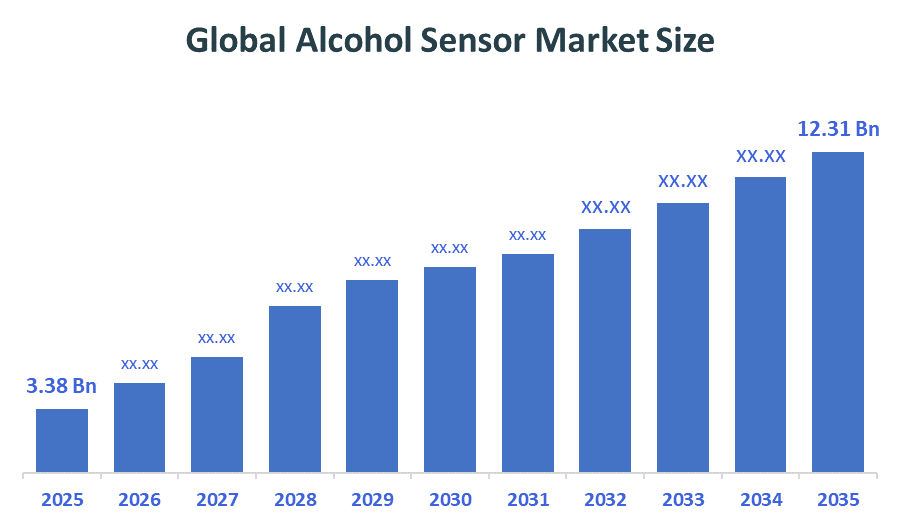
According to Decision Advisors, the Global Alcohol Sensor Market Size is expected to grow from USD 3.38 Billion in 2025 to USD 12.31 Billion by 2035, at a CAGR of 13.8% during the forecast period 2026-2035. Global Alcohol Sensor Market is projected to grow significantly over the next decade due to increasing enforcement of drunk-driving regulations, rising adoption of alcohol detection systems in vehicles, and growing awareness regarding workplace and public safety. Additionally, the integration of alcohol sensors in consumer electronics and wearable devices is contributing to market expansion.
Market Overview/ Introduction
The Alcohol Sensor Market consists of devices that use fuel cell, semiconductor, and infrared technologies for detecting and measuring alcohol levels in human breath, blood and environmental air. The market shows consistent growth because of strict DUI regulations and increased public awareness of road safety, and the growing use of alcohol detection devices in automotive ignition interlock systems and law enforcement and industrial safety applications. The implementation of stricter drunk-driving laws in the U.S., EU road safety regulations and India's Motor Vehicles Act supports government initiatives for drunk-driving law enforcement. Dragerwerk AG and Honeywell develop better sensor accuracy and smaller devices that work with Internet of Things technologies. The market provides benefits through detection accuracy, which enables real-time monitoring and supports safety compliance in various industrial sectors. The growing use of connected vehicles, wearable devices and smart infrastructure systems drives market demand. The market will experience significant growth because of ongoing technological progress, increased regulatory enforcement and growing healthcare, automotive and industrial sector applications.
Notable Insights: -
- North America holds the largest regional market share approximately 41% in the global alcohol sensor market.
- Asia Pacific is the fastest growing region in the global alcohol sensor market.
- By technology, the fuel cell technology segment held a dominant position with 48% in terms of market share in 2025.
- By application, the vehicle controlling segment is the dominating accounting for over 53% of the global market share in 2025.
- The compound annual growth rate of the global alcohol sensor market is 13.8%.
- The market is likely to achieve a valuation of USD 12.31 Billion by 2035.
What is the role of technology in grooming the market?
Technological advancements that improve alcohol sensor performance through better accuracy, quicker response times, and enhanced user experience. Fuel cell sensors provide high accuracy with stable performance, while infrared sensors allow users to detect substances from a distance. The system uses IoT and AI technologies to provide real-time monitoring, predictive analytics, and automated alerts, which enhance safety in both automotive and industrial settings. The ability to reduce sensor size allows manufacturers to create wearable devices and smartphone applications which will result in more people using their products. Centralised monitoring via cloud connectivity enables fleet management and law enforcement operations to operate from a single location. New technologies have increased detection efficiency by 15 percent and reduced response time by 20%, improving system reliability and accelerating industry adoption across end-use markets.
How are recent developments helping the market?
The alcohol sensor market is experiencing growth acceleration because of recent technological advances, enabling companies to develop new systems. Advanced alcohol detection systems now provide improved accuracy and faster response times, which results in better performance for critical applications. The implementation of ignition interlock devices in vehicles has resulted in a 30% increase in adoption rates for regulated areas, which helps drivers follow road safety rules while generating more than USD 1.1 billion in automotive revenue. The healthcare sector and personal safety applications now use wearable alcohol monitoring devices because they enhance monitoring efficiency. The combination of cloud-based platforms with AI-driven analytics solutions now provides users with real-time insights, which leads to wider alcohol sensor deployment in automotive, healthcare, industrial, and consumer markets.
Market Drivers
The alcohol sensor market exists because existing strict laws against drunk driving and workplace safety requirements operate in most major economies. The market experiences substantial growth because more vehicles now use ignition interlock devices that generate over USD 1.1 billion in 2025 revenue. Police departments now use breath analyzers more frequently, leading to better compliance and safer road conditions. The demand for industrial safety regulations in hazardous environments results in a market expansion that generates approximately USD 600 million in total demand. The market growth receives support from two factors, which function as AI technology improves and sensor components become smaller, while people learn more about alcohol monitoring systems used in healthcare and personal devices.
Restrain
The primary restraints in the global alcohol sensor market include high costs of advanced sensor technologies and calibration requirements. Environmental conditions, including temperature and humidity, have the potential to disrupt sensor accuracy. Some regions face adoption challenges because existing automotive and industrial systems create integration difficulties. The first reason for restricted deployment is privacy concerns about continuous alcohol monitoring, while the second reason, limited awareness in developing regions, serves as a second obstacle.
Competitive Analysis:
The report offers the appropriate analysis of the key organizations/companies involved within the global alcohol sensor market, along with a comparative evaluation primarily based on their product offerings, business overviews, geographic presence, enterprise strategies, segment market share, and SWOT analysis. The report also provides an elaborate analysis focusing on the current news and developments of the companies, which includes product development, innovations, joint ventures, partnerships, mergers & acquisitions, strategic alliances, and others. This allows for the evaluation of the overall competition within the market.
Top Companies in Global Alcohol Sensor Market
- Dragerwerk AG
- Honeywell International Inc.
- Intoximeters Inc.
- Lifeloc Technologies Inc.
- BACtrack
- AlcoPro Inc.
- Quest Products Inc.
- AK GlobalTech Corporation
- Andatech Pty Ltd
- EnviteC (Honeywell)
- Abbott Laboratories
- MPD Inc.
- Sentech Korea Corp.
Government Initiatives
|
Country |
Key Government Initiatives |
|
UK |
SCRAM sobriety tags relate to the global alcohol sensor market as wearable biosensors measuring alcohol via sweat, representing a niche compliance application, while the market primarily covers breathalyzers and vehicle safety sensors. |
|
US |
The 2021 Infrastructure Investment and Jobs Act directs NHTSA to require all new vehicles to include advanced alcohol impairment detection systems by 2026–2029, promoting widespread adoption of in-vehicle alcohol sensors. |
|
China |
China’s strict 0.02% BAC DUI limit drives demand for alcohol detection devices, including breathalyzers and vehicle interlocks, boosting regulatory-driven growth in the automotive and commercial alcohol sensor market. |
Study on the Supply, Demand, Distribution, and Market Environment of the Global Alcohol Sensor Market
The global alcohol sensor market shows balanced growth driven by increasing demand across automotive, law enforcement, healthcare, and industrial safety sectors. Manufacturers provide advanced sensing technologies and integrated solutions to support supply. Strict safety regulations, together with increased alcohol monitoring awareness and workplace and transportation compliance requirements drive demand. The distribution system uses direct sales and third-party distributors together with digital platforms to achieve maximum market coverage. The market environment exists because of ongoing technological progress that receives regulatory backing and smart device adoption, but high expenses and technical difficulties remain as major obstacles.
Price Analysis and Consumer Behaviour Analysis
The market shows different pricing structures that depends on the specific technological requirements and intended uses of its products. Advanced fuel cell-based breath analyzers can range from USD 500 to USD 2,000 per unit, while semiconductor-based sensors are more affordable. The expense of automotive integrated systems increases because their components require advanced engineering. From a consumer perspective, demand is driven by accuracy, reliability, and regulatory compliance. Law enforcement and industrial buyers prioritize precision and durability, while consumers prefer portable and user-friendly devices. The rising demand for smart devices that connect to other technology systems is now shaping how consumers make their purchasing choices.
Market Segmentation
The Alcohol Sensor Market share is classified into technology, application and end-users
- The fuel cell technology segment dominated the market in 2025, and is projected to grow at a substantial CAGR of approximately 48% during the forecast period.
Based on the technology, the alcohol sensor market is divided into fuel cell technology, semiconductor oxide sensor technology and other. Among these, the fuel cell technology segment dominated the market in 2025, and is projected to grow at a substantial CAGR of approximately 48% during the forecast period. It is due to its high accuracy, reliability, and alcohol-specific detection. It minimizes interference from other gases, ensures consistent results, and is widely adopted in law enforcement and automotive safety applications.
- The vehicle controlling systems segment accounted for the largest share in 2025, and is anticipated to grow at a significant CAGR of approximately 53 % during the forecast period.
Based on the application, the alcohol sensor market is divided into vehicle controlling and healthcare application. Among these, the vehicle controlling segment accounted for the largest share in 2025, and is anticipated to grow at a significant CAGR of approximately 53 % during the forecast period. This dominance is driven by stringent drunk-driving regulations, increasing adoption of ignition interlock systems, and strong demand from automotive safety applications. Governments across major regions mandate alcohol detection systems in vehicles to reduce road accidents, further supporting segment growth.
- The law enforcement agencies segment dominated the market in 2025, and is projected to grow at a substantial CAGR of approximately 58 % during the forecast period.
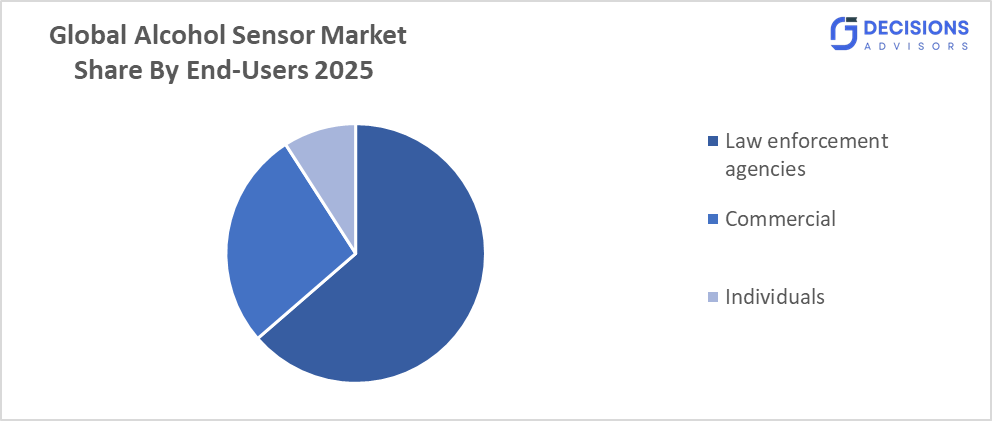
Based on the end-users, the alcohol sensor market is divided into law enforcement agencies, commercial, and individuals. Among these, the law enforcement agencies segment dominated the market in 2025, and is projected to grow at a substantial CAGR of approximately 58 % during the forecast period. This is due to widespread use of breath analyzers for roadside testing and regulatory enforcement. High adoption is driven by strict DUI laws, mandatory testing protocols, and government initiatives to improve road safety. Continuous demand from police departments and traffic authorities ensures consistent usage, making this segment the primary contributor to overall market revenue.
Strategies to Implement for Growth of the Market in Non-Leading Regions
Cost-effective product development, together with localization strategies, enables non-leading regions to achieve their growth objectives. The emerging markets with price-sensitive customers require companies to develop affordable alcohol sensors that they can easily transport. Local distributors, together with government agencies establish partnerships to enable companies to reach more customers while improving their distribution operations. Safety benefit education requires users to learn about safety advantages through training programs and awareness campaigns. Smart and connected technology investment enables organizations to overcome technical challenges while creating better user experiences. Companies can develop local service and support systems that enhance accessibility while they work with regulatory bodies to maintain compliance.
Regional Segment Analysis of the Alcohol Sensor Market
- North America (U.S., Canada, Mexico)
- Europe (Germany, France, U.K., Italy, Spain, Rest of Europe)
- Asia-Pacific (China, Japan, India, Rest of APAC)
- South America (Brazil and the Rest of South America)
- The Middle East and Africa (UAE, South Africa, Rest of MEA)
North America is anticipated to hold the largest share of the alcohol sensor market over the predicted timeframe.
North America is anticipated to hold the largest share of the alcohol sensor market over the predicted timeframe, accounting for approximately 41% of the global market. The region’s dominance is driven by strict drunk-driving regulations, strong enforcement by law enforcement agencies, and widespread adoption of breath analyzers and ignition interlock systems. The United States leads the region, contributing the majority of revenue due to advanced technological adoption and high awareness regarding road safety. Additionally, increasing integration of alcohol detection systems in vehicles and supportive government initiatives further strengthen market growth across North America.
Asia Pacific is expected to grow at a rapid CAGR in the alcohol sensor market during the forecast period.
Asia Pacific is expected to grow at a rapid CAGR of approximately 13% in the alcohol sensor market during the forecast period. This growth is driven by increasing vehicle production, rising road safety awareness, and stricter government regulations on drunk driving across countries such as China, India, and Japan. Expanding industrial sectors and growing adoption of workplace safety measures are further supporting demand. Additionally, rising investments in smart infrastructure and increasing penetration of advanced sensing technologies are accelerating market expansion. The region’s large population base and improving economic conditions also contribute significantly to sustained growth.
Europe is the 3rd largest region to grow in the alcohol sensor market during the region.
Europe is the third-largest region in the alcohol sensor market, accounting for approximately 27% of the global market share. Growth is driven by strict road safety regulations, low permissible blood alcohol limits, and widespread use of breath analyzers across countries such as Germany, the UK, and France. The region benefits from strong law enforcement systems and increasing adoption of alcohol detection technologies in automotive and industrial sectors. Additionally, government initiatives promoting road safety and workplace compliance continue to support steady market expansion across Europe.
Future Market Trends in Global Alcohol Sensor Market: -
1. Integration with Automotive Safety Systems
Alcohol sensors are increasingly integrated into vehicles through ignition interlock systems that prevent engine start if alcohol is detected. This trend supports stricter regulatory compliance, reduces road accidents, and enhances driver safety. Automakers are investing in embedded detection technologies to improve real-time monitoring and prevention.
2. Growth of Wearable Alcohol Monitoring Devices
Wearable alcohol sensors are gaining popularity for continuous and non-invasive monitoring of alcohol levels. These devices are widely used in healthcare, rehabilitation, and personal safety applications. They provide real-time data tracking, improve user awareness, and support remote monitoring, increasing adoption among individuals and medical professionals.
3. Advancements in Non-Contact Detection Technologies
Non-contact alcohol detection technologies, such as infrared and passive sensors, are improving convenience and usability. These systems eliminate the need for direct breath samples, enabling faster and hygienic detection. Advancements in accuracy and sensitivity are expanding their adoption in automotive, law enforcement, and public safety applications.
4. Expansion in Industrial Safety Applications
Industries are increasingly deploying alcohol sensors to maintain workplace safety and regulatory compliance, especially in hazardous environments like manufacturing and construction. These sensors help prevent accidents caused by impaired workers, ensure operational safety, and support organizational policies focused on employee health, safety standards, and risk management.
Recent Development
- In October?2025, a Michigan startup (ArborSense) developed a smartwatch?sized transdermal alcohol monitor that detects alcohol through the skin, offering a discreet wearable to replace bulky ankle devices and expand wearable monitoring applications.
- In April?2025, Dragerwerk AG launched the Alcotest?7000, a next?generation portable alcohol screening device for DUI enforcement, DOT compliance, and workplace safety, illustrating product innovation and expanding demand within the global alcohol sensor market.
- In April?2025, Alcolizer Druglizer LE5 launched as a handheld, fast?response electronic oral?fluid alcohol testing device, enhancing rapid screening capabilities and illustrating expanded demand within the global alcohol sensor market.
- In August?2023, SOBRsafe launched the SOBRsure wearable transdermal alcohol monitoring wristband, enabling fleet management, adolescent monitoring, and addiction treatment, illustrating continuous alcohol sensing applications and market expansion into wearable monitoring solutions.
Market Segment
This study forecasts revenue at global, regional, and country levels from 2020 to 2035. Decision Advisors has segmented the alcohol sensor market based on the below-mentioned segments:
Global Alcohol Sensor Market, By Technology
- Fuel Cell Technology
- Semiconductor Oxide Sensor Technology
- Others
Global Alcohol Sensor Market, By Application
- Vehicle Controlling
- Healthcare Application
Global Alcohol Sensor Market, By End-Users
- Law Enforcement Agencies
- Commercial
- Individuals
Global Alcohol Sensor Market, By Regional Analysis
- North America
- US
- Canada
- Mexico
- Europe
- Germany
- UK
- France
- Italy
- Spain
- Russia
- Rest of Europe
- Asia Pacific
- China
- Japan
- India
- South Korea
- Australia
- Rest of Asia Pacific
- South America
- Brazil
- Argentina
- Rest of South America
- Middle East & Africa
- UAE
- Saudi Arabia
- Qatar
- South Africa
- Rest of the Middle East & Africa
Frequently Asked Questions (FAQ)
Q. How do alcohol sensors differ from drug detection systems?
A. Alcohol sensors specifically measure ethanol concentration using breath, blood, or environmental analysis, while drug detection systems identify multiple substances through biochemical testing, making alcohol sensors faster and more suitable for real-time applications.
Q. What industries beyond automotive are adopting alcohol sensors?
A. Industries such as construction, mining, oil & gas, aviation, and manufacturing are adopting alcohol sensors to ensure workforce safety, reduce accident risks, and comply with occupational health regulations.
Q3. How often do alcohol sensors require calibration?
A. Calibration frequency depends on usage and sensor type, but most professional-grade devices require calibration every 6 to 12 months to maintain accuracy and compliance with regulatory standards.
Q4. Can alcohol sensors be integrated with mobile applications?
A. Yes, modern alcohol sensors can connect with smartphones via Bluetooth, enabling real-time monitoring, data tracking, and reporting through dedicated mobile applications.
Check Licence
Choose the plan that fits you best: Single User, Multi-User, or Enterprise solutions tailored for your needs.
We Have You Covered
- 24/7 Analyst Support
- Clients Across the Globe
- Tailored Insights
- Technology Tracking
- Competitive Intelligence
- Custom Research
- Syndicated Market Studies
- Market Overview
- Market Segmentation
- Growth Drivers
- Market Opportunities
- Regulatory Insights
- Innovation & Sustainability
Report Details
| Scope | Global |
| Pages | 245 |
| Delivery | PDF & Excel via Email |
| Language | English |
| Release | Apr 2026 |
| Access | Download from this page |