
Global Canthaxanthin Market
 |
Pages:
210
|
Pages:
210
Global Canthaxanthin Market Size, Share By Type (Synthetic Canthaxanthin, Natural Canthaxanthin), By Application (Animal Feed, Food & Beverages, Pharmaceuticals & Nutraceuticals, Cosmetics), By End User (Feed Manufacturers, Food Processing Industry, Pharmaceutical Companies, Cosmetic Industry), and By Region (North America, Europe, Asia-Pacific, Latin America, Middle East & Africa), Analysis and Forecast 2025?2035
REPORT COVERAGE
Global
Market Snapshot
- Global Canthaxanthin Market Size (2025): USD 119.5 Million
- Projected Global Canthaxanthin Market Size (2035): USD 231.1 Million
- Global Canthaxanthin Market Compound Annual Growth Rate (CAGR): 6.82%
- Largest Regional Market: Asia pacific
- 2nd Largest Region: North America
- Fastest Growing Region: Europe
- Base Year: 2025
- Historical Period: 2021–2024
- Forecast Period: 2026–2035
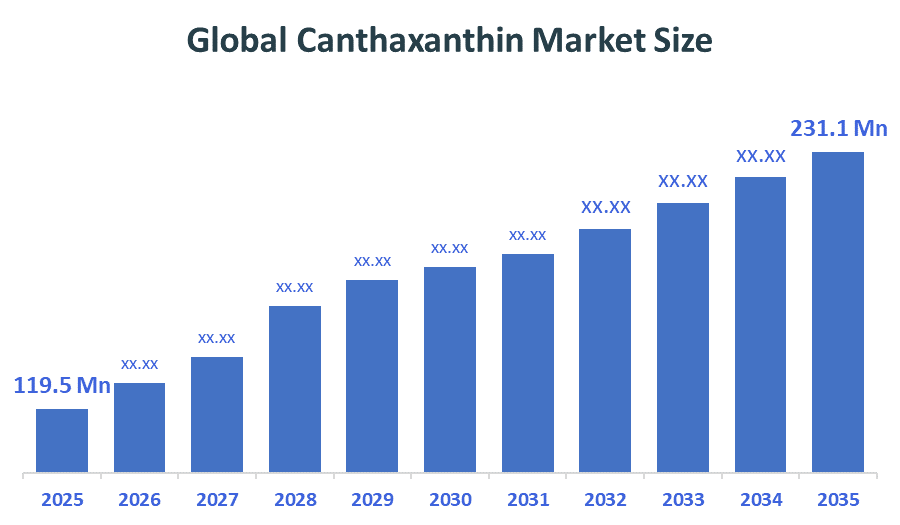
According to Decision Advisors, the Global Canthaxanthin Market Size is expected to grow from USD 119.5 Million in 2025 to USD 231.1 Million by 2035, at a CAGR of 6.82% during the forecast period 2025-2035. The Global Canthaxanthin Market is projected to grow significantly over the next decade. The growth is primarily driven by rising demand in animal feed, cosmetics, and nutraceutical applications, with steady expansion supported by increasing consumer awareness and regulatory approvals.
Market Overview/ Introduction
The global canthaxanthin market is defined as a keto-carotenoid used as a potent red-orange pigment and antioxidant, it is widely utilized to enhance the colour of egg yolks, salmon, and poultry skin. it helps to make food look more appetising and provides health benefits like skin and eye protection. This steady climb is being fuelled by a modern shift in consumer habits, more people are looking for clean-label products and natural additives in their food and supplements to keep up with this demand, big players like BASF and DSM-Firmenich are pouring a lot of heart and money into finding better ways to make this pigment. Even though lab-made versions have been the standard for years, these companies are shifting their focus toward more planet friendly methods. They are now looking at things like microalgae to pull that vibrant colour straight from nature, all to keep up with our growing desire for simpler, more natural ingredients in the food we eat. Looking forward, the real excitement is happening in the Asia-Pacific region. With massive growth in poultry and fish farming in countries like China and India, the demand for high-quality feed pigments is skyrocketing. The future of the market likely lies in microbial fermentation, a high-tech, eco-friendly way to grow the pigment in a lab, which promises to make natural canthaxanthin more affordable and sustainable for everyone.
- Health authorities like the EFSA and FDA are keeping a close watch, setting strict safety standards to ensure these additives remain healthy for consumers
- Governments offering grants to encourage greener manufacturing processes.
Notable Insights: -
- Asia Pacific is anticipated to hold the largest share, approximately 40% of the Global Canthaxanthin Market over the predicted timeframe.
- North America is expected to grow at a steady CAGR in the Global Canthaxanthin Market during the forecast period.
- By product type, the synthetic canthaxanthin segment dominated the market in 2025, and is projected to grow at a substantial CAGR of approximately 5.3% during the forecast period.
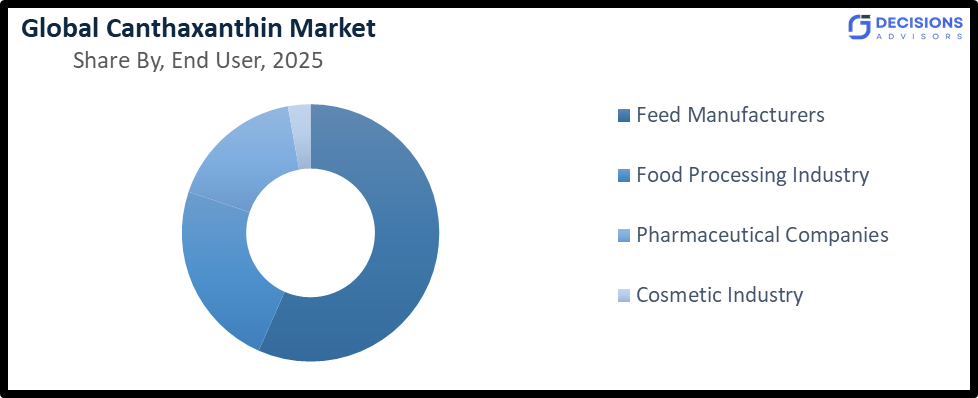
- By end user, the feed manufacturers segment dominated the market at a share of approximately 60% in 2025, and is projected to grow at a substantial CAGR during the forecast period.
- The compound annual growth rate of the global canthaxanthin market is 6.82%.
6. The market is likely to achieve a valuation of USD 231.1 Million by 2035.
What is the role of technology in grooming the market?
Technological advancements are improving synthetic production efficiency and purity levels of canthaxanthin. Innovations in fermentation-based natural carotenoid production are also gaining momentum. Microencapsulation technologies are enhancing stability, shelf life, and bioavailability, especially in feed and nutraceutical applications.
Market Drivers
A few big things are really pushing the canthaxanthin market forward right now, starting with our global appetite for high-quality protein. When we shop for salmon, trout, or chicken, we have come to expect a certain rich, healthy-looking colour, so farmers rely on this pigment to meet those expectations. But it’s not just about looking anymore, people are starting to realise it’s also a powerful antioxidant, which is opening up a whole new world for it in skin and eye health supplements. On top of that, there's a huge shift toward clean-label products, with more of us looking for natural, algae-based colours instead of lab-made ones. As fish and poultry farming get more advanced to keep up with the world’s needs, the demand for these reliable, high-performance additives just keeps growing.
Restrain
The canthaxanthin market faces several restraints, primarily due to stringent regulatory limitations on its usage in food and feed applications, as excessive intake may pose health risks. Additionally, the high production cost of natural canthaxanthin compared to synthetic variants limits its widespread adoption
Competitive Analysis:
The report offers the appropriate analysis of the key organizations/companies involved within the global canthaxanthin market, along with a comparative evaluation primarily based on their product of offering, business overviews, geographic presence, enterprise strategies, segment market share, and SWOT analysis. The report also provides an elaborative analysis focusing on the current news and developments of the companies, which includes product development, innovations, joint ventures, partnerships, mergers & acquisitions, strategic alliances, and others. This allows for the evaluation of the overall competition within the market.
Top Companies in the Global Canthaxanthin Market
- DSM-Firmenich AG
- BASF SE
- Allied Biotech Corporation
- Divi's Laboratories Limited
- Novus International
- Zhejiang Medicine Co., Ltd.
- Guangzhou Wisdom Bio-Technology Co., Ltd
- Novepha Company Limited
- Roha Dyechem Pvt Ltd
- Xi'an Wellgreen Technology Co., Ltd
Government Initiatives
|
Country |
Key Government Initiatives |
|
India |
The FEEDACTIV project received about €1.44 million in EU funding for developing functional fish feed using bioactive compounds, including carotenoids
|
|
US |
The Food and Drug Administration (FDA) regulates canthaxanthin under the 21 CFR 73.75 guidelines. It is approved for use in general foods (up to 30 mg/lb) and specific animal feeds, such as salmonid fish (up to 80 mg/kg) and broiler chickens. However, the FDA strictly prohibits its use in oral-tanning products. |
|
UK |
Government-backed sustainable aquaculture initiatives, such as UKRI’s £12 million funding program (2024–2025), are promoting the development of functional and efficient aquafeeds. This is expected to indirectly boost demand for feed additives like canthaxanthin, which are widely used to enhance fish pigmentation, health, and overall feed performance. |
Study on the Supply, Demand, Distribution, and Market Environment of the Global Canthaxanthin Market
The global canthaxanthin market is characterized by a stable supply driven mainly by synthetic production, with limited contribution from natural sources. Demand is largely fueled by the animal feed industry, particularly poultry and aquaculture, along with growing applications in nutraceuticals and cosmetics. Distribution channels include direct supply to feed manufacturers, ingredient distributors, and international trade networks. The overall market environment remains positive due to rising protein consumption, expansion of aquaculture industries, and increasing awareness of carotenoids, although it is influenced by regulatory frameworks and cost pressures.
Price Analysis and Consumer Behaviour Analysis
The price of canthaxanthin varies significantly based on its type, purity, and production method, with synthetic variants typically ranging between USD 300-700 per kg, while natural canthaxanthin commands substantially higher prices due to complex extraction processes and limited availability. Price fluctuations are influenced by raw material costs, regulatory compliance, and production efficiency. From a consumer behavior perspective, buyers primarily feed manufacturers and industrial users prioritize product consistency, color intensity, and regulatory approval over price alone. However, there is a growing shift toward natural and sustainable ingredients, especially in nutraceuticals and cosmetics, where consumers are willing to pay a premium for clean-label and naturally derived products.
Market Segmentation
The Global Canthaxanthin Market share is classified into product type, application and end user.
- The synthetic canthaxanthin segment dominated the market in 2025, and is projected to grow at a substantial CAGR of approximately 5.3% during the forecast period.
Based on the product type, the global canthaxanthin market is divided into synthetic canthaxanthin and natural canthaxanthin. Among these, the synthetic canthaxanthin segment dominated the market in 2025, and is projected to grow at a substantial CAGR of approximately 5.3% during the forecast period. It is attributed to its cost-effectiveness, consistent quality, and large-scale availability compared to natural variants. Additionally, synthetic canthaxanthin is widely used in animal feed applications due to its stability and ability to deliver uniform pigmentation in poultry and aquaculture products, making it the preferred choice for commercial producers.
- The animal feed segment accounted for the largest share in 2025, and is anticipated to grow at a significant CAGR of approximately 5.7% during the forecast period.
Based on the application, the global canthaxanthin market is divided into animal feed, food & beverages, pharmaceuticals & nutraceuticals, and cosmetics. Among these, the animal feed segment accounted for the largest share in 2025, and is anticipated to grow at a significant CAGR of approximately 5.7% during the forecast period. It is attributed to the extensive use of canthaxanthin as a pigmentation agent in poultry and aquaculture to enhance the color of egg yolks, chicken skin, and fish flesh. The increasing global demand for high-quality animal protein and visually appealing food products is further driving the adoption of canthaxanthin in this segment.
- The feed manufacturers segment dominated the market at a share of approximately 60% in 2025, and is projected to grow at a substantial CAGR during the forecast period.
Based on the end user, the global canthaxanthin market is divided into feed manufacturers, food processing industry, pharmaceutical companies, and cosmetic industry. Among these, the feed manufacturers segment dominated the market at a share of approximately 60% in 2025, and is projected to grow at a substantial CAGR during the forecast period. It is attributed to the large-scale consumption of canthaxanthin in the production of fortified animal feed. Additionally, the growing poultry and aquaculture industries, along with increasing demand for efficient feed additives, are driving segment growth. Food processing and nutraceutical segments are also emerging steadily due to rising demand for natural colorants and antioxidant-rich products.
Strategies to Implement for Growth of the Market in Non-Leading Regions
Growth in non-leading regions of the global canthaxanthin market can be achieved by focusing on cost-effective production, expanding distribution networks, and increasing awareness of its benefits across key industries. Companies should invest in local partnerships with feed manufacturers and aquaculture farms to strengthen market penetration. Establishing regional production or blending facilities can help reduce costs and improve supply reliability. Additionally, promoting the use of canthaxanthin in emerging applications such as nutraceuticals and cosmetics, along with educating consumers and industries about its advantages, can further drive demand in regions like Latin America, the Middle East, and Africa.
Regional Segment Analysis of the Global Canthaxanthin Market
- North America (U.S., Canada, Mexico)
- Europe (Germany, France, U.K., Italy, Spain, Rest of Europe)
- Asia-Pacific (China, Japan, India, Rest of APAC)
- South America (Brazil and the Rest of South America)
- The Middle East and Africa (UAE, South Africa, Rest of MEA)
Asia Pacific is anticipated to hold the largest share, approximately 40% of the Global Canthaxanthin Market over the predicted timeframe.
Asia Pacific is anticipated to hold the largest share, approximately 40% of the Global Canthaxanthin Market over the predicted timeframe. The region dominates due to its strong presence in poultry and aquaculture industries, where canthaxanthin is widely used as a feed additive for pigmentation. Countries such as China, India, and Vietnam are major contributors, supported by large-scale livestock production and increasing seafood consumption. Additionally, the availability of low-cost manufacturing and raw materials strengthens regional supply capabilities. Government initiatives promoting aquaculture and rising demand for high-quality animal protein further boost market growth. For instance, in 2025, several aquaculture producers in Southeast Asia expanded feed usage of carotenoids, including canthaxanthin, to improve product quality and export value.
North America is expected to grow at a steady CAGR in the Global Canthaxanthin Market during the forecast period.
North America is expected to grow at a steady CAGR in the Global Canthaxanthin Market during the forecast period. The growth is driven by strong demand from the animal feed and nutraceutical industries, particularly in the United States. The region benefits from advanced production technologies, strict regulatory frameworks, and high consumer awareness regarding food quality and safety. Increasing consumption of poultry products and farmed fish, along with the rising popularity of dietary supplements containing carotenoids, is supporting market expansion. Additionally, the presence of major market players and continuous research and development activities contribute to innovation and product quality improvements.
Europe is the third largest region in the Global Canthaxanthin Market during the forecast period.
Europe is the third largest region in the Global Canthaxanthin Market during the forecast period. The region is characterised by stringent regulatory standards and a strong preference for safe and natural food additives. Increasing demand for clean-label and naturally derived ingredients is influencing the adoption of canthaxanthin, particularly in food and cosmetics applications. The market is also supported by a well-established aquaculture sector and the growing use of carotenoids in nutraceuticals. Additionally, rising awareness regarding antioxidant benefits and sustainable sourcing practices is encouraging manufacturers to invest in natural canthaxanthin production. In 2025, several European companies focused on developing bio-based carotenoid solutions to align with sustainability goals and regulatory requirements.
Future Market Trends in the Global Canthaxanthin Market: -
1. Shift Toward Natural and Sustainable Carotenoids
There is a growing preference for naturally derived canthaxanthin driven by clean-label trends and sustainability concerns. Manufacturers are increasingly investing in bio-based production methods such as fermentation to meet consumer demand for eco-friendly and safe ingredients.
2. Expansion of Aquaculture and Animal Feed Industry
The rising global demand for seafood and poultry products is significantly boosting the use of canthaxanthin as a pigmentation additive. Rapid growth in aquaculture, especially in Asia-Pacific, is expected to remain a key driver for future market expansion.
3. Increasing Adoption in Nutraceuticals and Cosmetics
Canthaxanthin is gaining traction in nutraceutical and cosmetic applications due to its antioxidant properties and potential skin health benefits. Growing consumer awareness regarding health and wellness is encouraging its use in dietary supplements and personal care products.
Recent Development
- In January 2026, A study published in Scientific Reports reported that the use of purple LED light (410–420 nm) combined with crude glycerol (a biodiesel byproduct) significantly enhanced the production of carotenoids, including canthaxanthin, in Aurantiochytrium limacinum. The research demonstrated that optimized light conditions and low-cost carbon sources can boost yield while reducing production costs, offering a more sustainable and commercially viable approach for large-scale canthaxanthin production.
- In October 2025, The European Commission approved the modified authorization of canthaxanthin as a feed additive for ornamental fish, following a positive safety evaluation by EFSA. The update included the acceptance of a new production method using fermentation with Yarrowia lipolytica, confirming that the additive is safe for animals, consumers, and the environment under approved conditions.
- In September 2025, Researchers published a study demonstrating the successful upregulation of canthaxanthin biosynthesis using Paracoccus bogoriensis through a sustainable fermentation strategy in a laboratory-scale bioreactor. The study highlighted improved production efficiency and emphasized the potential of biotechnology-based methods as a sustainable alternative to conventional chemical synthesis.
- In August 2025, Researchers published a study demonstrating the successful use of metabolically engineered plant cell cultures (Nicotiana tabacum) as biofactories for canthaxanthin production. The study showed that genetic modification significantly increased canthaxanthin yield up to 788 µg/g dry weight, highlighting a scalable and sustainable alternative to traditional chemical synthesis and natural extraction methods.
How are recent developments helping the Market?
Recent developments in the global canthaxanthin market are playing a crucial role in improving product efficiency, expanding applications, and ensuring sustainable growth. Innovations in formulation technologies, such as microencapsulation, are enhancing pigment stability and bioavailability, making canthaxanthin more effective in animal feed, nutraceuticals, and cosmetic products. Additionally, the shift toward biotechnology-based production and natural carotenoids is helping companies meet growing demand for clean-label and sustainable ingredients. A key real-world example is the continuous innovation by major players like BASF and DSM, which have introduced advanced carotenoid formulations and invested in bio-based production methods to improve product quality and expand applications in food, feed, and supplements. These developments not only enhance product performance but also reduce environmental impact and production costs over time
Market Segment
This study forecasts revenue at global, regional, and country levels from 2020 to 2035. Decision Advisors has segmented the global canthaxanthin market based on the below-mentioned segments:
Global Canthaxanthin Market, By Product Type
- Synthetic Canthaxanthin
- Natural Canthaxanthin
Global Canthaxanthin Market, By Application
- Animal Feed
- Food & Beverages
- Pharmaceuticals & Nutraceuticals
- Cosmetics
Global Canthaxanthin Market, By End User
- Feed Manufacturers
- Food Processing Industry
- Pharmaceutical Companies
- Cosmetic Industry
Global Canthaxanthin Market, By Regional Analysis
- North America
- US
- Canada
- Mexico
- Europe
- Germany
- UK
- France
- Italy
- Spain
- Russia
- Rest of Europe
- Asia Pacific
- China
- Japan
- India
- South Korea
- Australia
- Rest of Asia Pacific
- South America
- Brazil
- Argentina
- Rest of South America
- Middle East & Africa
- UAE
- Saudi Arabia
- Qatar
- South Africa
- Rest of the Middle East & Africa
Frequently Asked Questions (FAQ)
Q. What are the key raw materials used in the production of canthaxanthin?
A. Canthaxanthin is primarily produced through chemical synthesis using petrochemical derivatives, while natural variants are derived from microorganisms, algae, or certain bacteria through fermentation processes.
Q. How does canthaxanthin impact the shelf life of animal products?
A. Canthaxanthin acts as an antioxidant, which can help improve the oxidative stability of animal products like eggs and fish, thereby slightly enhancing their shelf life and quality.
Q. What are the major challenges in producing natural canthaxanthin at scale?
A. The key challenges include high production costs, lower yield compared to synthetic methods, complex extraction processes, and maintaining consistent quality during large-scale fermentation.
Q. How is canthaxanthin stored and handled in industrial applications?
A. Canthaxanthin is typically stored in cool, dry conditions away from light and oxygen to prevent degradation, and is often stabilized using coating or encapsulation techniques for longer shelf life.
Q. Which emerging technologies are expected to disrupt the canthaxanthin market?
A. Technologies such as precision fermentation, synthetic biology, and advanced microencapsulation are expected to significantly improve production efficiency, sustainability, and product performance in the coming years.
Check Licence
Choose the plan that fits you best: Single User, Multi-User, or Enterprise solutions tailored for your needs.
We Have You Covered
- 24/7 Analyst Support
- Clients Across the Globe
- Tailored Insights
- Technology Tracking
- Competitive Intelligence
- Custom Research
- Syndicated Market Studies
- Market Overview
- Market Segmentation
- Growth Drivers
- Market Opportunities
- Regulatory Insights
- Innovation & Sustainability
Report Details
| Scope | Global |
| Pages | 210 |
| Delivery | PDF & Excel via Email |
| Language | English |
| Release | Apr 2026 |
| Access | Download from this page |