
Global Corneal Surgery Devices Market
 |
Pages:
210
|
Pages:
210
Global Corneal Surgery Devices Market Size, Share By Product Type (Diagnostic Devices, Surgical Devices, Vision Care Devices), By Transplantation Type (Penetrating Keratoplasty, Deep Anterior Lamellar Keratoplasty (DALK), Endothelial Keratoplasty, Artificial Corneas/Keratoprosthesis), By Application (Corneal Transplantation, Refractive Surgery, Corneal Disorders & Infections, Trauma & Injury), By End User (Hospitals, Ophthalmic Clinics, Ambulatory Surgical Centers, Academic & Research Institutes) and By Region (North America, Europe, Asia-Pacific, Latin America, Middle East & Africa), Analysis and Forecast 2025?2035
REPORT COVERAGE
Global
Market Snapshot
- Global Corneal Surgery Devices Market Size (2025): USD 6.54 Billion
- Projected Global Corneal Surgery Devices Market Size (2035): USD 13.6 Billion
- Global Corneal Surgery Devices Market Compound Annual Growth Rate (CAGR): 7.6%
- Largest Regional Market: North America
- 2nd Largest Region: Europe
- Fastest Growing Region: Asia-Pacific
- Base Year: 2025
- Historical Period: 2021–2024
- Forecast Period: 2026–2035
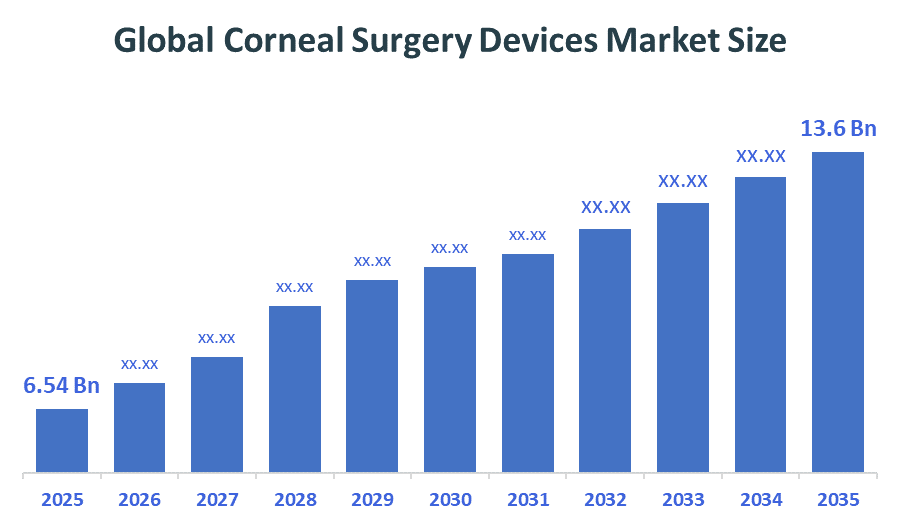
According to Decision Advisors, the Global Corneal Surgery Devices Market Size is expected to grow from USD 6.54 Billion in 2025 to USD 13.6 Billion by 2035, at a CAGR of 7.6% during the forecast period 2025-2035. The Global Corneal Surgery Devices Market is projected to grow significantly over the next decade. The growth is primarily driven by the increasing demand for minimally invasive ophthalmic procedures and continuous advancements in laser-based and image-guided surgical technologies.
Market Overview/ Introduction
The corneal surgery devices market is a rapidly evolving sector of ophthalmology focused on high-precision instruments, laser systems, and implants designed to treat corneal diseases, trauma, and refractive errors. Its growth is primarily driven by an aging global population and the rising prevalence of conditions like keratoconus and severe myopia. Industry leaders are pushing the boundaries of innovation; Alcon is pioneering corneal cell therapies, while ZEISS and Johnson & Johnson Vision have introduced advanced laser platforms that automate complex procedures for greater surgical consistency. Looking ahead, the real game-changer is the move toward synthetic and bioengineered corneas. This could finally end our long-standing struggle with donor tissue shortages. When you add AI-powered diagnostics and robotic precision into the mix, market is looking at a future where complex eye surgeries are not only faster and safer but truly accessible to everyone, everywhere. These high-tech leaps are being backed by major global and local efforts. Groups like the WHO, through their SPECS 2030 initiative, and India’s National Programme for Control of Blindness are working hard to ensure these advanced treatments actually reach the people who need them most, regardless of where they live.
- Femtosecond laser-based devices account for over 30% share in corneal surgeries due to their precision and increasing use in minimally invasive procedures.
- Keratoconus, a major corneal disorder, affects approximately 1 in 2,000 people globally, contributing to increasing surgical demand.
Notable Insights: -
- North America is anticipated to hold approximately 39% share of the Global Corneal Surgery Devices Market over the predicted timeframe.
- Europe is expected to grow at a rapid CAGR in the Global Corneal Surgery Devices Market by holding approximately 27% of the share during the forecast period.
- By product type, the diagnostic & surgical devices segment dominated the market and holds approximately 48% share in 2025, and is projected to grow at a substantial CAGR during the forecast period.
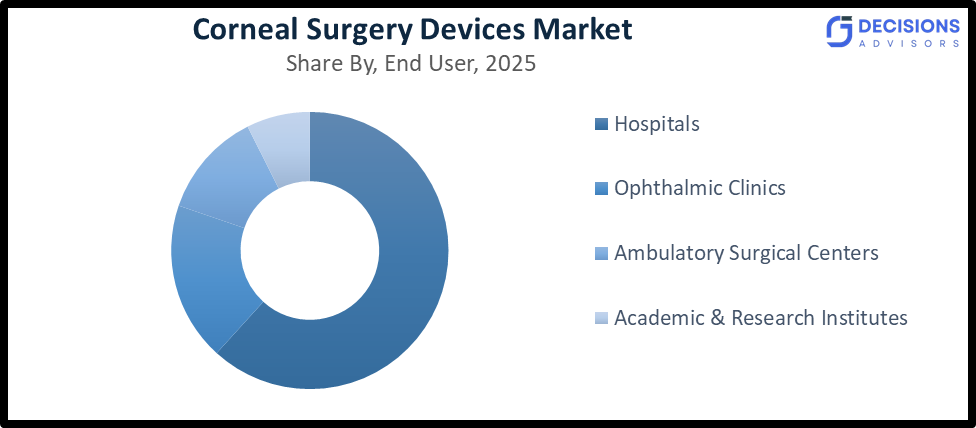
- By end user, the hospitals segment dominates the market, accounting for approximately 50% share.
- The compound annual growth rate of the Global Corneal Surgery Devices Market is 7.6%.
6. The market is likely to achieve a valuation of USD 13.6 Billion by 2035.
What is the role of technology in grooming the market?
Technology is revolutionizing corneal surgery through precision-based tools such as femtosecond lasers that allow bladeless surgeries. These systems improve accuracy in corneal incisions and flap creation, reducing complications by over 30%. Advanced corneal imaging systems, including optical coherence tomography (OCT) and corneal topography, provide real-time visualization, improving surgical planning. AI-powered diagnostic tools help in the early detection of corneal disorders, enabling timely interventions. Robotic-assisted microsurgery and customized laser ablation profiles are further enhancing outcomes, making procedures safer and more predictable.
Market Drivers
The main reason this is taking off is that more people are dealing with corneal blindness it now accounts for nearly 5% of blindness worldwide. We’re seeing a surge in things like infections, keratoconus, and basic refractive errors, all of which are driving the need for surgery. At the same time, procedures like LASIK have become huge because they’re fast and reliable; most people are back to their normal routine in just a day or two. When you add in the fact that the global population is getting older and healthcare spending is up, it makes sense why more people are turning to these advanced surgical tools to get their vision back.
Restrain
The market faces challenges such as the high cost of advanced laser systems, which can exceed USD 500,000, limiting adoption in developing regions. Lack of skilled ophthalmic surgeons and limited access to specialized eye care facilities also hinder growth. Furthermore, risks associated with surgical complications, such as infection or graft rejection in corneal transplants, may restrain adoption.
Competitive Analysis:
The report offers the appropriate analysis of the key organizations/companies involved within the global corneal surgery devices market, along with a comparative evaluation primarily based on their product of offering, business overviews, geographic presence, enterprise strategies, segment market share, and SWOT analysis. The report also provides an elaborative analysis focusing on the current news and developments of the companies, which includes product development, innovations, joint ventures, partnerships, mergers & acquisitions, strategic alliances, and others. This allows for the evaluation of the overall competition within the market.
Top Companies in the Global Corneal Surgery Devices Market
- Alcon Inc.
- Johnson & Johnson Vision
- Carl Zeiss Meditec AG
- Bausch-Lomb Corporation
- NIDEK Co., Ltd.
- Ziemer Ophthalmic Systems
- Topcon Corporation
- Haag-Streit Group
- EssilorLuxottica
- STAAR Surgical Company
Government Initiatives
|
Country |
Key Government Initiatives |
|
India |
As of March 2026, India has 396 functional eye banks. The government provides financial assistance for procuring sophisticated modern ophthalmic equipment, ranging from diagnostic tools like OCT scanners to surgical laser systems. |
|
US |
the NEI is being funded as a standalone entity with a budget of approximately $898.8 million. This supports over 1,200 research project grants, focusing on regenerative medicine and bio-engineered tissues for corneal repair. |
|
Europe |
General Ophthalmic Services (GOS) Uplift: Effective April 2025, the government implemented a 2.5% increase in sight test fees to help community practices modernise and adopt better diagnostic equipment. |
Study on the Supply, Demand, Distribution, and Market Environment of the Global Corneal Surgery Devices Market
The market demonstrates strong demand due to increasing surgical procedures and awareness about vision correction. Supply is supported by continuous innovation in laser systems and surgical tools. Hospitals, ophthalmic clinics, and ambulatory surgical centers are primary distribution channels. Favorable reimbursement policies in developed regions and increasing private healthcare investments are improving market accessibility.
Price Analysis and Consumer Behaviour Analysis
Corneal surgery devices, especially laser systems, are premium-priced due to technological complexity. However, healthcare providers prefer them due to improved patient outcomes and reduced complication rates. Patients increasingly opt for minimally invasive procedures, prioritizing faster recovery and long-term vision correction benefits.
Market Segmentation
The Global Corneal Surgery Devices Market share is classified into product type, transplantation type, application and end user.
- The diagnostic & surgical devices segment dominated the market and holds approximately 48% share in 2025, and is projected to grow at a substantial CAGR during the forecast period.
Based on the product type, the Global Corneal Surgery Devices Market is divided into diagnostic devices, surgical devices, and vision care devices. Among these, the diagnostic & surgical devices segment dominated the market and holds approximately 48% share in 2025, and is projected to grow at a substantial CAGR during the forecast period. This dominance is Due to the increasing adoption of advanced imaging systems such as corneal topographers, OCT systems, and femtosecond laser platforms. These technologies enhance surgical accuracy and reduce complications. Vision care devices are also witnessing steady growth due to increasing demand for corrective solutions such as contact lenses and post-surgical care devices. However, their share remains comparatively lower as they are primarily used for supportive care rather than surgical intervention.
- The penetrating keratoplasty segment accounted for the largest share in 2025 and is anticipated to grow at a significant CAGR during the forecast period.
Based on the transplantation type, the Global Corneal Surgery Devices Market is divided into Penetrating Keratoplasty, Deep Anterior Lamellar Keratoplasty (DALK), Endothelial Keratoplasty and Artificial Corneas / Keratoprosthesis. Among these, the penetrating keratoplasty segment accounted for the largest share in 2025 and is anticipated to grow at a significant CAGR during the forecast period. It remains the traditional and widely performed full-thickness corneal transplant procedure. However, endothelial keratoplasty and DALK are the fastest-growing segments due to their minimally invasive nature and reduced recovery time. Advancements in lamellar transplantation techniques are improving graft survival rates by over 25%, driving adoption. Artificial corneas (keratoprosthesis) are also gaining traction, especially in cases where donor tissue availability is limited.
- The refractive surgery segment dominated the market and holds approximately 55% share in 2025 and is projected to grow at a substantial CAGR during the forecast period.
Based on application, the Global Corneal Surgery Devices Market is divided into Corneal Transplantation, Refractive Surgery, Corneal Disorders and Infections, Trauma & Injury. Among those, the refractive surgery segment dominated the market and holds approximately 55% share in 2025 and is projected to grow at a substantial CAGR during the forecast period. This is driven by the increasing demand for LASIK and PRK procedures globally. Corneal transplantation remains a key application area due to the rising burden of corneal blindness. Additionally, increasing cases of infections such as keratitis and corneal ulcers are boosting demand for surgical interventions. The trauma & injury segment is also growing steadily due to rising incidences of eye injuries and accidents worldwide.
- The hospitals segment dominates the market, accounting for approximately 50% share.
Based on end user, the Global Corneal Surgery Devices Market is divided into Hospitals, Ophthalmic Clinics, Ambulatory Surgical Centers, Academic & Research Institutes. Among those, the hospitals segment dominates the market, accounting for approximately 50% share. This is due to the availability of advanced surgical infrastructure and skilled ophthalmologists. Ophthalmic clinics are the second-largest segment, driven by increasing preference for specialized eye care centers. Ambulatory surgical centers (ASCs) are witnessing the fastest growth due to the shift toward outpatient procedures and cost-effective treatments. Academic and research institutes contribute to innovation and clinical trials, supporting long-term market growth.
Strategies to Implement for Growth of the Market in Non-Leading Regions
Market players should focus on developing cost-effective corneal surgery devices to improve affordability and adoption in emerging regions. Expanding training programs for ophthalmologists and strengthening partnerships with local healthcare providers can enhance procedural capabilities. Additionally, increasing awareness campaigns for vision correction and corneal diseases, along with investments in portable and compact surgical technologies, will help improve accessibility and drive market penetration in non-leading regions.
Regional Segment Analysis of the Global Corneal Surgery Devices Market
- North America (U.S., Canada, Mexico)
- Europe (Germany, France, U.K., Italy, Spain, Rest of Europe)
- Asia-Pacific (China, Japan, India, Rest of APAC)
- South America (Brazil and the Rest of South America)
- The Middle East and Africa (UAE, South Africa, Rest of MEA)
North America is anticipated to hold approximately 39% share of the global corneal surgery devices market over the predicted timeframe.
North America is anticipated to hold approximately 39% share of the global corneal surgery devices market over the predicted timeframe. It maintains dominant market leadership due to a well-established ophthalmic healthcare infrastructure, a high volume of corneal and refractive surgeries, and strong adoption of advanced laser-based technologies such as femtosecond and excimer lasers. The United States is the key driver, supported by high healthcare expenditure and the increasing prevalence of vision disorders, including refractive errors and corneal diseases. Additionally, the growing adoption of minimally invasive procedures such as LASIK, PRK, and endothelial keratoplasty across hospitals and specialty eye clinics further strengthens regional demand. The presence of leading ophthalmic device manufacturers and continuous technological advancements also contribute significantly to market growth.
Europe is expected to grow at a rapid CAGR in the global corneal surgery devices market by holding approximately 27% of the share during the forecast period.
Europe is expected to grow at a rapid CAGR in the global corneal surgery devices market by holding approximately 27% of the share during the forecast period. Europe’s market is supported by advanced healthcare systems, favorable reimbursement policies, and increasing adoption of minimally invasive ophthalmic procedures. Key countries such as Germany, France, and the United Kingdom emphasize early diagnosis and treatment of eye disorders, contributing to increased surgical volumes. Additionally, rising investments in healthcare infrastructure, growing awareness about vision correction procedures, and the increasing demand for corneal transplantation are driving steady market growth across the region.
Asia Pacific is the fastest-growing region in the corneal surgery devices market during the period, holding approximately 24% share.
Asia Pacific is the fastest-growing region in the corneal surgery devices market during the period, holding approximately 24% share. This growth is driven by rising healthcare investments, increasing prevalence of visual impairments and corneal diseases, and improving access to ophthalmic care. Countries such as China, India, and Japan are witnessing significant growth due to large patient populations and expanding healthcare infrastructure. Government initiatives to reduce blindness, increasing number of eye care centers, and growing medical tourism for affordable vision correction procedures are further contributing to the rising demand and overall market expansion in the region.
Future Market Trends in the Global Corneal Surgery Devices Market: -
1. Rapid Shift Toward Minimally Invasive & Laser-Assisted Procedures
The market is witnessing a strong transition from conventional surgical methods to minimally invasive, laser-assisted procedures such as LASIK, SMILE, and advanced keratoplasty techniques. Technologies like femtosecond and excimer lasers are improving surgical precision and reducing complication rates by over 25–30%. These procedures also shorten recovery time by nearly 40–50%, making them highly preferred among patients and surgeons. This shift is expected to significantly drive demand for advanced corneal surgery devices over the forecast period.
2. Integration of AI and Advanced Imaging Technologies
Artificial intelligence (AI) and high-resolution imaging systems such as optical coherence tomography (OCT) and corneal topography are transforming diagnosis and surgical planning. AI-driven tools enable early detection of corneal disorders and enhance decision-making accuracy. These technologies improve surgical outcomes, reduce human error, and increase procedural efficiency by nearly 20–25%, making them a key future growth driver in the market.
3. Growing Adoption of Bioengineered Corneas and Keratoprosthesis
The increasing shortage of donor corneas is accelerating the development and adoption of artificial corneas (keratoprosthesis) and bioengineered corneal tissues. These innovations offer alternative solutions for patients unsuitable for traditional transplants. Advancements in regenerative medicine and tissue engineering are expected to revolutionize corneal transplantation, improving success rates and expanding treatment accessibility globally.
Recent Development
- In September 2025, Alcon announced the launch of its WaveLight Plus, the first fully personalized LASIK treatment, marking a major breakthrough in refractive surgery technology.
- In August 2025, Iantrek, Inc. announced that it secured 42 million in a Series C funding round to support the upcoming commercial launch of its innovative glaucoma treatment technology.
- In July 2025, Ziemer USA, in partnership with CorneaGen, announced the launch of the GALILEI CTAK module for its GALILEI diagnostic platform, marking a significant advancement in corneal surgery technology.
- In March 2025, Alcon, a global leader in eye care, strengthened its cataract surgery portfolio with the introduction of its advanced Clareon intraocular lens (IOL) portfolio in India. The newly launched lenses are designed to provide enhanced visual clarity, long-term stability, and improved refractive outcomes for patients undergoing cataract surgery.
How is Recent Developments Helping the Market?
Recent developments in the global corneal surgery devices market are significantly enhancing surgical precision, expanding treatment accessibility, and improving patient outcomes, thereby accelerating overall market growth. Technological advancements such as the introduction of next-generation femtosecond lasers are enabling highly precise corneal incisions and customized refractive procedures. These innovations reduce surgical complications and improve visual outcomes, with studies indicating improved accuracy and patient satisfaction in laser-assisted surgeries. Additionally, the integration of AI-enabled surgical planning and advanced imaging systems is transforming pre-operative diagnostics and intraoperative decision-making. These tools enhance procedural efficiency by nearly 20–25%, reduce human error, and enable personalized treatment approaches, making surgeries safer and more predictable.
Market Segment
This study forecasts revenue at global, regional, and country levels from 2020 to 2035. Decision Advisors has segmented the global corneal surgery devices market based on the below-mentioned segments:
Global Corneal Surgery Devices Market, By Product Type
- Diagnostic Devices
- Surgical Devices
- Vision Care Devices
Global Corneal Surgery Devices Market, By Transplantation Type
- Penetrating Keratoplasty
- Deep Anterior Lamellar Keratoplasty (DALK)
- Endothelial Keratoplasty
- Artificial Corneas / Keratoprosthesis
Global Corneal Surgery Devices Market, By Application
- Corneal Transplantation
- Refractive Surgery
- Corneal Disorders & Infections
- Trauma & Injury
Global Corneal Surgery Devices Market, By End User
- Hospitals
- Ophthalmic Clinics
- Ambulatory Surgical Centers
- Academic & Research Institutes
Global Corneal Surgery Devices Market, By Regional Analysis
- North America
- US
- Canada
- Mexico
- Europe
- Germany
- UK
- France
- Italy
- Spain
- Russia
- Rest of Europe
- Asia Pacific
- China
- Japan
- India
- South Korea
- Australia
- Rest of Asia Pacific
- South America
- Brazil
- Argentina
- Rest of South America
- Middle East & Africa
- UAE
- Saudi Arabia
- Qatar
- South Africa
- Rest of the Middle East & Africa
Frequently Asked Questions (FAQ)
Q. How does corneal thickness impact the choice of surgical procedure?
A. Corneal thickness plays a critical role in determining eligibility for procedures like LASIK or PRK. Patients with thinner corneas are often recommended alternative treatments such as SMILE or implantable lenses to avoid complications.
Q. What is the average lifespan of corneal surgery devices such as femtosecond lasers?
A. High-end corneal surgery devices typically have a lifespan of 7–10 years, depending on usage, maintenance, and technological upgrades, with regular servicing required to maintain accuracy.
Q. How does the availability of donor corneas affect market dynamics?
A. Limited availability of donor corneas can restrict the number of transplant procedures, thereby increasing the demand for artificial corneas and alternative treatment technologies.
Q. What role do outpatient settings play in corneal surgeries?
A. Outpatient and ambulatory surgical centers are increasingly performing corneal procedures due to reduced costs, faster patient turnover, and advancements in minimally invasive techniques.
Q. How are emerging markets addressing the shortage of skilled ophthalmic surgeons?
A.Emerging economies are investing in specialized training programs, teleophthalmology, and international collaborations to improve the availability of skilled professionals and expand access to advanced eye care.
Check Licence
Choose the plan that fits you best: Single User, Multi-User, or Enterprise solutions tailored for your needs.
We Have You Covered
- 24/7 Analyst Support
- Clients Across the Globe
- Tailored Insights
- Technology Tracking
- Competitive Intelligence
- Custom Research
- Syndicated Market Studies
- Market Overview
- Market Segmentation
- Growth Drivers
- Market Opportunities
- Regulatory Insights
- Innovation & Sustainability
Report Details
| Scope | Global |
| Pages | 210 |
| Delivery | PDF & Excel via Email |
| Language | English |
| Release | Apr 2026 |
| Access | Download from this page |