
Global Dextrose Injection Market
 |
Author:
David J
|
Pages:
210
|
Author:
David J
|
Pages:
210
Global Dextrose Injection Market Size, Share, By Product Type (5% Dextrose Injection, 10% Dextrose Injection, 50% Dextrose Injection, 70% Dextrose Injection), By Application (Hypoglycemia Treatment, Dehydration & Fluid Replacement, Parenteral Nutrition), By Distribution Channel (Hospital Pharmacies, Government Procurement/Tenders, Wholesale Distributors, Online Pharmacies), and By Region (North America, Europe, Asia-Pacific, Latin America, Middle East & Africa), Analysis and Forecast 2026?2035
CAGR
5.95%
REVENUE 2025
USD Million 13131.55
FORECAST 2035
USD Million 23399.66
REPORT COVERAGE
Global
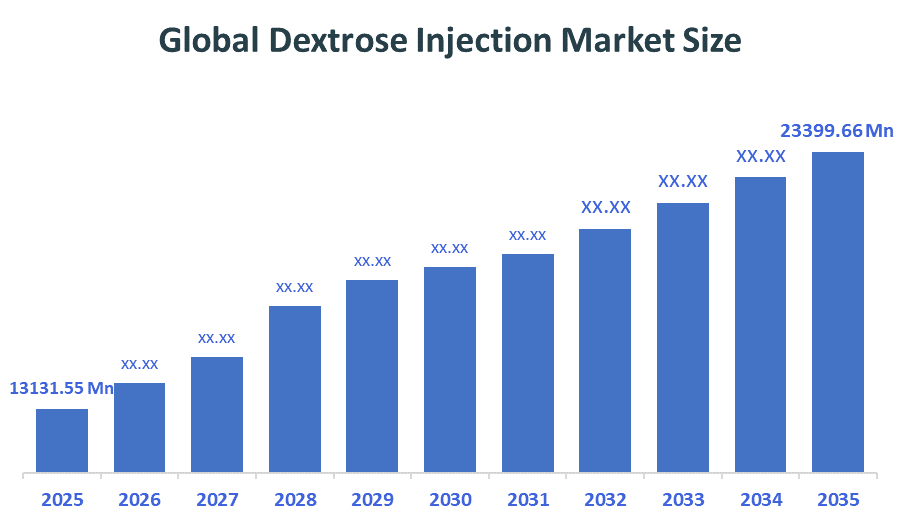
The Global Dextrose Injection Market size is forecast to grow from USD 13131.55 Million in 2025 to approximately USD 23399.66 Million by 2035. According to Decision Advisors, a detailed research report on the dextrose injection market indicates that the shift to non?PVC/DEHP?free IV bags and ready?to?use (RTU) IV containers dominates the market, accounting for approximately 75-80% of the total share globally. Baxter leads the market with an estimated 35-40% global market share. The company reported a 2025 revenue of approximately USD 4.5-5 billion, making it one of the most influential forces shaping industry trends and overall market growth.
Market Snapshot
- Global Dextrose Injection Market Size (2025): USD 13131.55 Million
- Projected Global Dextrose Injection Market Size (2035): USD 23399.66 Million
- Global Dextrose Injection Market Compound Annual Growth Rate (CAGR): 5.95%
- Largest Regional Market: North America
- Fastest Growing Region: Asia-Pacific
- Market 3rd Largest Region: Europe
- Base Year: 2025
- Historical Period: 2021–2024
- Forecast Period: 2026–2035
Market Overview/ Introduction
The dextrose injection market refers to the manufacture and supply of sterile intravenous glucose solutions for use as replacement fluid and energy source in clinical applications. Being one of the main sub-sectors of the IV fluids and parenteral therapy sector, it has an age-old use in hospitals and emergency medicine. Some of its major application areas include treating hypoglycemia, dehydration, providing support during the perioperative phase, and providing carbohydrate in the form of parenteral nutrition. The primary end users are the hospitals, clinics, Ambulatory surgical centers, and home care providers. Its importance is based on the life-saving and imperative use of dextrose in all healthcare settings and critical care. The significance of the dextrose injection market lies within its ability to be applied across the vast scope of medical situations, particularly within emergency and critical care settings, to potentially save lives, leading to a persistent demand for these products.
- India’s NHM strengthens public healthcare infrastructure and ensures free availability of essential medicines, including IV fluids like dextrose injections, at government facilities. The scheme improves access, supports hospital demand, and expands supply chains, thereby increasing consumption of IV fluids across primary and secondary healthcare systems nationwide.
- Ayushman Bharat promotes universal healthcare by expanding Health and Wellness Centres and ensuring availability of essential drugs and diagnostics. This initiative boosts demand for IV fluids such as dextrose injections in primary care and emergency settings, while improving affordability and accessibility across rural and urban populations.
Notable Insights: -
- North America is anticipated to hold the largest share of approximately 35% in the dextrose injection market over the forecast period.
- Asia Pacific is expected to grow at a rapid CAGR of approximately 6.5% in the dextrose injection market during the forecast period.
- The 5% dextrose injection segment dominated the market in 2025, approximately 40%, and is projected to grow at a substantial CAGR during the forecast period.
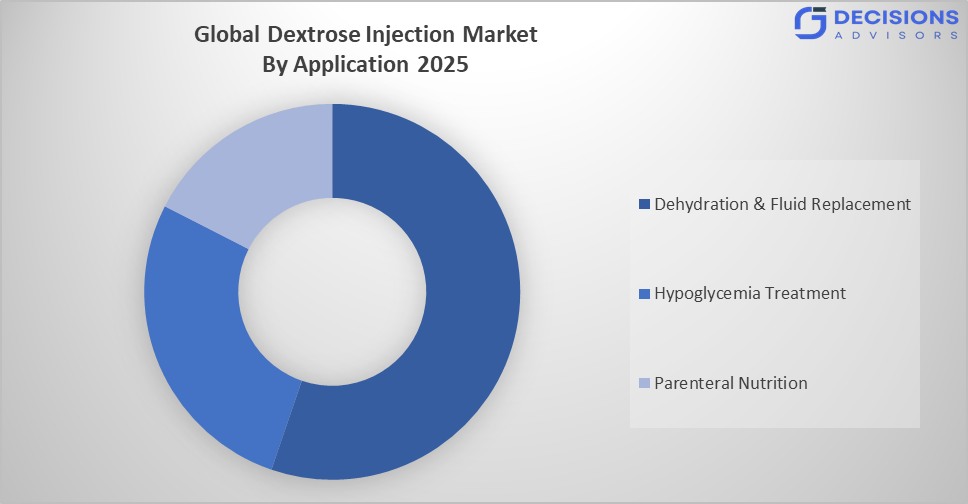
- The dehydration & fluid replacement segment dominated the market in 2025, approximately 45%, and is projected to grow at a substantial CAGR during the forecast period.
- The hospital pharmacies segment dominated the market in 2025, approximately 60%, and is projected to grow at a substantial CAGR during the forecast period.
- The compound annual growth rate of the Global Dextrose injection market is 5.95%.
- The market is likely to achieve a valuation of USD 23399.66 Million by 2035.
What is role of technology in grooming the market?
Technology is grooming the global dextrose injection market by improving quality, efficiency, and supply continuity. Advanced sterile manufacturing (automated filling, isolators, and real?time environmental monitoring) reduces contamination risk and increases output. Process analytical technology and better water-for-injection systems enhance consistency, while digital batch records and serialization strengthen traceability and regulatory compliance. Packaging innovations, non?PVC/DEHP?free bags, improved ports, and tamper-evident closures support safer administration and compatibility with closed systems. On the demand side, smart infusion pumps and dose-error reduction software help clinicians deliver dextrose safely, especially for high?concentration strengths used in emergencies. Supply-chain tech such as demand forecasting, track?and?trace, and inventory visibility helps distributors and hospitals prevent stockouts and manage tender-driven replenishment.
Market Drivers
The global market for dextrose injections is driven by the fact that it is primarily used in emergency and routine care, such as hypoglycaemia, dehydration, perioperative intravenous fluid replacement, and as a carbohydrate source for parenteral nutrition. Growing rates of hospitalization, increasing capacity of Intensive Care Units, and a rise in surgical operations lead to a basic and increasing market for dextrose injection. An aging population, coupled with the increased number of diabetic patients and patients suffering from chronic diseases, leads to a higher demand for rapid correction of glucose levels, intravenous treatment, etc. With the increasing expansion of the healthcare system in the emerging economies and better availability of emergency care and maternal care, demand. The availability of ready-to-use intravenous bags and consistent supply from the manufacturers support the purchasing trend in the hospitals.
Restrain
The Global Dextrose injection market faces restraints due to strict sterility and GMP compliance requirements, frequent regulatory inspections, and high costs for cleanroom operations and packaging. Price caps and tender pressure limit margins, while periodic shortages of bags, glass, or fill?finish capacity disrupt supply and contracts.
Competitive Analysis:
The report offers the appropriate analysis of the key organizations/companies involved within the global dextrose injection market, along with a comparative evaluation primarily based on their product offerings, business overviews, geographic presence, enterprise strategies, segment market share, and SWOT analysis. The report also provides an elaborative analysis focusing on the current news and developments of the companies, which includes product development, innovations, joint ventures, partnerships, mergers & acquisitions, strategic alliances, and others. This allows for the evaluation of the overall competition within the market.
Top Companies in Global Dextrose Injection Market
- Baxter International Inc.
- B. Braun Melsungen AG
- Fresenius Kabi AG
- Pfizer Inc.
- ICU Medical, Inc.
- Otsuka Pharmaceutical Factory, Inc.
- B. Pharmaceuticals (B.Pharma)
- Aculife Healthcare Pvt. Ltd.
- Axa Parenterals Ltd.
- Grifols, S.A.
Government Initiatives
|
Country |
Key Government Initiatives |
|
Australia |
The Australian government announced a $20 million (AUD) investment in Baxter Healthcare to expand its Sydney facility. The initiative aims to increase domestic IV fluid production capacity by one-third to prevent future critical shortages. |
|
Japan |
The Ministry of Health, Labour and Welfare (MHLW) prioritized "Supply Stability" in its FY2026 Budget, specifically targeting drug pricing reforms to incentivize reliable manufacturing systems for essential medical supplies like IV drips and generics. |
|
India |
The National Pharmaceutical Pricing Authority (NPPA) expanded price regulations for scheduled I.V. fluid formulations. These updates set ceiling prices for 500ml and 1000ml packs of glucose and saline injections to ensure affordability while mandating specific safety packaging standards to reduce contamination risks. |
Study on the Supply, Demand, Distribution, and Market Environment of the Dextrose injection market
The global dextrose injection market operates as a high-volume, essential sterile injectable segment with tight quality and logistics requirements. Supply is driven by glucose API availability and, more critically, sterile fill?finish capacity, container supply (glass, non?PVC bags), and regulatory compliance disruptions can quickly create shortages. Demand is steady and largely non-discretionary, led by hospitals for hydration, hypoglycemia management, perioperative care, and parenteral nutrition, with added needs from aging populations and rising chronic disease. Distribution is dominated by institutional procurement via government tenders, group purchasing organizations, and hospital pharmacies, supported by wholesalers and regional depots to maintain continuous stock. The market environment features price controls, stringent GMP/sterility standards, high switching costs due to approvals, and increasing focus on supply resilience, traceability, and safer packaging to reduce contamination and handling errors.
Price Analysis and Consumer Behaviour Analysis
Price dynamics in the global dextrose injection market are shaped by regulation, tender-based procurement, and sterile-manufacturing costs. In many countries, prices are capped or negotiated through public tenders and group purchasing organizations, keeping margins thin and making supply reliability a key differentiator. Costs fluctuate with dextrose/raw-material prices, sterile packaging (non?PVC bags), energy, compliance upgrades, and freight; shortages can temporarily raise spot prices and shift demand to alternative suppliers. Consumer behavior is such that institutional hospitals and clinics prioritize uninterrupted availability, regulatory approvals, sterility assurance, and compatibility with infusion systems over branding. Purchasing decisions favor suppliers with strong quality records, local distribution, and stable lead times. In private markets and home-care settings, buyers are more price sensitive but still prefer easy-to-use, ready-to-hang packs with clear labeling and longer shelf life.
Market Segmentation
The Dextrose injection market share is classified into product type, application, and distribution channel.
- The 5% dextrose injection segment dominated the market in 2025, approximately 40%, and is projected to grow at a substantial CAGR during the forecast period.
Based on the product type, the dextrose injection market is divided into 5% dextrose injection, 10% dextrose injection, 50% dextrose injection, and 70% dextrose injection. Among these, the 5% dextrose injection segment dominated the market in 2025, approximately 40%, and is projected to grow at a substantial CAGR during the forecast period. The growth of the 5% dextrose injection segment is growing because it is the most routinely used strength for general IV therapy. It is widely stocked for maintenance fluids, mild calorie supplementation, and as a common diluent for IV drugs. High procedure volumes and broad hospital protocols keep D5W demand consistently high.
- The dehydration & fluid replacement segment dominated the market in 2025, approximately 45%, and is projected to grow at a substantial CAGR during the forecast period.
Based on the application, the dextrose injection market is divided into hypoglycemia treatment, dehydration & fluid replacement, and parenteral nutrition. Among these, the dehydration & fluid replacement segment dominated the market in 2025, approximately 45%, and is projected to grow at a substantial CAGR during the forecast period. The dehydration & fluid replacement segment dominated due to IV fluid therapy, which is a daily, high-volume hospital requirement across emergency, medical, and surgical wards. Dextrose solutions are frequently used when clinicians need fluid support with an energy source or as part of combined fluid regimens, driving steady utilization.
- The hospital pharmacies segment dominated the market in 2025, approximately 60%, and is projected to grow at a substantial CAGR during the forecast period.
Based on the distribution channel, the dextrose injection market is divided into hospital pharmacies, government procurement/tenders, wholesale distributors, and online pharmacies. Among these, the hospital pharmacies segment dominated the market in 2025, approximately 60%, and is projected to grow at a substantial CAGR during the forecast period. The growth of the hospital pharmacies segment is because dextrose injection is primarily administered in inpatient, emergency, ICU, and perioperative settings. Purchasing is centralized through hospital procurement teams, and volumes are high due to routine admissions, surgeries, and critical care usage. Strict handling and storage requirements also favor hospital-controlled distribution.
Strategies to Implement for Growth of the Market in Non-Leading Regions
To expand the global dextrose injection market in non-leading regions, manufacturers are focusing on affordable, compliant, and reliable supply chain models. Establishing regional fill-finish facilities or contract manufacturing partnerships helps reduce import delays, logistics costs, tariffs, and cold-chain risks while ensuring compliance with WHO-GMP standards and faster local regulatory approvals. Companies are strengthening collaborations with ministries of health, public hospital systems, and procurement agencies to secure long-term tender-based contracts and predictable demand. Distribution networks are being expanded beyond urban centers through efficient wholesalers, last-mile delivery systems, and regional inventory hubs to avoid stockouts in emergency departments, ICUs, and maternity care units. Market players are also differentiating offerings through multiple concentrations such as D5W, D10W, D25W, and D50W in varied pack sizes, along with bilingual labeling and clinical training support. Value-based pricing and pharmacovigilance services further enhance trust and long-term market penetration.
Regional Segment Analysis of the Dextrose injection market
- North America (U.S., Canada, Mexico)
- Europe (Germany, France, U.K., Italy, Spain, Rest of Europe)
- Asia-Pacific (China, Japan, India, Rest of APAC)
- South America (Brazil and the Rest of South America)
- The Middle East and Africa (UAE, South Africa, Rest of MEA)
North America is anticipated to hold the largest share of approximately 35% the dextrose injection market over the forecast period.
North America is anticipated to hold the largest share of approximately 35% the dextrose injection market over the forecast period. The dominance of this region is primarily driven by high hospital admission volumes, strong ICU and surgical infrastructure, and consistent use of IV fluids in emergency and inpatient care. The region also benefits from established reimbursement systems, stringent quality standards, and long-term supply contracts that support higher per-unit value and stable procurement.
Asia Pacific is expected to grow at a rapid CAGR of approximately 6.5% in the dextrose injection market during the forecast period.
Asia Pacific is expected to grow at a rapid CAGR of approximately 6.5% in the dextrose injection market during the forecast period. This growth is driven by rapid expansion of healthcare infrastructure, rising hospitalization and surgery rates, and growing access to emergency care. Increasing prevalence of diabetes and chronic diseases, higher demand for parenteral nutrition, and government investment in public hospitals and tender procurement further accelerate dextrose injection consumption across emerging APAC markets.
Europe is the 3rd largest region to grow in the dextrose injection market during the period.
Europe ranks as the third-largest region in the global dextrose injection market because it has a large, aging population and a consistently high burden of chronic diseases that increase hospitalizations and IV therapy use. Strong public healthcare coverage sustains routine demand for dehydration management, perioperative fluids, and parenteral nutrition. Growth is moderated by strict price controls, tender-based procurement, and mature healthcare penetration, which limit volume expansion compared with Asia-Pacific.
Future Market Trends in Global Dextrose Injection Market: -
1. Shift toward ready-to-use and premixed formats
Hospitals are increasingly adopting ready-to-administer dextrose bags and premixed combinations to reduce medication errors, save nursing time, and limit compounding needs. Patient-safety initiatives, staffing constraints, and tighter aseptic preparation regulations in many regions drive this trend.
2. Growth in non-PVC, DEHP-free, and sustainable packaging
Demand is rising for non-PVC containers, recyclable overwraps, and lower-plastic designs to meet environmental targets and reduce leachables. Health systems and regulators are pushing for greener procurement, while manufacturers are using packaging upgrades to differentiate products and improve compatibility.
3. Stronger supply-chain resilience and localization
Buyers favor suppliers with diversified API sources, dual-site manufacturing, and regional warehousing to avoid shortages. Recent disruptions have made continuity of sterile injectables a top priority, so companies invest in capacity expansion, inventory buffers, and end-to-end traceability to win long-term contracts.
Recent Development
- In September 2025, Caplin Steriles Limited received USFDA approval for its Milrinone Lactate in 5% Dextrose Injection, supplied in ready-to-use infusion bags. This approval expanded the company’s sterile injectable portfolio with a critical cardiovascular therapy.
- In January 2025, Pharmaceutical companies increasingly partnered with Contract Manufacturing Organizations (CMOs) to outsource production and logistics, ensuring stable drug supply and reducing shortages. This trend was driven by cost pressures, complex manufacturing requirements, and the need for scalable production capacity.
- In September 2024, Hikma Pharmaceuticals PLC launched Clindamycin in 5% Dextrose Injection in the U.S., available in 300 mg/50 mL, 600 mg/50 mL, and 900 mg/50 mL strengths for treating a range of serious bacterial infections.
How is Recent Developments Helping the Market?
Recent developments are supporting growth in the global dextrose injection market by improving product safety, supply reliability, and clinical usability. Manufacturers are expanding sterile fill-finish capacity and upgrading facilities to meet stricter GMP and regulatory expectations, reducing shortages in hospitals and emergency care. Innovation in packaging, such as non?PVC, DEHP?free bags, ready?to?hang systems, and improved tamper evidence, enhances compatibility, reduces contamination risk, and supports sustainability goals. Wider adoption of closed?system transfer and better port designs also improves handling in the ICU and pharmacy compounding. Quality initiatives, including stronger sterility assurance, particulate control, and traceability through serialization, are increasing confidence among buyers and group purchasing organizations. In parallel, rising use in parenteral nutrition, perioperative care, dehydration, and hypoglycemia management, especially in aging populations, continues to broaden demand across hospitals, clinics, and home?care settings.
Market Segment
This study forecasts revenue at global, regional, and country levels from 2020 to 2035. Decision Advisors has segmented the Dextrose injection market based on the below-mentioned segments:
Global Dextrose Injection Market, By Product Type
- 5% Dextrose Injection
- 10% Dextrose Injection
- 50% Dextrose Injection
- 70% Dextrose Injection
Global Dextrose Injection Market, By Application
- Hypoglycemia Treatment
- Dehydration & Fluid Replacement
- Parenteral Nutrition
Global Dextrose Injection Market, By Distribution Channel
- Hospital Pharmacies
- Government Procurement/Tenders
- Wholesale Distributors
- Online Pharmacies
Global Dextrose Injection Market, By Regional Analysis
- North America
- US
- Canada
- Mexico
- Europe
- Germany
- UK
- France
- Italy
- Spain
- Russia
- Rest of Europe
- Asia Pacific
- China
- Japan
- India
- South Korea
- Australia
- Rest of Asia Pacific
- South America
- Brazil
- Argentina
- Rest of South America
- Middle East & Africa
- UAE
- Saudi Arabia
- Qatar
- South Africa
- Rest of the Middle East & Africa
Frequently Asked Questions (FAQ)
Q. How do supply chain disruptions impact the global dextrose injection market?
A. Supply chain disruptions can significantly affect the availability of dextrose injections due to their dependence on sterile manufacturing, packaging materials (like IV bags and glass), and regulated logistics. Any interruption in raw material supply, fill-finish capacity, or transportation can lead to shortages in hospitals. This often results in increased procurement costs, delayed treatments, and higher reliance on alternative suppliers, making supply chain resilience a critical focus for manufacturers.
Q. What role do group purchasing organizations (GPOs) play in the dextrose injection market?
A. Group purchasing organizations (GPOs) play a crucial role by negotiating bulk procurement contracts for hospitals and healthcare systems. They help standardize pricing, ensure consistent supply, and reduce procurement costs. Manufacturers often compete to secure GPO contracts, as they provide long-term volume visibility and strengthen market presence, especially in developed regions.
Q. Why is quality assurance critical in the dextrose injection market?
A. Quality assurance is essential because dextrose injections are sterile intravenous products directly administered into the bloodstream. Any contamination or deviation in formulation can pose serious patient risks. Therefore, strict adherence to GMP standards, sterility testing, and regulatory compliance is mandatory, making quality a key differentiator for manufacturers and a major factor in procurement decisions.
Q. How does the rise in home healthcare influence the dextrose injection market?
A. The rise in home healthcare is gradually expanding demand for user-friendly and ready-to-use dextrose injection products. Patients receiving long-term therapies or nutritional support outside hospitals require safe, portable, and easy-to-administer IV solutions. This trend is encouraging manufacturers to develop smaller pack sizes, improved packaging, and simplified administration systems tailored for non-hospital settings.
Check Licence
Choose the plan that fits you best: Single User, Multi-User, or Enterprise solutions tailored for your needs.
We Have You Covered
- 24/7 Analyst Support
- Clients Across the Globe
- Tailored Insights
- Technology Tracking
- Competitive Intelligence
- Custom Research
- Syndicated Market Studies
- Market Overview
- Market Segmentation
- Growth Drivers
- Market Opportunities
- Regulatory Insights
- Innovation & Sustainability
Report Details
| Scope | Global |
| Pages | 210 |
| Delivery | PDF & Excel via Email |
| Language | English |
| Release | Apr 2026 |
| Access | Download from this page |