
Global Fibroadenoma Market
 |
Author:
David J
|
Pages:
210
|
Author:
David J
|
Pages:
210
Global Fibroadenoma Market Size, Share, and By Type (Simple Fibroadenoma, Complex Fibroadenoma), By Diagnosis (Physical Examination, Ultrasound, Mammography, Biopsy, Others), By Application (Diagnosis, Treatment), By End User (Hospitals & Clinics, Diagnostic Centers, Ambulatory Surgical Centers, Others), and By Region (North America, Europe, Asia-Pacific, Latin America, Middle East & Africa), Analysis and Forecast 2026?2035.
CAGR
6.81%
REVENUE 2025
USD Billion 1.5
FORECAST 2035
USD Billion 2.9
REPORT COVERAGE
Global
Market Snapshot
- Global Fibroadenoma Market Size (2025): USD 1.5 Billion
- Global Fibroadenoma Market Projected Market Size (2035): USD 2.9 Billion
- Global Fibroadenoma Market Compound Annual Growth Rate (CAGR): 6.81%
- Largest Regional Market: North America
- 2nd Largest Region: Europe
- Fastest Growing Region: Asia-Pacific
- Base Year: 2025
- Historical Period: 2020–2024
- Forecast Period: 2026–2035
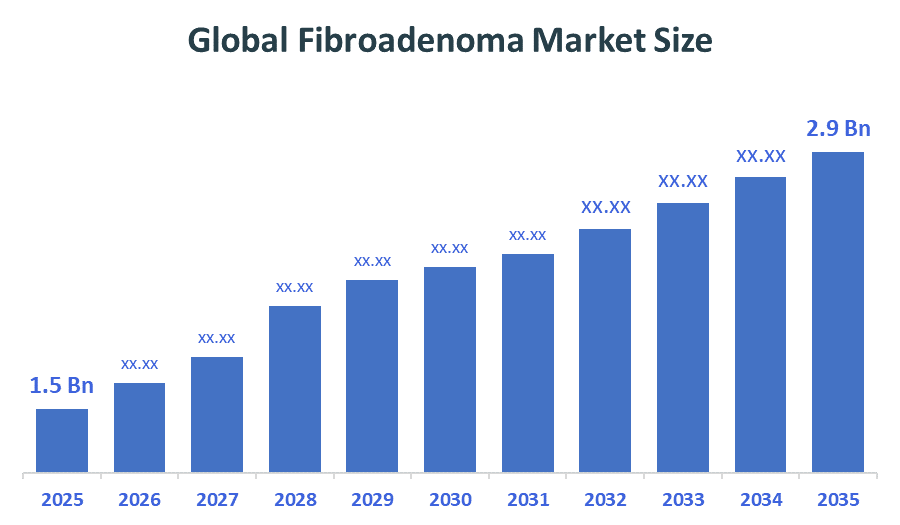
According to Decision Advisors, the Global Fibroadenoma Market Size is expected to grow from USD 1.5 Billion in 2025 to USD 2.9 Billion by 2035, at a CAGR of 6.81% during the forecast period 2026-2035. The global fibroadenoma market is projected to grow significantly over the next decade. The growth is driven by the increasing prevalence of benign breast tumors such as fibroadenoma, rising awareness and adoption of breast cancer screening programs, and advancements in diagnostic imaging technologies such as ultrasound and mammography, along with the growing preference for minimally invasive biopsy procedures.
Market Overview/ Introduction
The Fibroadenoma Market is currently undergoing a transformative shift, moving away from traditional wait-and-watch or invasive surgical approaches toward a patient-centric model defined by precision and comfort. At the same time, the market is seeing a beautiful shift in medicine toward scarless healing. It’s about more than just medical tech, it’s about giving women the chance to walk into a clinic, receive care, and head right back to their lives and loved ones the same afternoon keeping their health, their time, and their confidence completely intact. This evolution is supported by government initiatives, such as India’s NPCDCS, which integrates breast health into national screening programs to ensure that even rural populations have access to early detection. Looking ahead, the future market opportunity is deeply rooted in personalization and digital integration. Market is moving toward a future where Artificial Intelligence will not just detect a fibroadenoma but predict its growth pattern based on a patient’s unique hormonal profile. There is a massive opening for biotech firms to develop targeted drug therapies that could eventually dissolve these lumps without any physical intervention at all. As telehealth continues to bridge the gap between specialized breast centers and remote patients, the market is poised to become more inclusive, ensuring that every woman, regardless of geography, has access to the most advanced, dignified care possible.
- Approximately 10% of women globally develop fibroadenomas at some point in their lifetime, highlighting a large patient pool.
- Clinical studies indicate fibroadenomas account for approximately 72% of benign breast tumors in certain populations, emphasizing their dominance in the benign breast disease segment.
- The incidence among young women (adolescence to mid-20s) is estimated at approximately 7–13% in specialty clinical settings, reflecting high detection rates in healthcare systems.
Notable Insights: -
- North America is anticipated to hold approximately 38% share of the global fibroadenoma market over the predicted timeframe.
- Europe is expected to grow at a rapid CAGR in the fibroadenoma market by holding approximately 27% of the share during the forecast period.
- By type, the simple fibroadenoma segment dominated the market and holds approximately 72% share in 2025 and is projected to grow at a substantial CAGR during the forecast period.
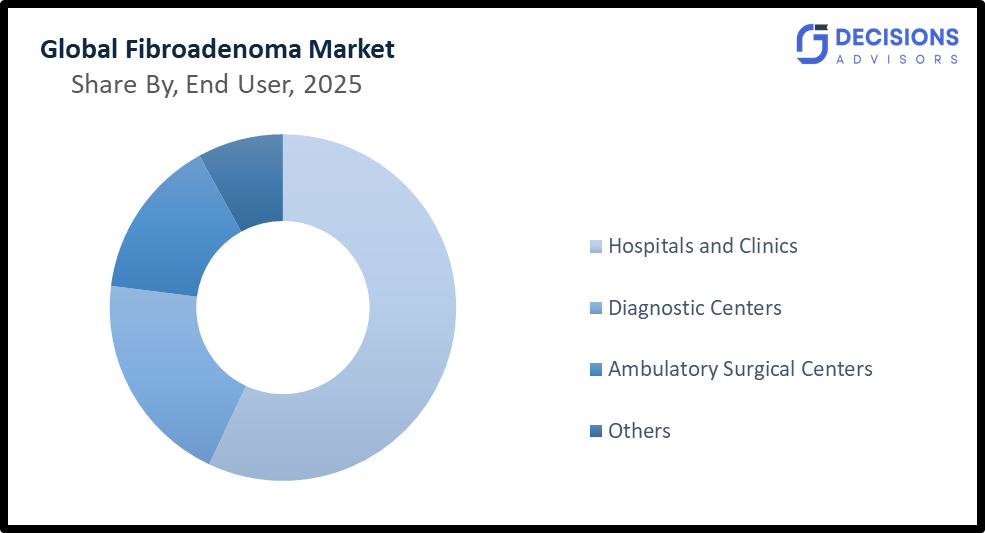
- By end user, the hospitals & clinics segment dominated the market and holds approximately 57% share in 2025 and is projected to grow at a substantial CAGR during the forecast period
- The compound annual growth rate of the global Fibroadenoma Market is 6.81%.
- The market is likely to achieve a valuation of USD 2.9 Billion by 2035.
What is the role of technology in grooming the market?
Technology plays a crucial role in advancing the fibroadenoma market, High-resolution ultrasound imaging, digital mammography, and MRI have significantly improved early detection and differentiation of benign and malignant lesions. AI-powered diagnostic tools are enhancing accuracy by reducing false positives and unnecessary biopsies. Minimally invasive technologies such as vacuum-assisted breast biopsy (VABB) and cryoablation are revolutionizing treatment by offering scarless procedures with faster recovery times. Portable and handheld imaging devices are also expanding access to breast screening in remote and underserved regions. These technological advancements are increasing patient preference for early diagnosis and non-surgical treatment options, thereby driving market expansion
Market Drivers
The fibroadenoma market is primarily driven by the increasing prevalence of benign breast disorders. Globally, fibroadenomas account for approximately 55% of all breast biopsies, highlighting their high occurrence and clinical significance. Additionally, nearly 10% of women worldwide develop fibroadenomas at some point in their lives, creating a consistent demand for diagnostic and monitoring procedures. The rising adoption of breast cancer screening programs is another major growth factor. Early screening initiatives have increased detection rates of benign breast lumps by over 35%, significantly boosting diagnostic procedure volumes. Furthermore, minimally invasive treatments such as VABB reduce procedure time by nearly 40% and eliminate the need for hospitalization, making them cost-effective and widely preferred. Increasing healthcare expenditure, growing awareness regarding women’s health, and advancements in diagnostic imaging technologies are collectively strengthening the market demand globally.
Restrain
The market faces several challenges, including the high cost of advanced imaging systems such as MRI and digital mammography. Limited access to screening facilities in low-income regions can delay diagnosis and treatment. Additionally, the lack of skilled radiologists and specialists in emerging markets may restrict adoption of advanced diagnostic techniques. Concerns regarding over diagnosis and unnecessary biopsies also pose challenges to market growth.
Competitive Analysis:
The report offers the appropriate analysis of the key organizations/companies involved within the global fibroadenoma market, along with a comparative evaluation primarily based on their product of offering, business overviews, geographic presence, enterprise strategies, segment market share, and SWOT analysis. The report also provides an elaborative analysis focusing on the current news and developments of the companies, which includes product development, innovations, joint ventures, partnerships, mergers & acquisitions, strategic alliances, and others. This allows for the evaluation of the overall competition within the market.
Top Companies in the Global Fibroadenoma Market
- Hologic, Inc.
- General Electric Company
- Siemens Healthineers AG
- Koninklijke Philips N.V.
- Fujifilm Holdings Corporation
- Canon Medical Systems Corporation
- Mindray Medical International Limited
- Hitachi, Ltd.
- Esaote SpA
- Shimadzu Corporation
Government Initiatives
|
Country |
Key Government Initiatives |
|
India |
|
|
US |
|
|
China |
|
Study on the Supply, Demand, Distribution, and Market Environment of the Fibroadenoma Market
The fibroadenoma market demonstrates steady demand due to the high prevalence of benign breast lumps and increasing awareness of early diagnosis. Supply is driven by advanced imaging systems, biopsy devices, and minimally invasive treatment technologies. Distribution channels include hospitals, diagnostic imaging centers, and specialty clinics. Favorable market conditions such as increasing healthcare investments, expansion of diagnostic centers, and supportive government screening programs are creating a strong growth environment.
Price Analysis and Consumer Behaviour Analysis
The market is experiencing steady revenue growth due to increasing screening rates and rising awareness among women regarding breast health. Consumers are increasingly opting for non-invasive and minimally invasive diagnostic procedures, which reduce anxiety and recovery time. Advanced imaging systems and biopsy devices come at a premium cost, however, their high accuracy and efficiency justify adoption in developed healthcare settings. In emerging markets, affordability and accessibility remain key factors influencing consumer behaviour.
Market Segmentation
The fibroadenoma market share is classified into type, diagnosis, application, and end user
- The simple fibroadenoma segment dominated the market and holds approximately 72% share in 2025 and is projected to grow at a substantial CAGR during the forecast period.
Based on the type, the fibroadenoma market is divided into simple fibroadenoma and complex fibroadenoma. Among these, the simple fibroadenoma segment dominated the market and holds approximately 72% share in 2025 and is projected to grow at a substantial CAGR during the forecast period. This supremacy stems from the broad clinical utility of flexible designs in accessing complex renal anatomy, superior imaging with digital and fiber optic technologies, and higher stone clearance rates in retrograde intrarenal surgery compared with rigid alternatives. Semi?rigid and rigid scopes have more limited use in specific lower?ureter cases; thus, their shares are smaller and grow at a more moderate pace.
- The ultrasound segment accounted for the largest share of approximately 46% in 2025 and is anticipated to grow at a significant CAGR during the forecast period.
Based on the diagnosis, the fibroadenoma market is divided into physical examination, ultrasound, mammography, biopsy, and others. Among these, the ultrasound segment accounted for the largest share of approximately 46% in 2025 and is anticipated to grow at a significant CAGR during the forecast period. This growth is driven by its widespread use as a first-line diagnostic tool, especially in younger patients with dense breast tissue, along with its cost-effectiveness, non-invasive nature, and real-time imaging capability. Mammography and biopsy are also widely used, particularly for confirmation, while physical examination plays a preliminary role in detection.
- The diagnosis segment accounted for the largest share in 2025 and is anticipated to grow at a significant CAGR during the forecast period.
Based on the application, the fibroadenoma market is divided into diagnosis and treatment. Among these, the diagnosis segment accounted for the largest share in 2025 and is anticipated to grow at a significant CAGR during the forecast period. This is primarily due to the high volume of screening procedures and frequent detection of benign breast lumps, which require imaging and monitoring rather than immediate intervention. The treatment segment is growing steadily with the rise in minimally invasive procedures.
- The hospitals & clinics segment dominated the market and holds approximately 57% share in 2025 and is projected to grow at a substantial CAGR during the forecast period.
Based on end user, the fibroadenoma market is divided into hospitals & clinics, diagnostic centers, ambulatory surgical centers, and others. Among those, the hospitals & clinics segment dominated the market and holds approximately 57% share in 2025 and is projected to grow at a substantial CAGR during the forecast period. owing to advanced diagnostic infrastructure, availability of skilled professionals, and higher patient inflow. Diagnostic centers are also witnessing strong growth due to increasing screening volumes, while ambulatory surgical centers are gaining traction with the rising adoption of minimally invasive outpatient procedures.
Strategies to Implement for Growth of the Market in Non-Leading Regions
To expand the fibroadenoma market in non-leading regions, companies should focus on strengthening diagnostic and screening infrastructure by supporting hospitals and diagnostic centers with cost-effective imaging technologies such as ultrasound and portable mammography systems. Increasing awareness through public health campaigns and women’s health programs is essential to promote early detection and reduce late-stage diagnosis. Training programs for radiologists and healthcare professionals can improve diagnostic accuracy and encourage adoption of advanced techniques such as minimally invasive procedures. Introducing affordable and scalable solutions, including low-cost biopsy devices and outpatient treatment options like cryoablation, can help overcome financial barriers. Additionally, forming strategic partnerships with local distributors, healthcare providers, and government bodies can enhance market penetration and ensure better accessibility.
Regional Segment Analysis of the Fibroadenoma Market
- North America (U.S., Canada, Mexico)
- Europe (Germany, France, U.K., Italy, Spain, Rest of Europe)
- Asia-Pacific (China, Japan, India, Rest of APAC)
- South America (Brazil and the Rest of South America)
- The Middle East and Africa (UAE, South Africa, Rest of MEA)
North America is anticipated to hold approximately 38% share of the global fibroadenoma market over the predicted timeframe.
North America is anticipated to hold approximately 38% share of the global fibroadenoma market over the predicted timeframe. It maintains dominant market leadership due to well-established healthcare infrastructure, high breast screening rates, and broad adoption of advanced diagnostic imaging technologies such as ultrasound and digital mammography. The United States is the key driver, supported by strong healthcare expenditure, widespread awareness regarding breast health, and the presence of organized screening programs. Additionally, increasing adoption of minimally invasive procedures such as vacuum-assisted biopsy and cryoablation across hospitals and diagnostic centers further strengthens regional demand and market share.
Europe is expected to grow at a rapid CAGR in the fibroadenoma market by holding approximately 27% of the share during the forecast period.
Europe is expected to grow at a rapid CAGR in the fibroadenoma market by holding approximately 27% of the share during the forecast period. Europe’s market is supported by well-established healthcare systems, high awareness of early breast cancer and benign tumor detection, and increasing adoption of advanced imaging and minimally invasive technologies. Key countries such as Germany, France, and the United Kingdom emphasize routine screening and early diagnosis, contributing to higher detection rates of fibroadenomas. Ongoing investments in healthcare infrastructure, favorable reimbursement policies, and the presence of skilled professionals are driving steady market growth across the region.
Asia Pacific is the fastest-growing region in the fibroadenoma market during the period, holding approximately 24% share.
Asia Pacific is the fastest-growing region in the Fibroadenoma Market during the period, holding approximately 24% share. It is due to rising healthcare investments, improving diagnostic infrastructure, and growing awareness regarding breast health and early screening. Countries such as China, India, and Japan are witnessing increasing patient volumes due to large population bases and improving access to healthcare services. Government initiatives promoting women’s health, expansion of private diagnostic centers, adoption of advanced imaging technologies, and growing medical tourism are further contributing to the rising demand and overall market expansion in the region.
Future Market Trends in Global Fibroadenoma Market: -
- Rapid Shift Toward Minimally Invasive & Non-Surgical Treatments
The market is strongly moving away from traditional surgical excision toward minimally invasive procedures such as cryoablation, vacuum-assisted biopsy (VABB), and high-intensity focused ultrasound (HIFU).
- These techniques reduce recovery time by 30–50% and improve cosmetic outcomes.
- Increasing R&D focus is being placed on robotic-assisted and image-guided procedures for benign breast tumours.
- Minimally invasive biopsy techniques are becoming standard for early detection and management.
- Advancements in Imaging and AI-Enabled Diagnostic Technologies
Technological advancements, particularly in breast imaging and artificial intelligence, are transforming fibroadenoma diagnosis. High-resolution ultrasound, digital mammography, and MRI are enhancing early detection and diagnostic accuracy. Additionally, AI-assisted imaging is improving lesion characterization, reducing false positives, and minimizing unnecessary biopsies. Emerging innovations such as automated breast imaging systems and portable diagnostic devices are further expanding access to screening and improving clinical efficiency. Continuous improvements in imaging precision and workflow automation are expected to drive market growth.
- Expansion of Screening Programs and Outpatient Care Settings
There is a growing emphasis on early detection through expanded breast screening programs, which is significantly influencing the fibroadenoma market. Governments and healthcare organizations are increasingly promoting routine screening, leading to higher diagnosis rates of benign breast conditions. At the same time, ambulatory surgical centers and diagnostic clinics are gaining traction due to cost-effectiveness, convenience, and faster patient turnaround. The shift toward outpatient care, combined with increasing awareness and accessibility of screening services, is expected to boost demand for both diagnostic and treatment solutions in the coming years.
Recent Development
- In March 2026, IceCure Medical Ltd. announced that the American Society of Breast Surgeons updated its 2026 Resource Guide on the Use of Transcutaneous and Percutaneous Ablation for the Treatment of Benign and Malignant Tumors of the Breast, recommending cryoablation as a treatment option for selected patients with biologically low-risk early-stage breast cancer.
- In October 2024, IceCure presented multiple studies on its ProSense system at the European Society of Breast Imaging (EUSOBI) 2024, showcasing strong clinical outcomes in both breast cancer and fibroadenoma treatment. The company also engaged with global experts through demonstrations and collaborations, strengthening its international presence.
- In November 2023, GE HealthCare (Nasdaq: GEHC) announced the release of a new all-in-one platform of artificial intelligence (AI) applications designed to support clinicians in breast cancer detection and enhance workflow productivity. The platform, called MyBreastAI Suite, was introduced to streamline diagnostic processes and improve clinical efficiency.
- In September 2023, IceCure Medical Ltd. received Class III regulatory approval from Brazil’s health authority for its ProSense System. This cryoablation technology offers a minimally invasive approach for tumor treatment, enhancing the availability of advanced cancer care solutions.
How is Recent Developments Helping the Market?
Recent developments in the fibroadenoma market are significantly improving diagnostic accuracy, treatment efficiency, and overall patient outcomes, thereby driving market growth. Advanced imaging technologies such as high-resolution ultrasound, elastography, and core-needle biopsy now account for over 40% of diagnostics, enabling earlier and more precise detection of fibroadenomas while reducing misdiagnoses. The adoption of minimally invasive procedures, including cryoablation, high-intensity focused ultrasound (HIFU), and vacuum-assisted biopsies, has improved patient comfort, shortened hospital stays, and minimized post-procedure complications, making these treatments increasingly preferred over traditional surgery. Additionally, the integration of AI and digital diagnostics is enhancing imaging analysis, reducing errors, and speeding clinical workflows, which expands the capacity of healthcare systems to manage more cases efficiently. Growing awareness of breast health and routine screening initiatives are further contributing to early diagnosis and treatment uptake.
Market Segment
This study forecasts revenue at global, regional, and country levels from 2020 to 2035. Decision Advisors has segmented the global Fibroadenoma Market based on the below-mentioned segments:
Global Fibroadenoma Market, By Type
- Simple Fibroadenoma
- Complex Fibroadenoma
Global Fibroadenoma Market, By Diagnosis
- Physical Examination
- Ultrasound
- Mammography
- Biopsy
- Others
Global Fibroadenoma Market, By Application
- Diagnosis
- Treatment
Global Fibroadenoma Market, By End user
- Hospitals and Clinics
- Diagnostic Centers
- Ambulatory surgical centers
- Others
Global Fibroadenoma Market, By Regional Analysis
- North America
- US
- Canada
- Mexico
- Europe
- Germany
- UK
- France
- Italy
- Spain
- Russia
- Rest of Europe
- Asia Pacific
- China
- Japan
- India
- South Korea
- Australia
- Rest of Asia Pacific
- South America
- Brazil
- Argentina
- Rest of South America
- Middle East & Africa
- UAE
- Saudi Arabia
- Qatar
- South Africa
- Rest of the Middle East & Africa
Frequently Asked Questions (FAQ)
Q. What factors influence the decision between monitoring and active treatment of fibroadenomas?
A. The decision depends on tumor size, growth rate, patient age, symptoms, and imaging characteristics. Stable, small fibroadenomas are usually monitored, while rapidly growing or symptomatic cases may require intervention.
Q. How does patient age impact the management of fibroadenomas?
A. Younger patients are more likely to undergo conservative management with regular monitoring, whereas older patients may require further diagnostic evaluation to rule out malignancy.
Q. What role do diagnostic centers play in the fibroadenoma market?
A. Diagnostic centers play a critical role by providing accessible and cost-effective imaging services, contributing significantly to early detection and ongoing monitoring of fibroadenomas.
Q. Are there any emerging non-invasive alternatives to biopsy for fibroadenoma diagnosis?
A. Yes, advanced imaging techniques combined with AI and elastography are emerging as potential non-invasive alternatives, helping differentiate benign from suspicious lesions with high accuracy.
Q. How does healthcare accessibility affect fibroadenoma diagnosis rates globally?
A. Regions with better healthcare infrastructure and screening programs report higher diagnosis rates, while limited access in developing regions often leads to underdiagnosis and delayed treatment.
- Introduction
- Objectives of the Study
- Market Definition
- Research Scope
- Research Methodology and Assumptions
- Executive Summary
- Premium Insights
- Porter’s Five Forces Analysis
- Value Chain Analysis
- Top Investment Pockets
- Market Attractiveness Analysis By Type
- Market Attractiveness Analysis By Diagnosis
- Market Attractiveness Analysis By Application
- Market Attractiveness Analysis By End User
- Market Attractiveness Analysis By Region
- Industry Trends
- Market Dynamics
- Market Evaluation
- Drivers
- Increasing awareness and screening for breast health
- Restraints
- High cost of diagnostic imaging and treatment procedures
- Opportunities
- Rising demand for minimally invasive procedures
- Challenges
5.5.1. Social stigma and delayed diagnosis related to breast disorders
- Global Fibroadenoma Market Analysis and Projection, By Type
- Segment Overview
- Simple Fibroadenoma
- Complex Fibroadenoma
- Global Fibroadenoma Market Analysis and Projection, By Diagnosis
- Segment Overview
- Physical Examination
- Ultrasound
- Mammography
- Biopsy
- Others
- Global Fibroadenoma Market Analysis and Projection, By Application
- Segment Overview
- Diagnosis
- Treatment
- Global Fibroadenoma Market Analysis and Projection, By End User
- Segment Overview
- Hospitals & Clinics
- Diagnostic Centers
- Ambulatory Surgical Centers
- Others
- Global Fibroadenoma Market Analysis and Projection, By Regional Analysis
- Segment Overview
- North America
- U.S.
- Canada
- Mexico
- Europe
- Germany
- France
- U.K.
- Italy
- Spain
- Asia-Pacific
- Japan
- China
- India
- South America
- Brazil
- Middle East and Africa
- UAE
- South Africa
- Global Fibroadenoma Market-Competitive Landscape
- Overview
- Market Share of Key Players in the Fibroadenoma Market
- Global Company Market Share
- North America Company Market Share
- Europe Company Market Share
- APAC Company Market Share
- Competitive Situations and Trends
- Coverage Launches and Developments
- Partnerships, Collaborations, and Agreements
- Mergers & Acquisitions
- Expansions
- Company Profiles
- Hologic, Inc.
- Business Overview
- Company Snapshot
- Company Market Share Analysis
- Company Coverage Portfolio
- Recent Developments
- SWOT Analysis
- General Electric Company
- Business Overview
- Company Snapshot
- Company Market Share Analysis
- Company Coverage Portfolio
- Recent Developments
- SWOT Analysis
- Siemens Healthineers AG
- Business Overview
- Company Snapshot
- Company Market Share Analysis
- Company Coverage Portfolio
- Recent Developments
- SWOT Analysis
- Koninklijke Philips N.V.
- Business Overview
- Company Snapshot
- Company Market Share Analysis
- Company Coverage Portfolio
- Recent Developments
- SWOT Analysis
- Fujifilm Holdings Corporation
- Business Overview
- Company Snapshot
- Company Market Share Analysis
- Company Coverage Portfolio
- Recent Developments
- SWOT Analysis
- Canon Medical Systems Corporation
- Business Overview
- Company Snapshot
- Company Market Share Analysis
- Company Coverage Portfolio
- Recent Developments
- SWOT Analysis
- Mindray Medical International Limited
- Business Overview
- Company Snapshot
- Company Market Share Analysis
- Company Coverage Portfolio
- Recent Developments
- SWOT Analysis
- Hitachi, Ltd.
- Business Overview
- Company Snapshot
- Company Market Share Analysis
- Company Coverage Portfolio
- Recent Developments
- SWOT Analysis
- Esaote SpA
- Business Overview
- Company Snapshot
- Company Market Share Analysis
- Company Coverage Portfolio
- Recent Developments
- SWOT Analysis
- Shimadzu Corporation
- Business Overview
- Company Snapshot
- Company Market Share Analysis
- Company Coverage Portfolio
- Recent Developments
- SWOT Analysis
- Hologic, Inc.
List of Table
- Global Fibroadenoma Market, By Type, 2024-2035(USD Billion)
- Global Simple Fibroadenoma, Fibroadenoma Market, By Region, 2024-2035(USD Billion)
- Global Complex Fibroadenoma, Fibroadenoma Market, By Region, 2024-2035(USD Billion)
- Global Fibroadenoma Market, By Diagnosis, 2024-2035(USD Billion)
- Global Physical Examination, Fibroadenoma Market, By Region, 2024-2035(USD Billion)
- Global Ultrasound, Fibroadenoma Market, By Region, 2024-2035(USD Billion)
- Global Mammography, Fibroadenoma Market, By Region, 2024-2035(USD Billion)
- Global Biopsy, Fibroadenoma Market, By Region, 2024-2035(USD Billion)
- Global Others, Fibroadenoma Market, By Region, 2024-2035(USD Billion)
- Global Fibroadenoma Market, By Application, 2024-2035(USD Billion)
- Global Diagnosis, Fibroadenoma Market, By Region, 2024-2035(USD Billion)
- Global Treatment, Fibroadenoma Market, By Region, 2024-2035(USD Billion)
- Global Fibroadenoma Market, By End User, 2024-2035(USD Billion)
- Global Hospitals & Clinics, Fibroadenoma Market, By Region, 2024-2035(USD Billion)
- Global Diagnostic Centers, Fibroadenoma Market, By Region, 2024-2035(USD Billion)
- Global Ambulatory Surgical Centers, Fibroadenoma Market, By Region, 2024-2035(USD Billion)
- Global Others, Fibroadenoma Market, By Region, 2024-2035(USD Billion)
- North America Fibroadenoma Market, By Type, 2024-2035(USD Billion)
- North America Fibroadenoma Market, By Diagnosis, 2024-2035(USD Billion)
- North America Fibroadenoma Market, By Application, 2024-2035(USD Billion)
- North America Fibroadenoma Market, By End User, 2024-2035(USD Billion)
- U.S. Fibroadenoma Market, By Type, 2024-2035(USD Billion)
- U.S. Fibroadenoma Market, By Diagnosis, 2024-2035(USD Billion)
- U.S. Fibroadenoma Market, By Application, 2024-2035(USD Billion)
- U.S. Fibroadenoma Market, By End User, 2024-2035(USD Billion)
- Canada Fibroadenoma Market, By Type, 2024-2035(USD Billion)
- Canada Fibroadenoma Market, By Diagnosis, 2024-2035(USD Billion)
- Canada Fibroadenoma Market, By Application, 2024-2035(USD Billion)
- Canada Fibroadenoma Market, By End User, 2024-2035(USD Billion)
- Mexico Fibroadenoma Market, By Type, 2024-2035(USD Billion)
- Mexico Fibroadenoma Market, By Diagnosis, 2024-2035(USD Billion)
- Mexico Fibroadenoma Market, By Application, 2024-2035(USD Billion)
- Mexico Fibroadenoma Market, By End User, 2024-2035(USD Billion)
- Europe Fibroadenoma Market, By Type, 2024-2035(USD Billion)
- Europe Fibroadenoma Market, By Diagnosis, 2024-2035(USD Billion)
- Europe Fibroadenoma Market, By Application, 2024-2035(USD Billion)
- Europe Fibroadenoma Market, By End User, 2024-2035(USD Billion)
- Germany Fibroadenoma Market, By Type, 2024-2035(USD Billion)
- Germany Fibroadenoma Market, By Diagnosis, 2024-2035(USD Billion)
- Germany Fibroadenoma Market, By Application, 2024-2035(USD Billion)
- Germany Fibroadenoma Market, By End User, 2024-2035(USD Billion)
- France Fibroadenoma Market, By Type, 2024-2035(USD Billion)
- France Fibroadenoma Market, By Diagnosis, 2024-2035(USD Billion)
- France Fibroadenoma Market, By Application, 2024-2035(USD Billion)
- France Fibroadenoma Market, By End User, 2024-2035(USD Billion)
- U.K. Fibroadenoma Market, By Type, 2024-2035(USD Billion)
- U.K. Fibroadenoma Market, By Diagnosis, 2024-2035(USD Billion)
- U.K. Fibroadenoma Market, By Application, 2024-2035(USD Billion)
- U.K. Fibroadenoma Market, By End User, 2024-2035(USD Billion)
- Italy Fibroadenoma Market, By Type, 2024-2035(USD Billion)
- Italy Fibroadenoma Market, By Diagnosis, 2024-2035(USD Billion)
- Italy Fibroadenoma Market, By Application, 2024-2035(USD Billion)
- Italy Fibroadenoma Market, By End User, 2024-2035(USD Billion)
- Spain Fibroadenoma Market, By Type, 2024-2035(USD Billion)
- Spain Fibroadenoma Market, By Diagnosis, 2024-2035(USD Billion)
- Spain Fibroadenoma Market, By Application, 2024-2035(USD Billion)
- Spain Fibroadenoma Market, By End User, 2024-2035(USD Billion)
- Asia Pacific Fibroadenoma Market, By Type, 2024-2035(USD Billion)
- Asia Pacific Fibroadenoma Market, By Diagnosis, 2024-2035(USD Billion)
- Asia Pacific Fibroadenoma Market, By Application, 2024-2035(USD Billion)
- Asia Pacific Fibroadenoma Market, By End User, 2024-2035(USD Billion)
- Japan Fibroadenoma Market, By Type, 2024-2035(USD Billion)
- Japan Fibroadenoma Market, By Diagnosis, 2024-2035(USD Billion)
- Japan Fibroadenoma Market, By Application, 2024-2035(USD Billion)
- Japan Fibroadenoma Market, By End User, 2024-2035(USD Billion)
- China Fibroadenoma Market, By Type, 2024-2035(USD Billion)
- China Fibroadenoma Market, By Diagnosis, 2024-2035(USD Billion)
- China Fibroadenoma Market, By Application, 2024-2035(USD Billion)
- China Fibroadenoma Market, By End User, 2024-2035(USD Billion)
- India Fibroadenoma Market, By Type, 2024-2035(USD Billion)
- India Fibroadenoma Market, By Diagnosis, 2024-2035(USD Billion)
- India Fibroadenoma Market, By Application, 2024-2035(USD Billion)
- India Fibroadenoma Market, By End User, 2024-2035(USD Billion)
- South America Fibroadenoma Market, By Type, 2024-2035(USD Billion)
- South America Fibroadenoma Market, By Diagnosis, 2024-2035(USD Billion)
- South America Fibroadenoma Market, By Application, 2024-2035(USD Billion)
- South America Fibroadenoma Market, By End User, 2024-2035(USD Billion)
- Brazil Fibroadenoma Market, By Type, 2024-2035(USD Billion)
- Brazil Fibroadenoma Market, By Diagnosis, 2024-2035(USD Billion)
- Brazil Fibroadenoma Market, By Application, 2024-2035(USD Billion)
- Brazil Fibroadenoma Market, By End User, 2024-2035(USD Billion)
- The Middle East and Africa Fibroadenoma Market, By Type, 2024-2035(USD Billion)
- The Middle East and Africa Fibroadenoma Market, By Diagnosis, 2024-2035(USD Billion)
- The Middle East and Africa Fibroadenoma Market, By Application, 2024-2035(USD Billion)
- The Middle East and Africa Fibroadenoma Market, By End User, 2024-2035(USD Billion)
- UAE Fibroadenoma Market, By Type, 2024-2035(USD Billion)
- UAE Fibroadenoma Market, By Diagnosis, 2024-2035(USD Billion)
- UAE Fibroadenoma Market, By Application, 2024-2035(USD Billion)
- UAE Fibroadenoma Market, By End User, 2024-2035(USD Billion)
- South Africa Fibroadenoma Market, By Type, 2024-2035(USD Billion)
- South Africa Fibroadenoma Market, By Diagnosis, 2024-2035(USD Billion)
- South Africa Fibroadenoma Market, By Application, 2024-2035(USD Billion)
- South Africa Fibroadenoma Market, By End User, 2024-2035(USD Billion)
List of Figures
- Global Fibroadenoma Market Segmentation
- Fibroadenoma Market: Research Methodology
- Market Size Estimation Methodology: Bottom-Up Approach
- Market Size Estimation Methodology: Top-down Approach
- Data Triangulation
- Porter’s Five Forces Analysis
- Value Chain Analysis
- Top investment pocket in the Fibroadenoma Market
- Top Winning Strategies, 2024-2035
- Top Winning Strategies, By Development, 2024-2035(%)
- Top Winning Strategies, By Company, 2024-2035
- Moderate Bargaining power of Buyers
- Moderate Bargaining power of Suppliers
- Moderate Bargaining power of New Entrants
- Low threat of Substitution
- High Competitive Rivalry
- Top Player Positioning, 2024
- Market Share Analysis, 2024
- Restraint and Drivers: Fibroadenoma Market
- Fibroadenoma Market Segmentation, By Type
- Fibroadenoma Market For Simple Fibroadenoma, By Region, 2024-2035 ($ Billion)
- Fibroadenoma Market For Complex Fibroadenoma, By Region, 2024-2035 ($ Billion)
- Fibroadenoma Market Segmentation, By Diagnosis
- Fibroadenoma Market For Physical Examination, By Region, 2024-2035 ($ Billion)
- Fibroadenoma Market For Ultrasound, By Region, 2024-2035 ($ Billion)
- Fibroadenoma Market For Mammography, By Region, 2024-2035 ($ Billion)
- Fibroadenoma Market For Biopsy, By Region, 2024-2035 ($ Billion)
- Fibroadenoma Market For Others, By Region, 2024-2035 ($ Billion)
- Fibroadenoma Market Segmentation, By Application
- Fibroadenoma Market For Diagnosis, By Region, 2024-2035 ($ Billion)
- Fibroadenoma Market For Treatment, By Region, 2024-2035 ($ Billion)
- Fibroadenoma Market Segmentation, By End User
- Fibroadenoma Market For Hospitals & Clinics, By Region, 2024-2035 ($ Billion)
- Fibroadenoma Market For Diagnostic Centers, By Region, 2024-2035 ($ Billion)
- Fibroadenoma Market For Ambulatory Surgical Centers, By Region, 2024-2035 ($ Billion)
- Fibroadenoma Market For Others, By Region, 2024-2035 ($ Billion)
- Hologic, Inc.: Net Sales, 2024-2035 ($ Billion)
- Hologic, Inc.: Revenue Share, By Segment, 2024 (%)
- Hologic, Inc.: Revenue Share, By Region, 2024 (%)
- General Electric Company: Net Sales, 2024-2035 ($ Billion)
- General Electric Company: Revenue Share, By Segment, 2024 (%)
- General Electric Company: Revenue Share, By Region, 2024 (%)
- Siemens Healthineers AG: Net Sales, 2024-2035 ($ Billion)
- Siemens Healthineers AG: Revenue Share, By Segment, 2024 (%)
- Siemens Healthineers AG: Revenue Share, By Region, 2024 (%)
- Koninklijke Philips N.V.: Net Sales, 2024-2035 ($ Billion)
- Koninklijke Philips N.V.: Revenue Share, By Segment, 2024 (%)
- Koninklijke Philips N.V.: Revenue Share, By Region, 2024 (%)
- Fujifilm Holdings Corporation: Net Sales, 2024-2035 ($ Billion)
- Fujifilm Holdings Corporation: Revenue Share, By Segment, 2024 (%)
- Fujifilm Holdings Corporation: Revenue Share, By Region, 2024 (%)
- Canon Medical Systems Corporation: Net Sales, 2024-2035 ($ Billion)
- Canon Medical Systems Corporation: Revenue Share, By Segment, 2024 (%)
- Canon Medical Systems Corporation: Revenue Share, By Region, 2024 (%)
- Mindray Medical International Limited: Net Sales, 2024-2035 ($ Billion)
- Mindray Medical International Limited: Revenue Share, By Segment, 2024 (%)
- Mindray Medical International Limited: Revenue Share, By Region, 2024 (%)
- Hitachi, Ltd.: Net Sales, 2024-2035 ($ Billion)
- Hitachi, Ltd.: Revenue Share, By Segment, 2024 (%)
- Hitachi, Ltd.: Revenue Share, By Region, 2024 (%)
- Esaote SpA.: Net Sales, 2024-2035 ($ Billion)
- Esaote SpA.: Revenue Share, By Segment, 2024 (%)
- Esaote SpA.: Revenue Share, By Region, 2024 (%)
- Shimadzu Corporation: Net Sales, 2024-2035 ($ Billion)
- Shimadzu Corporation: Revenue Share, By Segment, 2024 (%)
- Shimadzu Corporation: Revenue Share, By Region, 2024 (%)
Check Licence
Choose the plan that fits you best: Single User, Multi-User, or Enterprise solutions tailored for your needs.
We Have You Covered
- 24/7 Analyst Support
- Clients Across the Globe
- Tailored Insights
- Technology Tracking
- Competitive Intelligence
- Custom Research
- Syndicated Market Studies
- Market Overview
- Market Segmentation
- Growth Drivers
- Market Opportunities
- Regulatory Insights
- Innovation & Sustainability
Report Details
| Scope | Global |
| Pages | 210 |
| Delivery | PDF & Excel via Email |
| Language | English |
| Release | Apr 2026 |
| Access | Download from this page |