
Global High Volume Dispensing Systems Market
 |
Pages:
240
|
Pages:
240
Global High Volume Dispensing Systems Market Size, Share, By Dispensing Mode (Manual Dispensing, Automatic Dispensing), By Dispensing Material (Adhesives, Sealants, Lubricants, Epoxies, Greases), By End User (Automotive, Electronics, Medical, Packaging, Aerospace), and By Region (North America, Europe, Asia-Pacific, Latin America, Middle East & Africa), Analysis and Forecast 2026-2035
REPORT COVERAGE
Global
Market Snapshot
- Market Size (2025): USD 1.90 Billion
- Projected Market Size (2035): USD 3.45 Billion
- Compound Annual Growth Rate (CAGR): 6.15%
- Largest Regional Market: North America
- Fastest Growing Region: Asia-Pacific
- 3rd Largest Region: Europe
- Base Year: 2025
- Historical Period: 2021–2024
- Forecast Period: 2026–2035
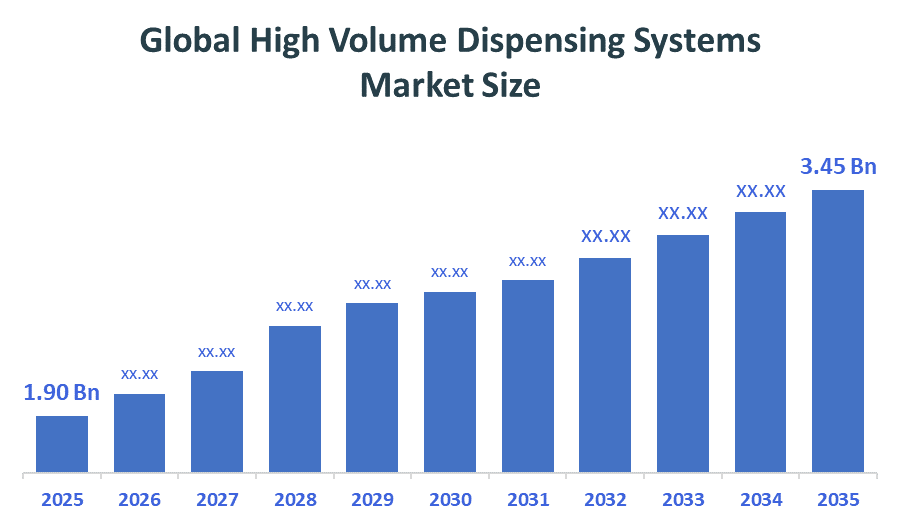
According to Decision Advisors, the Global High Volume Dispensing Systems Market Size is expected to grow from USD 1.90billion in 2025 to USD 3.45billion by 2035, at a CAGR of 6.15% during the forecast period 2026-2035. The global High volume dispensing systems Market is projected to grow significantly over the next decade, fuelled by the need for automation in healthcare to manage high prescription volumes, reduce medication errors, alleviate staffing shortages, expand mail-order pharmacy, and technological advancements.
Market Overview/ Introduction
The Global High Volume Dispensing Systems Market refers to automated technologies that allow precise dispensing of pharmaceuticals, adhesives, sealants, lubricants, epoxies, and greases at large volumes for both healthcare facilities and industrial operations. The market has grown steadily to reach multi-billion valuations because of automation and AI integration, and government mandates like the U.S. Drug Supply Chain Security Act DSCSA and Europe Critical Medicines Act require serialization and resilience funding, and digital compliance. Company initiatives like BD’s Pyxis Pro and Incada Connected Care Platform, or Titan XT’s AI?enabled Dynamic Restock workflows, highlight innovation in cloud connectivity, RFID security, and guided automation. These systems provide advantages through their ability to decrease medication mistakes while allowing clinical personnel to focus on patient treatment and enhancing production efficiency in industrial settings. The market has developed from manual dispensing to its current state, which uses fully automated systems that operate through artificial intelligence and connect with electronic health records and cloud-based analytical systems, which receive validation from European health technology assessment studies and backing from India’s PMPDS program and MedTech Zones that support local manufacturing efforts.
- India’s Pharmaceutical & Medical Devices Promotion and Development Scheme (PMPDS), along with the expansion of over 18,600 Jan Aushadhi outlets, is strengthening drug distribution networks and supply chain efficiency. This growth indirectly supports the adoption of high-volume dispensing systems by increasing demand for scalable, automated medication handling and inventory solutions.
Notable Insights: -
- North America is anticipated to hold the largest share of approximately 40.1% in the high volume dispensing systems market over the forecast period.
- Asia Pacific is expected to grow at a rapid CAGR of approximately 7.45% in the high volume dispensing systems market during the forecast period.
- The automatic dispensing segment dominated the market in 2025 and is anticipated to grow at a significant CAGR of approximately 7.3% during the forecast period.
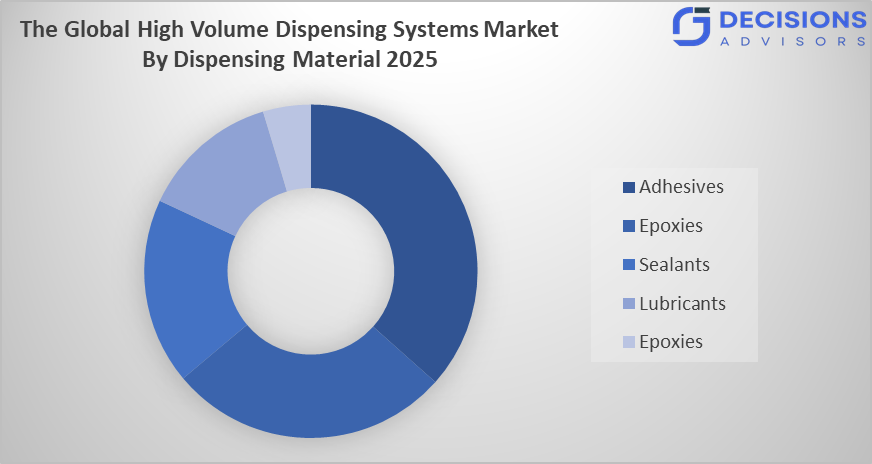
- The adhesives segment dominated the market in 2025 and is anticipated to grow at a significant CAGR of approximately 6.9% during the forecast period.
- The automotive segment dominated the market in 2025 and is anticipated to grow at a significant CAGR of approximately 6.8% during the forecast period.
- The compound annual growth rate of the Global High Volume Dispensing Systems Market is 6.15%.
- The market is likely to achieve a valuation of USD 3.45 billion by 2035.
What is role of technology in grooming the market?
Technology plays a crucial role in shaping the global high volume dispensing systems market by enhancing operational efficiency, accuracy, and scalability. Advanced automation technologies, including robotics and AI, streamline medication dispensing processes, reducing human errors and improving patient safety. Integration of cloud computing enables real-time data access, centralized monitoring, and seamless coordination across multiple pharmacy locations. Technologies such as RFID, barcode scanning, and electronic verification systems ensure precise tracking and regulatory compliance. Additionally, data analytics supports demand forecasting, inventory optimization, and workflow management. Continuous innovations in software and hardware are enabling faster processing of prescriptions, lowering operational costs, and supporting the growing demand for high-volume, centralized pharmacy services globally.
Market Drivers
The growth of the global high-volume dispensing systems market is primarily driven by the rising aging population and the increasing prevalence of chronic diseases, which boost medication demand. Pharmacies are increasingly adopting automated, high-throughput dispensing solutions to address workforce shortages and improve operational efficiency. Additionally, the growing incidence of medication errors has heightened the need for precise and reliable automated systems to enhance patient safety. The expansion of centralized and mail-order pharmacies further fuels demand, as these facilities must manage large prescription volumes efficiently. Moreover, seamless integration with pharmacy management systems (PMS) and electronic health records (EHR) improves workflow, accuracy, and overall productivity.
Restrain
The Global High Volume Dispensing Systems Market faces restraints due to high initial investment and maintenance costs, limiting adoption among small pharmacies. Integration challenges with the existing IT infrastructure and workflow disruptions also hinder growth. Additionally, concerns over data security, system errors, and the need for skilled personnel may restrict widespread implementation across healthcare facilities.
Competitive Analysis:
The report offers the appropriate analysis of the key organizations/companies involved within the global high volume dispensing systems market, along with a comparative evaluation primarily based on their product offerings, business overviews, geographic presence, enterprise strategies, segment market share, and SWOT analysis. The report also provides an elaborative analysis focusing on the current news and developments of the companies, which includes product development, innovations, joint ventures, partnerships, mergers & acquisitions, strategic alliances, and others. This allows for the evaluation of the overall competition within the market.
Top Companies in Global High Volume Dispensing Systems Market
- Omnicell, Inc.
- McKesson Corporation
- Becton, Dickinson and Company
- Innovation Associates
- ScriptPro LLC
- ARxIUM
- Swisslog Healthcare
- RxSafe, LLC
- TCGRx
- Healthmark Group
- Capsa Healthcare
- Yuyama Co., Ltd.
Government Initiatives
|
Country |
Key Government Initiatives |
|
US |
The Drug Supply Chain Security Act (DSCSA) reached its final implementation phase, mandating fully electronic and interoperable prescription tracking. High-volume dispensing systems were upgraded with compliant RFID and 2D barcode technologies to meet federal serialization and traceability requirements. |
|
UK |
The East of England NHS Collaborative Procurement Hub has standardized the acquisition of "Full Pack Robots" and "Unit Dose Robots." This allows NHS Trusts to bypass lengthy individual tenders, accelerating the rollout of high-volume systems to free up clinical staff for patient-facing roles. |
|
India |
The Department of Pharmaceuticals is actively supporting workshops and "MedTech Zones" (such as the one in Andhra Pradesh) to promote the domestic manufacturing of high-volume dispensing components. |
Study on the Supply, Demand, Distribution, and Market Environment of High Volume Dispensing Systems Market
The global high volume dispensing systems market demonstrates a strong balance between supply and demand, driven by rising prescription volumes and the need for automation in pharmacies and hospitals. Supply is supported by key manufacturers offering advanced robotic and software-integrated systems, while demand is increasing due to efficiency and patient safety requirements. Distribution channels include direct sales, third-party vendors, and healthcare system partnerships, ensuring a wide market reach. The market environment is highly competitive, shaped by technological innovation and regulatory compliance. Raw materials primarily include electronic components, sensors, robotics hardware, storage units, and durable plastics, which influence production costs and system reliability. Continuous advancements in these materials further enhance system performance and scalability.
Price Analysis and Consumer Behaviour Analysis
The Global High Volume Dispensing Systems Market reflects a strong price and consumer behavior dynamic driven by technological value and long-term efficiency. Pricing trends are influenced by advanced automation, software integration, and system capabilities, leading to premium costs for highly sophisticated solutions. From a consumer behavior perspective, hospitals and retail pharmacies prioritize return on investment, accuracy, and workflow efficiency over initial costs. Buyers increasingly prefer systems with AI, cloud integration, and scalability, as they help reduce labor dependency and minimize medication errors. Additionally, rising prescription volumes and the need for faster, reliable dispensing solutions are encouraging healthcare providers to invest in advanced systems despite higher upfront expenses.
Market Segmentation
The high volume dispensing systems market share is classified into dispensing mode, dispensing material, and end user
- The automatic dispensing segment dominated the market in 2025 and is anticipated to grow at a significant CAGR of approximately 7.3% during the forecast period.
Based on the dispensing mode, the high volume dispensing systems market is divided into manual dispensing and automatic dispensing. Among these,the automatic dispensing segment dominated the market in 2025 and is anticipated to grow at a significant CAGR of approximately 7.3% during the forecast period. The automatic dispensing segment dominated due to its ability to improve accuracy, reduce medication errors, and enhance workflow efficiency. Growing prescription volumes and labour shortages further drive adoption, as automated systems streamline operations, ensure compliance, and provide faster, reliable dispensing solutions in healthcare settings.
- The adhesives segment dominated the market in 2025 and is anticipated to grow at a significant CAGR of approximately 6.9% during the forecast period.
Based on the dispensing material, the high volume dispensing systems market is divided into adhesives, sealants, lubricants, epoxies, and greases. Among these, the adhesives segment dominated the market in 2025 and is anticipated to grow at a significant CAGR of approximately 6.9% during the forecast period. The growth of the adhesives segment is growing due to its essential role in labelling, packaging, and securing medication containers within dispensing systems. Increasing demand for reliable, durable, and tamper-evident packaging solutions, along with advancements in medical-grade adhesives, supports its steady growth in healthcare applications.
- The automotive segment dominated the market in 2025 and is anticipated to grow at a significant CAGR of approximately 6.8% during the forecast period.
Based on the end user, the high volume dispensing systems market is divided into automotive, electronics, medical, packaging, and aerospace. Among these, the automotive segment dominated the market in 2025 and is anticipated to grow at a significant CAGR of approximately 6.8% during the forecast period. The growth of the automotive segment is growing due to increasing demand for precision dispensing systems in manufacturing processes such as lubrication, coating, and assembly. Growing vehicle production and the need for efficiency, consistency, and reduced material wastage are driving the adoption of advanced dispensing technologies in the automotive industry.
Strategies to Implement for Growth of the Market in Non-Leading Regions
To drive growth in non-leading regions, companies in the global high volume dispensing systems market should focus on cost-effective and scalable solutions tailored to smaller healthcare facilities and emerging economies. Forming partnerships with local distributors and healthcare providers can improve market penetration and trust. Increasing awareness through training programs and demonstrations will help highlight efficiency and safety benefits. Flexible financing options, such as leasing and subscription models, can address budget constraints. Additionally, adapting systems to regional regulatory requirements and infrastructure limitations is essential. Investing in after-sales support and maintenance services further enhances adoption. Emphasizing digital integration and user-friendly interfaces can also accelerate acceptance and long-term growth in these developing markets.
Regional Segment Analysis of the High Volume Dispensing Systems Market
- North America (U.S., Canada, Mexico)
- Europe (Germany, France, U.K., Italy, Spain, Rest of Europe)
- Asia-Pacific (China, Japan, India, Rest of APAC)
- South America (Brazil and the Rest of South America)
- The Middle East and Africa (UAE, South Africa, Rest of MEA)
North America is anticipated to hold the largest share of approximately 40.1% the high volume dispensing systems market over the forecast period.
North America is anticipated to hold the largest share of approximately 40.1% the high volume dispensing systems market over the forecast period. The dominance of this region is primarily driven by advanced healthcare infrastructure, high adoption of automation technologies, and strong presence of key market players. Additionally, rising prescription volumes, strict regulatory standards, and increasing focus on patient safety and efficiency are driving demand for high volume dispensing systems.
Asia Pacific is expected to grow at a rapid CAGR of approximately 7.45% in the high volume dispensing systems market during the forecast period.
Asia Pacific is expected to grow at a rapid CAGR of approximately 7.45% in the high volume dispensing systems market during the forecast period. This growth is driven by expanding healthcare infrastructure, rising prescription volumes, and increasing adoption of pharmacy automation. Growing investments in hospitals and retail pharmacies, along with improving awareness of medication safety and efficiency, are driving demand for high volume dispensing systems.
Europe is the 3rd largest region to grow in the high volume dispensing systems market during the period.
Europe is the third largest region due to well-established healthcare systems and gradual adoption of pharmacy automation technologies. Increasing focus on medication safety, regulatory compliance, and efficiency, along with rising demand for advanced dispensing solutions in hospitals and retail pharmacies, supports steady market growth across the region.
Future Market Trends in Global High Volume Dispensing Systems Market: -
1. Rapid Shift Toward Advanced Automation & AI Integration
The rapid shift toward advanced automation and AI integration is driven by the need to minimize medication errors, improve dispensing accuracy, and handle rising prescription volumes efficiently. Automated systems reduce dependency on manual labour while enhancing workflow speed and compliance. Additionally, AI-powered analytics enable predictive inventory management, helping pharmacies optimize operations, reduce costs, and improve patient safety outcomes.
2. Growing Adoption of Cloud-Based Software & Data Analytics
The growing adoption of cloud-based software and data analytics is driven by the need for real-time visibility, centralized control, and scalable pharmacy operations. Cloud platforms enable seamless integration across multiple locations, improve inventory tracking, and ensure regulatory compliance. Advanced analytics further support demand forecasting, reduce stock outs, and enhance decision-making, ultimately improving operational efficiency and patient service quality.
3. Expansion of Central-Fill & High-Volume Pharmacy Models
The expansion of central-fill and high-volume pharmacy models is driven by increasing prescription demand and the need for cost-efficient operations. These centralized facilities use advanced automation to process large volumes with high accuracy and speed. They reduce labour costs, improve turnaround times, and support mail-order and retail pharmacies, enhancing scalability and overall service efficiency.
Recent Development
In April 2026, BD launched the Pyxis Pro Dispensing Solution and the BD Incada Connected Care Platform in Europe. This system utilizes AI-driven insights and a "refrigerated-to-ambient" storage configuration to maximize medication availability and security via RFID badge scanning.
In April 2026, Becton, Dickinson and Company partnered with Amazon Web Services (AWS) to host its Incada analytics platform, specifically utilizing the AWS European Sovereign Cloud to meet EU digital sovereignty and data privacy regulations.
In December 2025, the Titan XT was launched as a next-generation automated dispensing system powered by the OmniSphere cloud platform. It features AI-enabled "DynamicRestock" guided workflows and is expected to expand into international markets later in 2026.
How is Recent Developments Helping the Market?
Recent developments are significantly accelerating the growth of the global high volume dispensing systems market by enhancing efficiency, accuracy, and scalability. Advancements in robotics, artificial intelligence, and machine learning have enabled faster and error-free medication dispensing, reducing operational risks in pharmacies and hospitals. Integration of cloud-based platforms allows real-time data tracking, remote monitoring, and improved inventory management across multiple locations. Additionally, innovations in barcode scanning, RFID, and automated packaging systems have strengthened regulatory compliance and patient safety. Strategic partnerships, mergers, and product launches by key players are further expanding technological capabilities. These developments collectively support centralized pharmacy models, reduce labour dependency, and improve overall workflow, driving widespread adoption across healthcare systems.
Market Segment
This study forecasts revenue at global, regional, and country levels from 2020 to 2035. Decision Advisors has segmented the high volume dispensing systems market based on the below-mentioned segments:
Global High Volume Dispensing Systems Market, Dispensing Mode
- Manual Dispensing
- Automatic Dispensing
Global High Volume Dispensing Systems Market, By Dispensing Material
- Adhesives
- Sealants
- Lubricants
- Epoxies
- Greases
Global High Volume Dispensing Systems Market, By End User
- Automotive
- Electronics
- Medical
- Packaging
- Aerospace
Global High Volume Dispensing Systems Market, By Regional Analysis
- North America
- US
- Canada
- Mexico
- Europe
- Germany
- UK
- France
- Italy
- Spain
- Russia
- Rest of Europe
- Asia Pacific
- China
- Japan
- India
- South Korea
- Australia
- Rest of Asia Pacific
- South America
- Brazil
- Argentina
- Rest of South America
- Middle East & Africa
- UAE
- Saudi Arabia
- Qatar
- South Africa
- Rest of the Middle East & Africa
Frequently Asked Questions (FAQ)
Q How do high-volume dispensing systems impact pharmacy workforce productivity?
A. High-volume dispensing systems significantly enhance workforce productivity by automating repetitive and time-consuming tasks such as sorting, counting, labelling, and packaging medications. This reduces the burden on pharmacists and technicians, allowing them to focus more on clinical responsibilities and patient interaction. As a result, overall workflow efficiency improves, staff fatigue decreases, and healthcare facilities can manage higher prescription volumes without proportionally increasing workforce size.
Q. What challenges do manufacturers face in developing high-volume dispensing systems?
A. Manufacturers face several challenges, including ensuring system accuracy, maintaining compliance with evolving regulatory standards, and integrating advanced technologies like AI and robotics. Additionally, designing systems that are compatible with diverse healthcare IT infrastructures and scalable across different facility sizes can be complex. High R&D costs and the need for continuous innovation also create pressure to deliver cost-effective yet technologically advanced solutions.
Q. How are emerging markets contributing to the growth of high-volume dispensing systems?
A. Emerging markets are playing a crucial role in market expansion due to increasing healthcare investments, rising awareness of automation, and growing demand for efficient medication management systems. Governments and private healthcare providers in these regions are gradually adopting advanced dispensing technologies to improve service delivery, reduce errors, and handle growing patient populations, thereby creating new growth opportunities for global manufacturers.
Q. What role does interoperability play in high-volume dispensing systems?
A. Interoperability is essential as it allows dispensing systems to seamlessly communicate with other healthcare technologies such as hospital information systems, inventory management platforms, and electronic health records. This connectivity ensures real-time data exchange, improves coordination between departments, enhances accuracy in medication dispensing, and supports better decision-making, ultimately leading to more efficient and integrated healthcare operations.
Check Licence
Choose the plan that fits you best: Single User, Multi-User, or Enterprise solutions tailored for your needs.
We Have You Covered
- 24/7 Analyst Support
- Clients Across the Globe
- Tailored Insights
- Technology Tracking
- Competitive Intelligence
- Custom Research
- Syndicated Market Studies
- Market Overview
- Market Segmentation
- Growth Drivers
- Market Opportunities
- Regulatory Insights
- Innovation & Sustainability
Report Details
| Scope | Global |
| Pages | 240 |
| Delivery | PDF & Excel via Email |
| Language | English |
| Release | Apr 2026 |
| Access | Download from this page |