
Global Kidney Stone Market
 |
Author:
David J
|
Pages:
195
|
Author:
David J
|
Pages:
195
Global Kidney Stone Market Size, Share By Stone Type (Calcium Stones, Uric Acid Stones, Struvite Stones, Cystine Stones), By Treatment Type (Medication, Extracorporeal Shock Wave Lithotripsy, Ureteroscopy, Percutaneous Nephrolithotomy), By Diagnosis (Ultrasound, CT Scan, X-ray, Intravenous Pyelography, Others), By End User (Hospitals, Ambulatory Surgical Centers, Specialty Clinics), and By Region (North America, Europe, Asia-Pacific, Latin America, Middle East & Africa), Analysis and Forecast 2026?2035.
CAGR
5.9%
REVENUE 2025
USD Billion 3.1
FORECAST 2035
USD Billion 5.5
REPORT COVERAGE
Global
Market Snapshot
- Global Kidney Stone Market Size (2025): USD 3.1 Billion
- Global Kidney Stone Market Projected Market Size (2035): USD 5.5 Billion
- Global Kidney Stone Market Compound Annual Growth Rate (CAGR): 5.9%
- Largest Regional Market: North America
- Fastest Growing Region: Europe
- 3rd Largest Region: Asia Pacific
- Base Year: 2025
- Historical Period: 2021–2024
- Forecast Period: 2026–2035
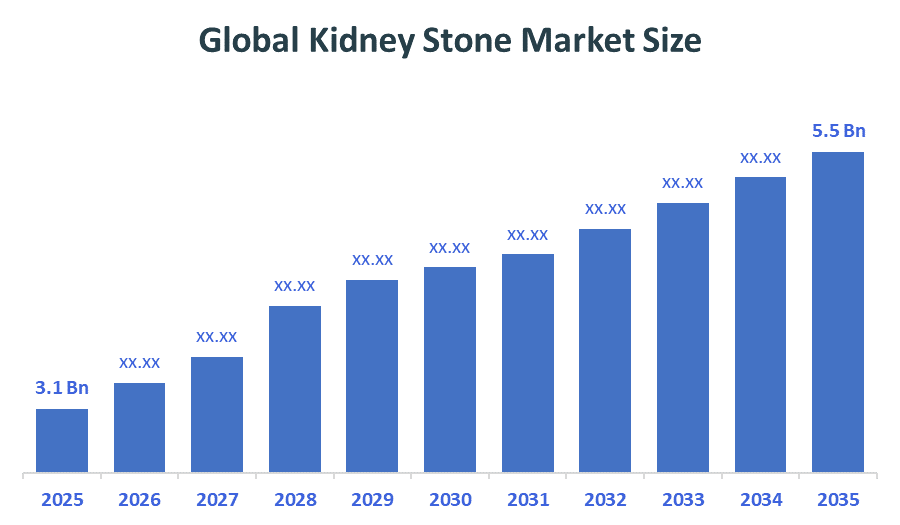
According to Decision Advisors, the Global Kidney Stone Market Size is expected to grow from USD 3.1 Billion in 2026 to USD 5.5 Billion by 2035, at a CAGR of 5.9% during the forecast period 2025-2035. The global Kidney Stone Market is projected to grow significantly over the next decade, driven by rising prevalence of urolithiasis, increasing adoption of minimally invasive procedures, and technological advancements in lithotripsy and endourology devices.
Market Overview/ Introduction
The Global Kidney Stone Market is no longer just about surgical tools, it is a global effort to protect the quality of life for the one in ten populations who will face this debilitating pain. As modern lifestyles lead to more frequent cases, the industry is shifting from cold clinical outcomes to a deeply human focus reducing fear and speeding up recovery. For families, government lifelines like India’s Ayushman Bharat or the PMNDP represent the difference between a medical crisis and a manageable recovery, ensuring that a sudden health shock doesn't become a financial disaster. Innovation is also becoming more personal. When companies like Boston Scientific and Olympus develop single-use digital ureteroscopes, they aren’t just selling hardware; they are removing the hidden anxiety of infection and offering patients peace of mind. The true heart of this market’s evolution is the move away from invasive, open surgeries toward high-precision lasers that dust stones into sand. This change gives patients their lives back in days rather than weeks, allowing them to return to their roles as parents and providers with dignity. Looking ahead, AI and robotics promise a future of proactive care, ensuring that treatment is as unique as the person receiving it.
- The global kidney stone market is supported by well-established healthcare systems such as the National Health Service, which ensure comprehensive management of Urolithiasis through advanced diagnostic imaging, medical therapies, and minimally invasive surgical procedures, thereby driving consistent demand for treatment technologies and urology services.
- Government healthcare initiatives, such as schemes by the Government of Karnataka, that cover treatments for Urolithiasis enhance patient access to urology procedures, reduce financial burden, and drive higher adoption of kidney stone treatments, supporting overall market growth.
Notable Insights: -
- North America is anticipated to hold approximately 37% share of the global Kidney stone market over the predicted timeframe.
- Europe is expected to grow at a rapid CAGR in the Kidney stone market by holding approximately 28% of the share during the forecast period.
- By stone type, the calcium stones segment dominated the market in 2025 and holds approximately 75% share, and is projected to grow at a substantial CAGR during the forecast period.
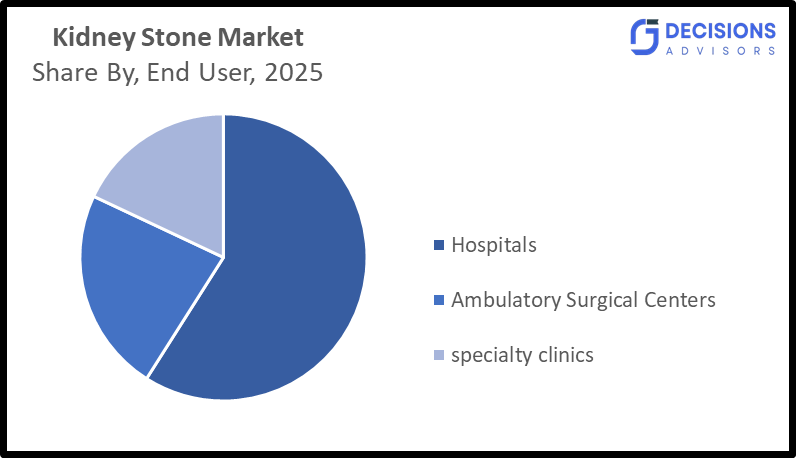
- By end user, the hospitals segment dominated the market and holds approximately 58% share in 2025, and is projected to grow at a substantial CAGR during the forecast period.
- The compound annual growth rate of the Global Kidney Stone Market is 5.9%.
- The market is likely to achieve a valuation of USD 5.5 Billion by 2035.
What is role of technology in grooming the market?
Technology plays a critical role in advancing the kidney stone market by improving diagnostic accuracy and treatment efficiency. Innovations such as high-power Holmium: YAG and Thulium fiber lasers enable faster and more effective stone fragmentation. Digital ureteroscopes and advanced imaging systems provide enhanced visualization, allowing precise targeting of stones. Robotic-assisted surgeries and AI-based imaging tools further improve clinical outcomes by increasing procedural accuracy and reducing complications. Additionally, non-invasive techniques like ESWL continue to evolve, offering safer outpatient treatment options. These technological improvements increase patient preference for minimally invasive procedures and drive market expansion globally.
Market Drivers
The global Kidney Stone Market is primarily driven by the rising global prevalence of urolithiasis, affecting nearly 1 in 10 individuals worldwide. Increasing risk factors such as obesity, dehydration, high sodium diets, and sedentary lifestyles are significantly contributing to disease incidence. For instance, studies indicate that obesity increases kidney stone risk by up to 75%, directly impacting treatment demand. The growing adoption of minimally invasive procedures is another key driver, as these techniques reduce hospital stays by approximately 40% and improve recovery time. Technological advancements in laser lithotripsy have achieved success rates exceeding 90%, boosting physician confidence and patient acceptance. Additionally, increasing healthcare expenditure and expanding access to advanced urological care in emerging economies are supporting procedural growth. The high recurrence rate of kidney stones ensures repeated treatment demand, creating a sustainable and expanding market environment.
Restrain
The global Kidney Stone Market faces challenges such as high treatment costs, especially for advanced procedures like laser lithotripsy and robotic-assisted surgeries. Limited access to advanced healthcare facilities in developing regions may restrict market growth. Additionally, a lack of awareness regarding preventive measures and recurrence management can hinder early diagnosis and treatment. Risks associated with procedures, such as infection or ureteral injury, may also impact patient adoption.
Competitive Analysis:
The report offers the appropriate analysis of the key organizations/companies involved within the global kidney stone market, along with a comparative evaluation primarily based on their product of offering, business overviews, geographic presence, enterprise strategies, segment market share, and SWOT analysis. The report also provides an elaborative analysis focusing on the current news and developments of the companies, which includes product development, innovations, joint ventures, partnerships, mergers & acquisitions, strategic alliances, and others. This allows for the evaluation of the overall competition within the market.
Top Companies in the Global Kidney Stone Market
- Boston Scientific Corporation
- Olympus Corporation
- Cook Medical
- Karl Storz SE & Co. KG
- Dornier MedTech
- Becton, Dickinson and Company
- Richard Wolf GmbH
- Coloplast A/S
- EMS Electro Medical Systems
- Lumenis Ltd.
Government Initiatives
|
Country |
Key Government Initiatives |
|
India |
Free kidney stone operations in are now possible through government schemes like Mahatma Jyotiba Phule Jan Arogya Yojana (MJPJAY) and Ayushman Bharat – PMJAY. |
|
US |
NIH-Funded USDHub Project: A $7.37 million grant supports the Urinary Stone Disease Hub, aggregating data from 230,000+ patients across nine health systems |
|
Europe |
The 2026 Horizon Europe ‘Health’ calls include a EUR 7.3 billion total budget for research careers and competitiveness. Specific 2025–2026 initiatives like EU4Health focus on the resilience of healthcare systems, including better management of chronic conditions like kidney stones. |
Study on the Supply, Demand, Distribution, and Market Environment of the Global Kidney Stone Market
The global Kidney Stone Market demonstrates strong demand due to the increasing prevalence of urolithiasis and rising awareness about minimally invasive treatment options. Supply is driven by advanced lithotripsy devices, ureteroscopes, and laser systems developed by leading manufacturers. Distribution occurs through hospitals, ambulatory surgical centers, and specialty clinics, supported by direct sales and distributor networks. Favorable healthcare policies, technological advancements, and increasing patient awareness contribute to a positive market environment globally.
Price Analysis and Consumer Behaviour Analysis
The global Kidney stone market is witnessing increased spending due to rising procedure volumes and demand for advanced treatment technologies. Patients are increasingly opting for minimally invasive procedures despite higher costs due to benefits such as reduced pain, shorter recovery time, and lower complication rates. Hospitals and healthcare providers are investing in high-end equipment to improve clinical outcomes and attract patients. Additionally, growing awareness about early diagnosis and preventive care is influencing consumer behaviour, encouraging timely treatment and follow-up procedures.
Market Segmentation
The kidney stone market share is classified into stone type, treatment type, diagnosis and end user
- The calcium stones segment dominated the market in 2025 and holds approximately 75% share, and is projected to grow at a substantial CAGR during the forecast period.
Based on the stone type, the global kidney stone market is divided into calcium stones, uric acid stones, struvite stones, and cystine stones. Among these, the calcium stones segment dominated the market in 2025 and holds approximately 75% share, and is projected to grow at a substantial CAGR during the forecast period. Calcium stones (primarily calcium oxalate) dominate due to their high global prevalence, accounting for nearly 3 out of 4 kidney stone cases. This dominance is driven by increasing dietary risk factors such as high sodium intake, dehydration, and metabolic disorders. Uric acid stones represent the second-largest segment and are growing steadily due to rising cases of obesity and metabolic syndrome. Struvite and cystine stones account for a smaller share but require complex treatment due to higher recurrence and infection-related complications.
- The extracorporeal shock wave lithotripsy segment dominated the market with approximately 41% share in 2025, and is projected to grow at a significant CAGR during the forecast period.
Based on the treatment type, the global kidney stone market is divided into reusable ureteroscopes and disposable ureteroscopes. Among these, the extracorporeal shock wave lithotripsy (ESWL) segment dominated the market with approximately 41% share in 2025, and is projected to grow at a significant CAGR during the forecast period. Due to its non-invasive nature and widespread availability, it is the first-line treatment for small to medium-sized stones. Medication accounts for nearly 30% of the market, primarily used for pain management and prevention of recurrence. Ureteroscopy is the fastest-growing segment, supported by high success rates and increasing adoption of minimally invasive procedures, while PCNL is preferred for large and complex stones, contributing a moderate share.
- The CT scan segment dominated the market with approximately 38% share in 2025, and is projected to grow at a significant CAGR during the forecast period.
Based on the diagnosis, the global kidney stone market is divided into ultrasound, CT scan, X-ray, intravenous pyelography, and others. Among these, the CT scan segment dominated the market with approximately 38% share in 2025, and is projected to grow at a significant CAGR during the forecast period. CT scans dominate due to their high accuracy above 95% in detecting stone size, location, and composition, making them the gold standard in diagnosis. Ultrasound is widely used as a first-line imaging technique due to its cost-effectiveness and safety, especially in developing regions. X-rays and intravenous pyelography are used in specific cases but have lower sensitivity compared to CT imaging.
- The hospitals segment dominated the market and holds approximately 58% share in 2025, and is projected to grow at a substantial CAGR during the forecast period.
Based on end user, the global kidney stone market is divided into hospitals, ambulatory surgical centers, and specialty clinics. Among those, the hospitals segment dominated the market and holds approximately 58% share in 2025, and is projected to grow at a substantial CAGR during the forecast period. This is due to the availability of advanced surgical infrastructure, skilled professionals, and higher patient volumes. Ambulatory surgical centers are expected to witness the fastest growth due to increasing preference for outpatient procedures and cost-effective treatments, while specialty clinics contribute a moderate share with increasing adoption of advanced urology services.
Strategies to Implement for Growth of the Market in Non-Leading Regions
To expand the kidney stone market in non-leading regions companies and healthcare stakeholders should focus on a combination of infrastructure development, affordability, and awareness-driven strategies. One of the most critical approaches is strengthening healthcare infrastructure by equipping hospitals and emerging healthcare centers with advanced urology devices such as lithotripsy systems and ureteroscopy equipment. Many Tier 2 and Tier 3 cities still lack access to minimally invasive treatment options, despite kidney stones affecting nearly 10–15% of the population globally. Expanding surgical capabilities in these regions can significantly increase treatment volumes.
Regional Segment Analysis of the Global Kidney Stone Market
- North America (U.S., Canada, Mexico)
- Europe (Germany, France, U.K., Italy, Spain, Rest of Europe)
- Asia-Pacific (China, Japan, India, Rest of APAC)
- South America (Brazil and the Rest of South America)
- The Middle East and Africa (UAE, South Africa, Rest of MEA)
North America is anticipated to hold approximately 38% share of the Global Kidney Stone Market over the predicted timeframe.
North America is anticipated to hold approximately 37% share of the global kidney stone market over the predicted timeframe. It is due to its well-established healthcare infrastructure, high procedural volumes, and strong adoption of minimally invasive technologies. The United States is the key contributor, where kidney stones affect nearly 1 in 10 individuals, creating a large and recurring patient pool. The region benefits from high healthcare expenditure (over USD 12,000 per capita annually in the U.S.) and favorable reimbursement policies for procedures such as ureteroscopy and lithotripsy. Additionally, the widespread use of advanced technologies, including laser lithotripsy systems and single-use ureteroscopes, supports procedural success rates exceeding 90%, thereby sustaining strong regional demand and market share.
Europe is expected to grow at a rapid CAGR in the Global Kidney Stone market by holding approximately 29% of the share during the forecast period.
Europe is expected to grow at a rapid CAGR in the global kidney stone market by holding approximately 29% of the share during the forecast period. The prevalence of kidney stones in Europe ranges between 5–9% of the population, with rising incidence linked to lifestyle and dietary changes. Key countries such as Germany, France, and the United Kingdom focus heavily on minimally invasive procedures, supported by strong regulatory frameworks and reimbursement systems. Investments in hospital infrastructure and increasing use of laser-based lithotripsy and ureteroscopic procedures are improving treatment outcomes and driving steady market growth across the region.
Asia Pacific is the 3rd largest region to grow in the Global Kidney Stone Market during the period.
The Asia Pacific region is experiencing rapid growth due to the prevalence of global kidney stone market, which is estimated at approximately 10%, with a higher incidence in countries with warmer climates. Emerging economies such as China and India are witnessing rapid growth due to improving healthcare infrastructure, increasing awareness, and expanding access to minimally invasive treatments. Government initiatives to strengthen healthcare systems, along with the rise of private hospitals and medical tourism, are further boosting procedural volumes. Additionally, increasing adoption of cost-effective lithotripsy technologies and outpatient procedures is accelerating market expansion across the region.
Future Market Trends in Global Kidney Stone Market: -
- Rapid Shift Toward Minimally Invasive & Non-Invasive Procedures
One of the most dominant future trends is the increasing adoption of minimally invasive treatments such as ureteroscopy, laser lithotripsy, and extracorporeal shock wave lithotripsy (ESWL). These procedures are becoming the standard of care due to reduced hospital stays, faster recovery, and lower complication rates. Studies show that minimally invasive procedures are now preferred in the majority of cases, with success rates exceeding 90%, significantly improving patient outcomes. Additionally, the demand for lithotripsy devices is growing at a CAGR of over 6%, largely driven by this shift toward less invasive treatments. This trend will continue to accelerate as healthcare systems prioritize outpatient care and cost efficiency, making minimally invasive solutions the backbone of future market growth.
- Advancements in Laser & Digital Technologies
Technological innovation is transforming kidney stone treatment, particularly through the development of high-power laser systems (Holmium: YAG and Thulium Fiber Laser) and advanced digital imaging.
New-generation laser technologies offer:
- Faster stone fragmentation
- Higher precision
- Reduced procedure time
For example, Thulium fiber lasers are gaining traction due to superior “dusting” capabilities and improved safety profiles. Additionally, integration of AI-based imaging and real-time visualization systems is enhancing diagnostic accuracy and surgical outcomes.
- Expansion of Outpatient & Ambulatory Care Settings
There is a strong shift toward ambulatory surgical centers (ASCs) and same-day procedures, driven by cost-effectiveness and patient convenience. Lithotripsy and other kidney stone treatments are increasingly performed in outpatient settings, reducing hospitalization costs by 40% and improving patient turnover. The growing number of ASCs globally is further supporting this trend. Additionally, the integration of telemedicine and remote monitoring for post-operative care is improving follow-up outcomes and patient management, making outpatient care a key future growth driver.
Recent Development
- In March 2026, Boston Scientific announced that it had received U.S. Food and Drug Administration (FDA) 510(k) clearance for its Asurys Fluid Management System, marking a significant technological advancement in the kidney stone treatment market.
- In March 2026, Cook Medical announced the commercial launch of two new urology products aimed at improving kidney stone management procedures. The company introduced the Syfonix Suction Ureteral Access Sheath and a 7.5 Fr Ascend single-use flexible ureteroscope.
- In January 2026, SonoMotion received U.S. FDA 510(k) clearance for its Break Wave lithotripsy system, introducing a non-invasive approach to kidney stone treatment. The system uses low-pressure focused ultrasound to fragment stones without surgery or anesthesia, allowing treatment in outpatient and clinical settings.
- In September 2025, Dornier MedTech America announced the U.S. launch of its Hoover Flexible and Navigable Suction (FANS) ureteral access sheath and Axis II Slim single-use ureteroscope, expanding advanced solutions for kidney stone treatment.
- In December 2024, Calyxo announced results from its ASPIRE clinical trial, demonstrating superior outcomes for its CVAC System in kidney stone treatment. The study showed that the SURE procedure using the CVAC System achieved approximately 97% stone clearance, compared to 93% with standard ureteroscopy, highlighting improved efficacy in stone removal.
How is Recent Developments Helping the Market?
Recent developments are enhancing the kidney stone market by improving treatment efficiency, expanding procedural capabilities, and increasing accessibility. Advanced laser technologies enable faster stone fragmentation, reducing procedure time and improving patient outcomes. The introduction of digital imaging and disposable devices supports infection control and operational efficiency. Additionally, increasing adoption of outpatient procedures and government healthcare initiatives are expanding access to treatment, driving overall market growth.
Market Segment
This study forecasts revenue at global, regional, and country levels from 2020 to 2035. Decision Advisors has segmented the global kidney stone market based on the below-mentioned segments:
Global Kidney Stone Market, By Stone Type
- Calcium stones
- Uric acid stones
- Struvite stones
- Cystine stones
Global Kidney Stone Market, By Treatment Type
- Medication
- Extracorporeal shock wave lithotripsy
- Ureteroscopy
- Percutaneous nephrolithotomy
Global Kidney Stone Market, By Diagnosis
- Ultrasound
- CT scan
- X-ray
- Intravenous pyelography
- Others
Global Kidney Stone Market, By End user
- Hospitals
- Ambulatory surgical centers
- Specialty clinics
Global Kidney Stone Market, By Regional Analysis
- North America
- US
- Canada
- Mexico
- Europe
- Germany
- UK
- France
- Italy
- Spain
- Russia
- Rest of Europe
- Asia Pacific
- China
- Japan
- India
- South Korea
- Australia
- Rest of Asia Pacific
- South America
- Brazil
- Argentina
- Rest of South America
- Middle East & Africa
- UAE
- Saudi Arabia
- Qatar
- South Africa
- Rest of the Middle East & Africa
Frequently Asked Questions (FAQ)
Q. How does climate change impact the kidney stone market?
A. Rising global temperatures and increasing dehydration levels are contributing to a higher incidence of kidney stones, particularly in tropical and subtropical regions. Studies indicate that warmer climates can increase kidney stone cases by up to 20%, thereby driving long-term demand for diagnosis and treatment solutions.
Q. What role does diet play in influencing market demand?
A. Dietary patterns such as high sodium intake, excessive protein consumption, and low water intake significantly increase the risk of kidney stone formation. As unhealthy dietary habits rise globally, especially in urban populations, the demand for preventive care, diagnostics, and treatment procedures is expected to grow.
Q. How are wearable and digital health technologies impacting kidney stone management?
A. Emerging digital health tools, including hydration tracking apps and wearable devices, are helping patients monitor risk factors and prevent recurrence. These technologies support early intervention and reduce hospital visits, indirectly influencing the demand for advanced diagnostic and monitoring solutions.
Q. What is the economic burden of kidney stones on healthcare systems?
A. Kidney stones impose a significant financial burden due to emergency visits, surgical procedures, and recurrence management. In developed countries, annual treatment costs run into billions of dollars, making cost-effective and preventive solutions increasingly important for healthcare providers.
Q. How does patient age distribution affect the kidney stone market?
A. While kidney stones are most common in adults aged 30–60 years, there is a rising incidence among younger populations due to lifestyle changes. This expanding patient base is increasing long-term demand for both treatment and preventive care solutions, supporting sustained market growth.
Check Licence
Choose the plan that fits you best: Single User, Multi-User, or Enterprise solutions tailored for your needs.
We Have You Covered
- 24/7 Analyst Support
- Clients Across the Globe
- Tailored Insights
- Technology Tracking
- Competitive Intelligence
- Custom Research
- Syndicated Market Studies
- Market Overview
- Market Segmentation
- Growth Drivers
- Market Opportunities
- Regulatory Insights
- Innovation & Sustainability
Report Details
| Scope | Global |
| Pages | 195 |
| Delivery | PDF & Excel via Email |
| Language | English |
| Release | Apr 2026 |
| Access | Download from this page |