
Global Nephroureteral Stents Market
 |
Author:
Disha B
|
Pages:
210
|
Author:
Disha B
|
Pages:
210
Global Nephroureteral Stents Market Size, Share By Type (Internal Stents, External Stents), By Material (Polyurethane, Silicone, Hybrid), By Application (Kidney Stones, Ureteral Obstruction, Post-Surgical Drainage, Others), By End User (Hospitals & Clinics, Ambulatory Surgical Centers, Others) and By Region (North America, Europe, Asia-Pacific, Latin America, Middle East & Africa), Analysis and Forecast 2025?2035.
CAGR
6.55%
REVENUE 2025
USD Billion 3.5
FORECAST 2035
USD Billion 6.6
REPORT COVERAGE
Global
Market Snapshot
- Global Nephroureteral Stents Market Size (2025): USD 3.5 Billion
- Projected Global Nephroureteral Stents Market Size (2035): USD 6.6 Billion
- Global Nephroureteral Stents Market Compound Annual Growth Rate (CAGR): 6.55%
- Largest Regional Market: North America
- 2nd Largest Region: Europe
- Fastest Growing Region: Asia-Pacific
- Base Year: 2025
- Historical Period: 2021–2024
- Market Forecast Period: 2026–2035
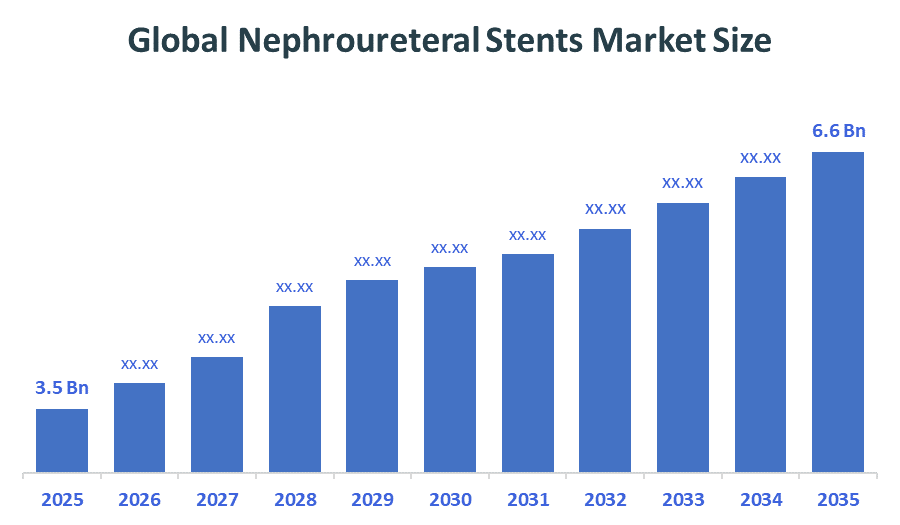
According to Decision Advisors, the Global Nephroureteral Stents Market Size is expected to grow from USD 3.5 Billion in 2025 to USD 6.6 Billion by 2035, at a CAGR of 6.55% during the forecast period 2025-2035. The Global Nephroureteral Stents Market is projected to grow significantly over the next decade. The growth is driven by the rising prevalence of urological disorders, increasing incidence of kidney stones, and growing adoption of minimally invasive procedures.
Market Overview/ Introduction
The Global Nephroureteral Stent Market is defined by flexible tubes that bypass obstructions like stones or tumors. the market is growing rapidly due to an aging global population and a rising preference for minimally invasive surgeries. Governments in North America and Europe are cutting through the red tape to get breakthrough medical tools to patients faster, while in developing countries, better insurance and healthcare spending are finally making these life-saving treatments affordable for millions. On the business side, giants like Boston Scientific and Cook Medical are putting patients first by reinventing the stent itself. They are pouring money into high-tech vanishing stents that dissolve on their own and special coatings that fight off infections, all to make the recovery process much smoother and less painful for the person on the table. The primary market advantage lies in the clinical necessity of these devices; they are indispensable tools that prevent permanent kidney damage and reduce long-term hospital costs. Looking forward, the most significant future opportunities reside in smart technology, including 3D-printed custom stents and sensors that monitor blockages in real-time.
- Nearly 62% of leading companies in the nephroureteral (ureteral) stents market adopt partnership and collaboration strategies with hospitals, clinics, and distributors to expand market reach and improve product adoption.
- Additionally, around 65% of total sales are generated through direct hospital collaborations and contracts, highlighting the critical role of partnerships in distribution and revenue generation
Notable Insights: -
- North America is anticipated to hold approximately 38% share of the Global Nephroureteral Stents Market over the predicted timeframe.
- Europe is expected to grow at a rapid CAGR in the Nephroureteral Stents Market by holding approximately 27% of the share during the forecast period.
- By type, the internal stents segment dominated the market and holds approximately 62% share in 2025 and is projected to grow at a substantial CAGR during the forecast period.
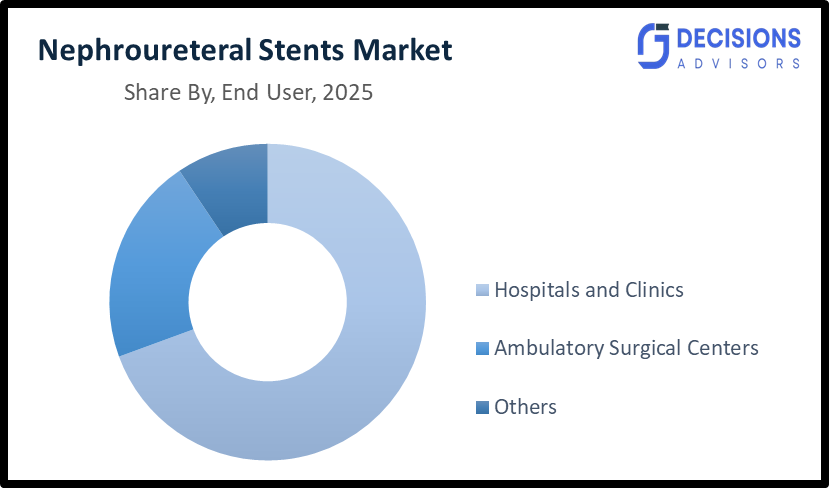
- By end user, the hospitals & clinics segment dominated the market and holds approximately 59% share in 2025 and is projected to grow at a substantial CAGR during the forecast period.
- The compound annual growth rate of the Global Nephroureteral Stents Market is 6.55%.
- The market is likely to achieve a valuation of USD 6.6 Billion by 2035.
What is the role of technology in grooming the market?
Technology plays a vital role in advancing the nephroureteral stents market. Innovations such as drug-eluting stents, hydrophilic coatings, and biodegradable materials are significantly improving patient outcomes. Imaging technologies like fluoroscopy and ultrasound enhance placement accuracy, reducing procedural complications. Additionally, AI-assisted imaging and robotic-assisted urological procedures are improving precision, reducing operation time, and increasing success rates. These advancements are driving higher adoption rates globally.
Market Drivers
The Global Nephroureteral Stents Market reflects a deeply personal shift in urological care, driven by the growing prevalence of kidney stones, affecting nearly one in eight people worldwide. Over the past decade, a 30% transition toward minimally invasive procedures have increased the adoption of nephroureteral stents, which support effective urinary drainage and faster patient recovery. These stents are especially critical for the 25–30% of patients with complex conditions such as urological cancers and ureteral strictures, where maintaining kidney function is essential. Additionally, an aging global population and rising awareness of urological health are accelerating demand for advanced, patient-friendly stent technologies, positioning the market for sustained growth and continuous innovation in care delivery.
Restrain
The market faces challenges such as stent-related complications, including infections, encrustation, and discomfort. High costs of advanced stents and limited access to specialized urological care in developing regions may restrict growth. Additionally, frequent need for stent replacement (every 3–6 months) can increase patient burden and healthcare costs.
Competitive Analysis:
The report offers the appropriate analysis of the key organizations/companies involved within the Global Nephroureteral Stents Market, along with a comparative evaluation primarily based on their product of offering, business overviews, geographic presence, enterprise strategies, segment market share, and SWOT analysis. The report also provides an elaborative analysis focusing on the current news and developments of the companies, which includes product development, innovations, joint ventures, partnerships, mergers & acquisitions, strategic alliances, and others. This allows for the evaluation of the overall competition within the market.
Top Companies in the Global Nephroureteral Stents Market
- Boston Scientific Corporation
- Cook Medical
- Coloplast A/S
- B. Braun Melsungen AG
- Olympus Corporation
- Teleflex Incorporated
- Becton, Dickinson and Company
- Merit Medical Systems, Inc.
- Allium Medical Solutions Ltd.
- PNN Medical A/S
Government Initiatives
|
Country |
Key Government Initiatives |
|
India |
PRIP & PLI Schemes: The Production Linked Incentive (PLI) Scheme (FY2022–23 to FY2026–27) with a ?3,420 crore outlay incentivises domestic production of high-end medical devices. Approved manufacturers for stents and catheters include Meril Healthcare and Bio India Interventional Technologies. |
|
US |
2026 CMS Final Rule: Effective January 1, 2026, the Centers for Medicare and Medicaid Services (CMS) updated the Physician Fee Schedule (PFS), increasing the Conversion Factor by 3.26% for most physicians. |
|
China |
Price Compression: Following its success with coronary stents, China expanded Volume-Based Procurement (VBP) to high-value medical consumables, resulting in average price reductions of nearly 80–95%. |
Study on the Supply, Demand, Distribution, and Market Environment of the Nephroureteral Stents Market
The Nephroureteral Stents Market demonstrates a balanced and steadily expanding ecosystem driven by rising urological disease burden and improving healthcare access. Demand is primarily fueled by the increasing prevalence of kidney stones and ureteral obstruction, with urolithiasis affecting approximately 10–15% of the global population, creating a consistent need for stent placement in both emergency and elective procedures. Additionally, growing adoption of minimally invasive urological procedures, which has increased by over 30% in the past decade, is further strengthening demand. On the supply side, leading medical device manufacturers are focusing on innovation in biocompatible materials, hydrophilic coatings, and biodegradable stents, ensuring a steady pipeline of advanced products. Distribution is largely dominated by hospitals and clinics, accounting for nearly 58–60% of total usage, supported by expanding ambulatory surgical centers and specialty urology clinics that are enhancing accessibility, especially in urban areas.
Price Analysis and Consumer Behaviour Analysis
The nephroureteral stents market demonstrates moderate-to-premium pricing dynamics, influenced by material type, technology, and healthcare infrastructure. Advanced stents such as drug-eluting, hydrophilic-coated, and biodegradable stents are priced significantly higher than conventional polymer stents due to their enhanced performance and reduced complication rates. On average, polymer-based stents dominate with over 65–67% share due to their cost-effectiveness and widespread adoption, particularly in developing regions. In contrast, metallic and advanced coated stents are priced at a premium but are preferred in chronic and complex cases due to their longer durability and lower replacement frequency.
Market Segmentation
The Nephroureteral Stents Market share is classified into type, material, application and end user
- The internal stents segment dominated the market and holds approximately 62% share in 2025 and is projected to grow at a substantial CAGR during the forecast period.
Based on the type, the Nephroureteral Stents Market is divided into internal stents and external stents. Among these, the internal stents segment dominated the market and holds approximately 62% share in 2025 and is projected to grow at a substantial CAGR during the forecast period. This dominance is attributed to their ease of placement, better patient comfort, and reduced risk of external infection compared to external drainage systems. Internal stents are widely used in long-term management of ureteral obstruction and post-surgical drainage. External stents, although useful in complex cases, are associated with higher maintenance and patient discomfort, leading to relatively slower growth.
- The polyurethane segment accounted for the largest share of approximately 44% in 2025 and is anticipated to grow at a significant CAGR during the forecast period.
Based on the materials, the Nephroureteral Stents Market is divided into polyurethane, silicone, and hybrid materials. Among these, the ultrasound segment accounted for the largest share of approximately 46% in 2025 and is anticipated to grow at a significant CAGR during the forecast period. This growth is driven by its high strength, flexibility, and cost-effectiveness, making it suitable for a wide range of clinical applications. Silicone stents are also gaining traction due to their superior biocompatibility and lower encrustation rates, while hybrid materials are emerging with enhanced performance characteristics.
- The kidney stones segment accounted for the largest share of approximately 48% in 2025 and is anticipated to grow at a significant CAGR during the forecast period.
Based on the application, the Nephroureteral Stents Market is divided into kidney stone, ureteral obstruction, post-surgical drainage, and others. Among these, the kidney stones segment accounted for the largest share of approximately 48% in 2025 and is anticipated to grow at a significant CAGR during the forecast period. This is primarily due to the high global prevalence of urolithiasis and increasing number of minimally invasive procedures such as ureteroscopy and lithotripsy, where stents are routinely used. The ureteral obstruction segment also contributes significantly, particularly in cases related to malignancies and strictures.
- The hospitals & clinics segment dominated the market and holds approximately 59% share in 2025 and is projected to grow at a substantial CAGR during the forecast period.
Based on end user, the Nephroureteral Stents Market is divided into hospitals & clinics, ambulatory surgical centers, and others. Among those, the hospitals & clinics segment dominated the market and holds approximately 59% share in 2025 and is projected to grow at a substantial CAGR during the forecast period, owing to advanced healthcare infrastructure, availability of skilled urologists, and higher procedural volumes. Ambulatory surgical centers are also witnessing strong growth due to the increasing shift toward minimally invasive outpatient procedures, offering cost efficiency and faster patient turnaround.
Strategies to Implement for Growth of the Market in Non-Leading Regions
To expand the nephroureteral stents market in non-leading regions, companies should focus on strengthening urological care infrastructure by supporting hospitals and clinics with cost-effective stent technologies and minimally invasive equipment. Increasing awareness about kidney stone management and urinary tract disorders through public health campaigns is essential to promote early diagnosis and timely intervention. Improving access to treatment can be achieved by introducing affordable stent options, including polyurethane-based and reusable delivery systems, which can reduce procedural costs. Training programs for urologists and interventional radiologists are critical to enhance procedural efficiency and encourage adoption of advanced techniques such as fluoroscopy-guided and endoscopic stent placement.
Regional Segment Analysis of the Nephroureteral Stents Market
- North America (U.S., Canada, Mexico)
- Europe (Germany, France, U.K., Italy, Spain, Rest of Europe)
- Asia-Pacific (China, Japan, India, Rest of APAC)
- South America (Brazil and the Rest of South America)
- The Middle East and Africa (UAE, South Africa, Rest of MEA)
North America is anticipated to hold approximately 38% share of the global nephroureteral stents market over the predicted timeframe.
North America is anticipated to hold approximately 38% share of the global nephroureteral stents market over the predicted timeframe. It maintains dominant market leadership due to well-established healthcare infrastructure, high prevalence of kidney stones and urological disorders, and strong adoption of advanced minimally invasive urological procedures. The United States is the key driver, supported by high healthcare expenditure, availability of skilled urologists, and widespread use of technologies such as ureteroscopy and fluoroscopy-guided stent placement. Additionally, increasing adoption of drug-eluting stents, hydrophilic-coated stents, and outpatient urological procedures across hospitals and ambulatory surgical centers further strengthens regional demand and market share.
Europe is expected to grow at a rapid CAGR in the nephroureteral stents market by holding approximately 27% of the share during the forecast period
Europe is expected to grow at a rapid CAGR in the nephroureteral stents market by holding approximately 27% of the share during the forecast period Europe’s market is supported by well-established healthcare systems, rising incidence of urolithiasis, and increasing adoption of advanced urological devices and minimally invasive procedures. Key countries such as Germany, France, and the United Kingdom emphasize early diagnosis and effective management of urinary tract disorders, contributing to higher procedural volumes involving stent placement. Ongoing investments in healthcare infrastructure, favorable reimbursement policies, and the presence of skilled professionals are driving steady market growth across the region.
Asia Pacific is the fastest-growing region in the nephroureteral stents market during the period, holding approximately 24% share.
Asia Pacific is the fastest-growing region in the nephroureteral stents market during the period, holding approximately 24% share. This growth is driven by rising healthcare investments, increasing prevalence of kidney stones, and improving access to urological care. Countries such as China, India, and Japan are witnessing increasing patient volumes due to large population bases, changing dietary patterns, and rising incidence of urological disorders. Government initiatives supporting healthcare infrastructure, expansion of private hospitals, adoption of advanced stent technologies, and growing medical tourism are further contributing to the rising demand and overall market expansion in the region.
Future Market Trends in Global Nephroureteral Stents Market: -
- Rapid Adoption of Biodegradable and Drug-Eluting Stents
The market is witnessing a strong shift toward biodegradable and drug-eluting nephroureteral stents, which eliminate the need for secondary removal procedures and reduce complications such as infections and encrustation. These advanced stents are expected to improve patient compliance and reduce long-term healthcare costs, making them a key future growth driver.
- Increasing Preference for Minimally Invasive and Outpatient Procedures
There is a growing transition toward minimally invasive urological procedures, such as ureteroscopy and percutaneous nephrostomy, where nephroureteral stents are routinely used. The rise of ambulatory surgical centers is enabling faster recovery, reduced hospital stays, and cost-effective treatment, significantly boosting demand for stents globally.
- Technological Advancements in Stent Design and Materials
Continuous innovation in stent materials and coatings, including hydrophilic coatings, anti-microbial layers, and flexible polymer designs, is enhancing patient comfort and reducing complications. Smart stents and sensor-enabled technologies are also emerging, enabling real-time monitoring of urinary flow and early detection of blockages, which is expected to transform future urological care.
Recent Development
- In April 2026, the development of biodegradable ureteral stents (BUS) is gaining momentum, marking a significant advancement in urological care. Unlike conventional ureteral stents, BUS are designed to naturally degrade within the body, eliminating the need for secondary removal procedures and reducing long-term complications such as infection, encrustation, and patient discomfort.
- In March 2026, UroNova GmbH announced clinical study results for a novel stent coating that virtually eliminates severe encrustation and reduces patient pain by 66%, all without the use of pharmacological agents.
- In January 2025, The U.S. Food and Drug Administration granted 510(k) clearance to the RELIEF ureteral stent for the prevention of vesicoureteral reflux (VUR), marking a significant advancement in urological device innovation.
- In May 2024, Dornier MedTech announced the launch of UroGPT, a first-of-its-kind artificial intelligence tool designed to support patients suffering from Kidney Stones.
How is Recent Developments Helping the Market?
Recent developments in the Nephroureteral Stents Market are playing a crucial role in improving clinical outcomes, patient comfort, and overall market adoption, thereby accelerating market growth. Advancements in stent materials and coating technologies have significantly reduced complications such as infection, encrustation, and biofilm formation. Modern stents with anti-microbial and hydrophilic coatings help inhibit bacterial colonization and improve biocompatibility, leading to better patient outcomes and fewer hospital readmissions. Additionally, innovations in polymer and hybrid materials have enhanced flexibility, durability, and patient comfort, making stents more suitable for long-term use.
Market Segment
This study forecasts revenue at global, regional, and country levels from 2020 to 2035. Decision Advisors has segmented the Global Nephroureteral Stents Market based on the below-mentioned segments:
Global Nephroureteral Stents Market, By Type
- Internal Stents
- External Stents
Global Nephroureteral Stents Market, By Materials
- Polyurethane
- Silicone
- Hybrid
Global Nephroureteral Stents Market, By Application
- Kidney Stones
- Ureteral Obstruction
- Post-Surgical Drainage
- Others
Global Nephroureteral Stents Market, By End user
- Hospitals & Clinics
- Ambulatory Surgical Centers
- Others
Global Nephroureteral Stents Market, By Regional Analysis
- North America
- US
- Canada
- Mexico
- Europe
- Germany
- UK
- France
- Italy
- Spain
- Russia
- Rest of Europe
- Asia Pacific
- China
- Japan
- India
- South Korea
- Australia
- Rest of Asia Pacific
- South America
- Brazil
- Argentina
- Rest of South America
- Middle East & Africa
- UAE
- Saudi Arabia
- Qatar
- South Africa
- Rest of the Middle East & Africa
Frequently Asked Questions (FAQ)
Q. What factors influence the duration of nephroureteral stent placement?
A. The duration depends on the underlying condition (such as obstruction or post-surgical recovery), risk of infection, and patient-specific factors. Some stents are used short-term (a few weeks), while others may remain for several months with monitoring.
Q. How do nephroureteral stents impact patient quality of life?
A. While stents are essential for urinary drainage, they may cause temporary discomfort, urinary urgency, or mild pain. However, advancements in stent design and materials are significantly improving patient comfort and reducing side effects.
Q. What are the key differences between nephroureteral stents and nephrostomy tubes?
A. Nephroureteral stents allow internal drainage from the kidney to the bladder, whereas nephrostomy tubes drain urine externally into a collection bag. Stents are generally preferred for improved mobility and patient convenience.
Q. How is infection risk managed in patients with nephroureteral stents?
A. Infection risk is managed through proper placement techniques, use of anti-microbial coated stents, regular monitoring, and sometimes prophylactic antibiotics, depending on patient condition.
Q. What role do outpatient settings play in nephroureteral stent procedures?
A. Outpatient and ambulatory surgical centers are increasingly performing stent placements due to minimally invasive techniques, reducing hospital stays and overall treatment costs while maintaining high procedural success rates.
Check Licence
Choose the plan that fits you best: Single User, Multi-User, or Enterprise solutions tailored for your needs.
We Have You Covered
- 24/7 Analyst Support
- Clients Across the Globe
- Tailored Insights
- Technology Tracking
- Competitive Intelligence
- Custom Research
- Syndicated Market Studies
- Market Overview
- Market Segmentation
- Growth Drivers
- Market Opportunities
- Regulatory Insights
- Innovation & Sustainability
Report Details
| Scope | Global |
| Pages | 210 |
| Delivery | PDF & Excel via Email |
| Language | English |
| Release | Apr 2026 |
| Access | Download from this page |