
Global Robotic Surgery Market
 |
Author:
Disha B
|
Pages:
210
|
Author:
Disha B
|
Pages:
210
Global Robotic Surgery Market Size, Share By Product Type (Robotic Surgical Systems, Instruments & Accessories, Services), By Technology Type (Laparoscopic Robotic Systems, Orthopedic Robotic Systems, Neurosurgical Robotic Systems, Radiosurgery Robots, Robotic Catheter System), By End User (Hospitals, Ambulatory Surgical Centers, Specialty Clinics) and By Region (North America, Europe, Asia-Pacific, Latin America, Middle East & Africa), Analysis and Forecast 2025?2035.
CAGR
16.75%
REVENUE 2025
USD Billion 13.99
FORECAST 2035
USD Billion 65.85
REPORT COVERAGE
Global
Market Snapshot
- Global Robotic Surgery Market Size (2025): USD 13.99 Billion
- Projected Global Robotic Surgery Market Size (2035): USD 65.85 Billion
- Global Robotic Surgery Market Compound Annual Growth Rate (CAGR): 16.75%
- Largest Regional Market: North America
- 2nd Largest Region: Europe
- Fastest Growing Region: Asia-Pacific
- Base Year: 2025
- Historical Period: 2021–2024
- Forecast Period: 2026–2035
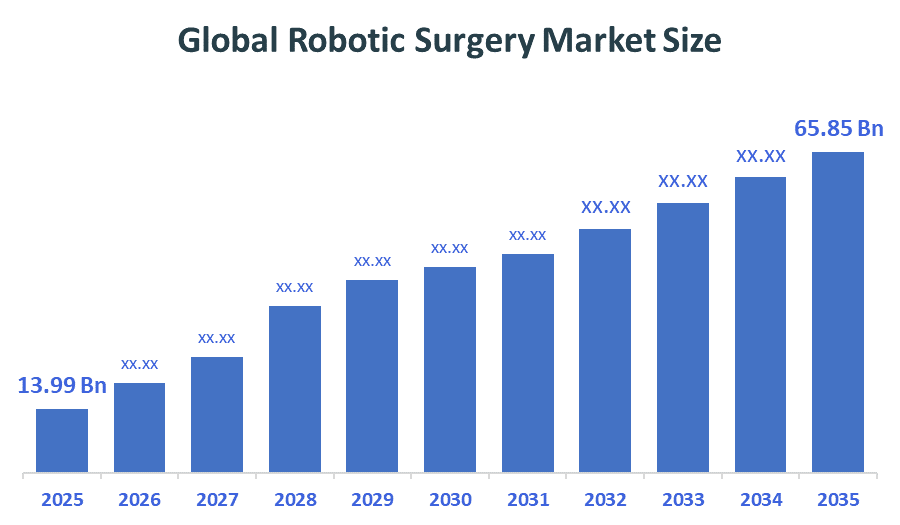
According to Decision Advisors, the Global Robotic Surgery Market Size is expected to grow from USD 13.99 Billion in 2025 to USD 65.85 Billion by 2035, at a CAGR of 16.75% during the forecast period 2025-2035. The global robotic surgery market is projected to grow significantly over the next decade, the growth is primarily driven by the increasing demand for minimally invasive surgical procedures, along with continuous advancements in robotic-assisted systems, AI integration, and image-guided surgical technologies.
Market Overview/ Introduction
The Global Robotic Surgery Market is defined as the sector encompassing computer-controlled robotic systems designed to assist surgeons in performing minimally invasive procedures with enhanced precision, 3D visualization, and greater dexterity. This growth is fuelled by a perfect storm of factors, such as populations starting to live longer, chronic illnesses like cancer being more common, and patients everywhere are choosing keyhole surgeries that get them back on their feet faster with less blood loss. Governments, including the NHS in the UK and various health ministries across Asia, are finally investing in public hospitals to bring these tools to everyone. At the same time, industry giants like Intuitive Surgical and Medtronic are rolling out smarter, more compact systems like the da Vinci 5 and Hugo RAS. These new machines use AI to give surgeons a literal second set of eyes in real-time. Because these robots are becoming smaller and more affordable, they’re moving out of massive city hospitals and into local outpatient centers, making advanced care more accessible to the community. Looking ahead, the big excitement is around 5G-enabled telesurgery, which could allow a world-class expert to operate on someone from hundreds of miles away. As these systems get smarter and more specialized for things like brain or bone surgery, having a robot in the operating room will likely shift from being a luxury to the standard way.
- Udai Omni Hospital announced the launch of its advanced robotic surgery unit, introducing the ultra?modern Misso robotic surgical system to enhance joint replacement care. The system was unveiled at the hospital’s Chapel Road facility with senior medical consultants, patients, and Shri D. Sridhar Babu, then Minister for Information Technology & Industries, Government of Telangana, presiding over the inauguration.
Notable Insights: -
- North America is anticipated to hold approximately 42% share of the Global Robotic Surgery Market over the predicted timeframe.
- Europe is expected to grow at a rapid CAGR in the Global Robotic Surgery Market by holding approximately 28% of the share during the forecast period.
- By product type, the robotic surgical systems segment dominated the market with approximately 57% share in 2025 and is expected to maintain its dominance during the forecast period.
- By end user, the hospitals segment dominates the market, accounting for approximately 65% share in 2025.
- The compound annual growth rate of the Global Robotic Surgery Market is 16.75%.
6. The market is likely to achieve a valuation of USD 65.85 Billion by 2035.
What is the role of technology in grooming the market?
Technology plays a critical role in transforming robotic surgery through innovations such as AI-assisted navigation, 3D visualization, and haptic feedback systems. Advanced robotic platforms provide surgeons with enhanced dexterity and precision, enabling complex procedures in confined anatomical spaces. Integration of machine learning algorithms allows predictive analytics and improved surgical planning. Real-time imaging technologies enhance intraoperative visualization, reducing surgical errors by nearly 20–25%. Additionally, telesurgery and remote robotic operations are emerging trends, expanding access to advanced surgical care globally.
Market Drivers
The surge in robotic surgery is really being driven by a shift toward keyhole procedures, which have become the gold standard for anyone wanting to avoid the physical toll of traditional open surgery. By using tiny incisions, these systems significantly dial down the pain, lower the risk of infections, and cut hospital stays from a week-long ordeal to just a few days. It’s a win for patients to get to recover in the comfort of their own homes sooner, and hospitals get some much-needed breathing room. By getting people back on their feet faster, these robots help clear out the constant backlog in wards, making it easier for doctors to focus on the next person in line without the stress of an overcrowded floor. At the same time, the market is seeing a steady rise in chronic health problems that require incredibly steady hands. With global cancer cases now topping approximately 19 million a year. alongside record levels of heart disease and obesity. The sheer number of complex surgeries is pushing even the best surgeons to their limits. Robotic platforms act like a superhuman assistant here, offering high-definition 3D views and filtering out natural hand tremors.
Restrain
The market faces challenges such as the high cost of robotic systems, which can exceed USD 1.5–2 million per unit, along with significant maintenance costs. Limited availability of skilled surgeons trained in robotic systems and a lack of infrastructure in developing regions also hinder adoption. Furthermore, concerns related to system malfunctions and longer setup times may restrain market growth.
Competitive Analysis:
The report offers the appropriate analysis of the key organizations/companies involved within the global robotic surgery market, along with a comparative evaluation primarily based on their product of offering, business overviews, geographic presence, enterprise strategies, segment market share, and SWOT analysis. The report also provides an elaborative analysis focusing on the current news and developments of the companies, which includes product development, innovations, joint ventures, partnerships, mergers & acquisitions, strategic alliances, and others. This allows for the evaluation of the overall competition within the market.
Top Companies in the Global Robotic Surgery Market
- Intuitive Surgical Inc.
- Medtronic plc
- Stryker Corporation
- Zimmer Biomet
- Johnson & Johnson (Ethicon)
- Smith & Nephew
- CMR Surgical
- Asensus Surgical
- Globus Medical
- Brainlab AG
Government Initiatives
|
Country |
Key Government Initiatives |
|
India |
The government is actively promoting robotics and AI in healthcare through initiatives such as the National Mission on Interdisciplinary Cyber-Physical Systems (NM-ICPS) and ARTPARK, which support robotics R&D and medical applications. Public hospitals like AIIMS have adopted robotic surgery systems, and over 300 robotic systems are installed across India, with more than 60,000 robotic surgeries performed annually. Additionally, state governments are investing in robotic surgery infrastructure and subsidized treatment programs to improve accessibility. |
|
US |
-Private Grants: Intuitive Foundation offers USD 75,000 per project for clinical research in robotic-assisted surgery. |
|
UK |
11 robotic surgery systems approved for NHS implementation. Six projects have received £32 million in government funding to help transform NHS healthcare delivery. |
Study on the Supply, Demand, Distribution, and Market Environment of the Global Robotic Surgery Market
The demand for robotic surgery systems is rapidly increasing due to growing patient awareness and preference for minimally invasive procedures. Supply is supported by continuous technological advancements and increasing investments by major players. Hospitals and specialty surgical centers are the primary end users. The market environment is favorable due to rising healthcare investments and technological adoption worldwide.
Price Analysis and Consumer Behaviour Analysis
Robotic surgery systems are premium-priced due to their technological complexity. However, hospitals and healthcare providers prefer them due to improved patient outcomes and operational efficiency. Patients are increasingly opting for robotic-assisted procedures due to reduced recovery time, minimal scarring, and lower complication risks.
Market Segmentation
The Global Robotic Surgery Market share is classified into product type, technology type, application and end user.
- The robotic surgical systems segment dominated the market with approximately 57% share in 2025 and is expected to maintain its dominance during the forecast period.
Based on the product type, the Global Robotic Surgery Market is divided into robotic surgical systems, instruments and accessories, and services. Among these, the robotic surgical systems segment dominated the market with approximately 57% share in 2025 and is expected to maintain its dominance during the forecast period. This is primarily due to the high cost of robotic platforms, which can exceed USD 1.5–2 million per system. Instruments and accessories represent a significant recurring revenue stream, contributing nearly 30–35% of the market, as they are required for every surgical procedure. The services segment is also growing steadily due to increasing demand for maintenance contracts, surgeon training, and software upgrades, especially with the integration of AI-driven systems.
- The laparoscopic robotic segment accounted for the largest share of over 50% in 2025 and is anticipated to grow at a significant CAGR during the forecast period.
Based on the technology type, the Global Robotic Surgery Market is divided into laparoscopic robotic systems, orthopedic robotic systems, neurosurgical robotic systems, radiosurgery robots, robotic catheter systems. Among these, the laparoscopic robotic segment accounted for the largest share of over 50% in 2025 and is anticipated to grow at a significant CAGR during the forecast period, as they are widely used across multiple surgical specialties for minimally invasive procedures. Orthopedic robotic systems are among the fastest-growing segments, driven by increasing knee and hip replacement surgeries. Neurosurgical robotic systems are gaining traction due to their ability to perform highly delicate procedures with sub-millimetre precision. Radiosurgery robots, such as those used in cancer treatment, are expanding rapidly, improving tumor targeting accuracy by up to 30% while minimizing damage to surrounding tissues. Robotic catheter systems are also emerging, particularly in cardiovascular interventions.
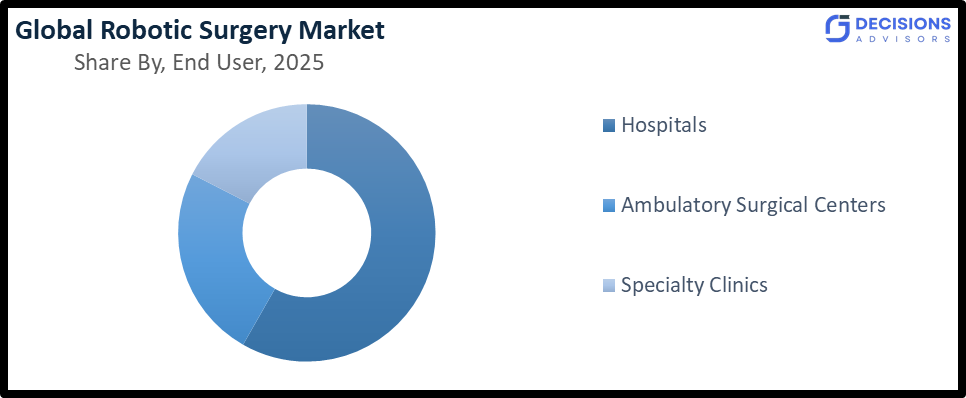
- The hospitals segment dominates the market, accounting for approximately 65% share in 2025.
Based on end user, the Global Robotic Surgery Market is divided into hospitals, ambulatory surgical centers, and specialty clinics. Among those, the hospitals segment dominates the market, accounting for approximately 65% share in 2025. This is due to the availability of advanced infrastructure, skilled professionals, and high patient volume. Ambulatory surgical centers (ASCs) are the fastest-growing segment, driven by the increasing shift toward outpatient procedures and cost-effective surgical solutions. These centers reduce procedure costs by nearly 20–30% compared to hospitals. Specialty clinics are also expanding, particularly in developed regions, due to the rising demand for specialized and minimally invasive surgical care.
Strategies to Implement for Growth of the Market in Non-Leading Regions
Companies should focus on cost-effective robotic systems to improve affordability in emerging markets. Expanding surgeon training programs, partnerships with local healthcare providers, and government collaborations can enhance adoption. Additionally, portable and modular robotic systems can improve accessibility in smaller healthcare facilities.
Regional Segment Analysis of the Global Robotic Surgery Market
- North America (U.S., Canada, Mexico)
- Europe (Germany, France, U.K., Italy, Spain, Rest of Europe)
- Asia-Pacific (China, Japan, India, Rest of APAC)
- South America (Brazil and the Rest of South America)
- The Middle East and Africa (UAE, South Africa, Rest of MEA)
North America is anticipated to hold approximately 42% share of the Global Robotic Surgery Market over the predicted timeframe.
North America is anticipated to hold approximately 42% share of the Global Robotic Surgery Market over the predicted timeframe. It maintains dominant market leadership due to a well-established healthcare infrastructure, a high volume of robotic-assisted surgical procedures, and strong adoption of advanced robotic technologies. The United States is the key driver, supported by healthcare expenditure exceeding USD 4.5 trillion and widespread adoption of robotic platforms such as the da Vinci system. Additionally, the increasing prevalence of chronic diseases such as cancer and cardiovascular disorders is driving surgical demand. The growing preference for minimally invasive procedures across hospitals and surgical centers further strengthens regional growth. The presence of leading market players and continuous technological innovations also contribute significantly to market expansion.
Europe is expected to grow at a rapid CAGR in the Global Robotic Surgery Market by holding approximately 28% of the share during the forecast period.
Europe is expected to grow at a rapid CAGR in the Global Robotic Surgery Market by holding approximately 28% of the share during the forecast period. Europe’s market is supported by advanced healthcare systems, favorable reimbursement frameworks, and increasing adoption of minimally invasive robotic-assisted procedures. Key countries such as Germany, France, and the United Kingdom are focusing on early diagnosis and advanced surgical treatments, contributing to rising surgical volumes. Additionally, increasing investments in healthcare digitization, expansion of robotic surgery training programs, and growing demand for precision-based surgeries are driving steady market growth across the region.
Asia Pacific is the fastest-growing region in the Robotic Surgery Market during the period, holding approximately 23% share.
Asia Pacific is the fastest-growing region in the Robotic Surgery Market during the period, holding approximately 23% share. This growth is driven by rising healthcare investments, increasing prevalence of chronic diseases, and improving access to advanced surgical care. Countries such as China, India, and Japan are witnessing significant growth due to large patient populations and expanding healthcare infrastructure. Government initiatives supporting digital health, an increasing number of multi-speciality hospitals, and growing medical tourism for cost-effective robotic surgeries are further contributing to the rising demand and overall market expansion in the region.
Future Market Trends in the Global Robotic Surgery Market: -
1. Rapid Integration of AI and Smart Surgical Systems
The integration of artificial intelligence (AI) and machine learning into robotic surgery is transforming surgical precision and decision-making. AI-powered robotic systems enable real-time data analysis, predictive insights, and enhanced surgical planning. These technologies improve surgical accuracy and reduce complications by approximately 26%, while also enabling personalized treatment approaches. The future will see increased adoption of autonomous and semi-autonomous robotic systems, significantly enhancing efficiency and patient outcomes.
2. Expansion of Minimally Invasive and Outpatient Procedures
There is a strong shift toward minimally invasive robotic-assisted surgeries due to benefits such as reduced pain, smaller incisions, and faster recovery times. Robotic systems are enabling complex procedures to be performed with minimal tissue damage. This trend is accelerating the growth of ambulatory surgical centers (ASCs), where procedures cost approximately 25% less than in hospitals. Additionally, recovery time is reduced by approximately 45%, making robotic surgery a preferred choice for both patients and healthcare providers.
3. Growing Adoption in Emerging Markets and Cost-Effective Innovations
Emerging economies such as India, China, and Brazil are witnessing rapid adoption of robotic surgery due to improving healthcare infrastructure and rising investments. Manufacturers are focusing on developing cost-effective and compact robotic systems, making the technology more accessible. The Asia-Pacific region is expected to grow at a CAGR of over approximately 15%, driven by increasing demand and government support for advanced healthcare technologies. Additionally, partnerships, training programs, and local manufacturing initiatives are helping expand the reach of robotic surgery in underserved regions.
Recent Development
- In March 2026, CMR Surgical officially kicked off the U.S. commercial launch of its next-generation Versius Plus surgical robot, following regulatory clearance late in December 2025.
- In March 2026, CMR Surgical revealed that it deliberately delayed its U.S. robot launch by about a year as part of a strategic pivot to strengthen its market entry with a more advanced system.
- In February 2026, GreyOrange, an Indian robotics and warehouse automation company, announced plans to raise between USD 500 million and USD 600 million through a potential U.S. initial public offering (IPO). The listing is expected to take place by late 2026 or early 2027, depending on market conditions.
- In February 2026, Stryker accelerated its push into robotic surgery, leveraging new product launches and strong financial performance to strengthen its position in the orthopedics and trauma markets.
- In February 2026, competition in robotic surgery intensified as Medtronic advanced the U.S. rollout of its Hugo robotic-assisted surgery system, directly challenging Intuitive Surgical and its dominant da Vinci platform.
- In June 2025, ForSight Robotics Secures $125M in Series B Funding, Addressing Global Surgeon Shortage and Exploding Demand for Ophthalmic Surgery.
How is Recent Developments Helping the Market?
Recent developments in the Global Robotic Surgery Market are significantly enhancing surgical precision, accessibility, and overall healthcare efficiency, thereby accelerating market growth. Technological advancements such as AI-integrated robotic systems, real-time imaging, and smart operating rooms are transforming surgical procedures. These innovations enable better visualization, improved dexterity, and data-driven decision-making, helping reduce surgical errors and improve outcomes. Studies indicate that AI-enabled robotic systems can enhance procedural efficiency and accuracy by approximately 25%. Another major development is the increase in regulatory approvals and product launches. New robotic platforms from companies like Medtronic and CMR Surgical are receiving clearances for multiple procedures, expanding the scope of robotic-assisted surgeries across specialities such as urology, gynecology, and general surgery. This is increasing competition and accelerating innovation in the market.
Market Segment
This study forecasts revenue at global, regional, and country levels from 2020 to 2035. Decision Advisors has segmented the global robotic surgery market based on the below-mentioned segments:
Global Robotic Surgery Market, By Product Type
- Robotic Surgical Systems
- Instruments & Accessories
- Services
Global Robotic Surgery Market, By Technology Type
- Laparoscopic Robotic Systems
- Orthopedic Robotic Systems
- Neurosurgical Robotic Systems
- Radiosurgery Robots
- Robotic Catheter System
Global Robotic Surgery Market, By End User
- Hospitals
- Ambulatory Surgical Centers
- Specialty Clinics
Global Robotic Surgery Market, By Regional Analysis
- North America
- US
- Canada
- Mexico
- Europe
- Germany
- UK
- France
- Italy
- Spain
- Russia
- Rest of Europe
- Asia Pacific
- China
- Japan
- India
- South Korea
- Australia
- Rest of Asia Pacific
- South America
- Brazil
- Argentina
- Rest of South America
- Middle East & Africa
- UAE
- Saudi Arabia
- Qatar
- South Africa
- Rest of the Middle East & Africa
Frequently Asked Questions (FAQ)
Q. What is the average procedure time for robotic-assisted surgeries compared to traditional surgeries?
A. Robotic-assisted surgeries may initially take slightly longer due to setup time, but overall procedure efficiency improves with experience, often reducing total operation time by approximately 13% in the long run.
Q. How does robotic surgery impact surgeon ergonomics and fatigue?
A. Robotic systems provide ergonomic consoles that reduce physical strain on surgeons, minimizing fatigue during long procedures and improving surgical performance and precision.
Q. What are the key training requirements for surgeons to operate robotic systems?
A. Surgeons typically require specialized certification programs, simulation-based training, and hands-on experience, which can take several weeks to months, depending on the system and procedure complexity.
Q. How does robotic surgery affect hospital return on investment (ROI)?
A. Although initial costs are high, hospitals achieve ROI through increased patient volume, shorter hospital stays, fewer complications, and higher surgical precision over time.
Q. What role does cybersecurity play in robotic surgery systems?
A. As robotic systems become digitally connected, cybersecurity is critical to protect patient data and prevent system vulnerabilities, ensuring safe and uninterrupted surgical operations.
Check Licence
Choose the plan that fits you best: Single User, Multi-User, or Enterprise solutions tailored for your needs.
We Have You Covered
- 24/7 Analyst Support
- Clients Across the Globe
- Tailored Insights
- Technology Tracking
- Competitive Intelligence
- Custom Research
- Syndicated Market Studies
- Market Overview
- Market Segmentation
- Growth Drivers
- Market Opportunities
- Regulatory Insights
- Innovation & Sustainability
Report Details
| Scope | Global |
| Pages | 210 |
| Delivery | PDF & Excel via Email |
| Language | English |
| Release | Apr 2026 |
| Access | Download from this page |