
Global Superheater Market
 |
Author:
Omkar J
|
Pages:
210
|
Author:
Omkar J
|
Pages:
210
Global Superheater Market Size, Share, By Type (Water Tube Superheaters, Steam Superheaters, Reheaters, and Fire Tube Superheaters), By Fuel Source (Biomass, Oil, Coal, and Natural Gas) By End User (Chemical Plants, Power Plants, Food Processing, and Oil Gas), and By Region (North America, Europe, Asia-Pacific, Latin America, Middle East, and Africa), Analysis and Forecast 2026-2035
CAGR
4.83%
REVENUE 2025
USD Billion 5.59
FORECAST 2035
USD Billion 8.97
REPORT COVERAGE
Global
Market Snapshot
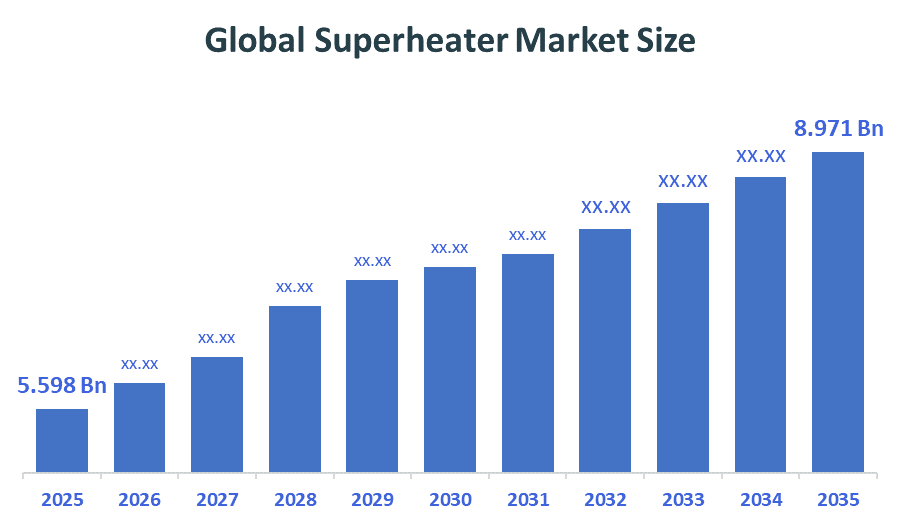
- Global Superheater Market Size (2025): USD 5.598 Billion
- Projected Global Superheater Market Size (2035): USD 8.971 Billion
- Global Superheater Compound Annual Growth Rate (CAGR): 4.83%
- Largest Regional Market: Asia pacific
- Fastest Growing Region: North America
- 3rd Largest Region: Europe
- Base Year: 2025
- Historical Period: 2021–2024
- Forecast Period: 2026–2035
Market Overview/ Introduction
A superheater is a device that increases the temperature of the saturated steam from a boiler without increasing the pressure. As a result, saturated steam turns into superheated steam. The superheater market is considered an industry that creates superheaters for steam generation purposes. It includes activities related to designing, manufacturing, installing, testing, and maintaining the mentioned devices. The global superheater market operates actively in power plants, boilers, refineries, chemical facilities, and ships. Superheaters help increase energy efficiency and minimize fuel usage as well as provide stable and reliable heat. Growing demands for energy, the development of industries, and modernizing old electrical infrastructure drive market growth. Moreover, energy efficiency and environmental regulations contribute to market demand. New technologies in alloys, coating materials, and thermal management make superheaters more efficient and durable. New developments in superheaters are also based on incorporating superheaters into advanced monitoring and automation processes and implementing technologies related to predictive maintenance. There is global pressure from government bodies for more efficient and cleaner energy production, as governments all over the world encourage such technologies by creating high-efficiency thermal power plants.
- India’s AUSC mission is developing 700°C superheaters to improve power plant efficiency and cut CO? emissions by 10–20%, supporting cleaner, advanced thermal power generation through government-backed R&D initiatives.
- India’s Carbon Credit Trading Scheme (CCTS), developed during 2023–2026, promotes emission reduction in industries. It encourages energy-efficient technologies like superheaters, supporting lower energy use and cleaner industrial production.
- In 2024, EU Clean Industrial Deal, supports industrial decarbonisation and clean technologies, enhancing energy efficiency and competitiveness across Europe while aligning with Horizon Europe’s 2021–2027 innovation and sustainability framework.
Notable Insights: -
- Asia-Pacific holds the largest regional market share approximately 45% in the global Superheater market.
- North America is the fastest growing region market share approximately 21% in the global Superheater market.
- By type, the water tube superheaters segment held a dominant position with 49% in terms of market share in 2025.
- By Fuel Source, coal segment is the dominating accounting for market is approximately 40%.
- By end user, power plants segment held a dominant position market is approximately 57%.
- The market is likely to achieve a valuation of USD 8.971 Billion by 2035.
What is role of technology in grooming the market?
Technology has played an important role in determining the development of the superheater market by increasing the efficiency, reliability, and performance of superheaters. The use of advanced technology in manufacturing, like the use of superior quality materials for corrosion protection, ensures that the superheater is able to withstand extreme temperatures and pressure conditions, leading to its increased longevity. Technologies like IoT-based sensors ensure that performance can be monitored, leading to timely and proactive maintenance. Technologies like CFD ensure effective heat transfer.
How is Recent Developments Helping the Market?
Latest trends are revolutionizing the superheater market through the application of state-of-the-art material engineering and artificial intelligence to address increasing energy requirements. With the introduction of Ultra Supercritical (USC) systems employing materials that can withstand high temperatures, there have been substantial gains in thermal efficiency along with reduced emissions from the production of energy. Moreover, the implementation of IoT-based sensors for thermal analysis and predictive maintenance has minimized any operational disruptions. Besides energy production, developments in steam systems in other niche areas such as food and chemicals have diversified the market.
Market Drivers
The market for superheaters is impacted by many factors. The rising need for electricity worldwide is leading to the establishment of more thermal power plants, which employ superheaters that improve the efficiency of steam utilization. The swift industrialization of developing countries is also causing a rise in demand for efficient boiler systems in various industries like chemical engineering, oil and gas production, refining plants, and manufacturing facilities. There is an increased requirement for energy-efficient systems with less fuel consumption, and companies are opting for state-of-the-art superheater technology to meet their needs. Stringent government policies concerning carbon emission reductions have led to the adoption of efficient steam production processes. Moreover, technological progressions in materials and monitoring systems for improved longevity are propelling market growth.
Restrain
The superheater market faces restraints such as high installation and maintenance costs, which limit adoption in small industries. Corrosion, scaling, and material degradation under extreme temperatures reduce equipment lifespan. Additionally, slow replacement of existing systems and fluctuating raw material prices further hinder market growth, especially in developing regions.
Competitive Analysis:
The report offers the appropriate analysis of the key organizations/companies involved within the global superheater market, along with a comparative evaluation primarily based on their Product of offering, business overviews, geographic presence, enterprise strategies, segment market share, and SWOT analysis. The report also provides an elaborative analysis focusing on the current news and developments of the companies, which includes Product development, innovations, joint ventures, partnerships, mergers & acquisitions, strategic alliances, and Oil Gas. This allows for the evaluation of the overall competition within the market.
Top Companies in Global Superheater Market
- General Electric
- Siemens AG
- Mitsubishi Heavy Industries
- Babcock & Wilcox Enterprises
- Hitachi Ltd.
- Doosan Enerbility
- Alfa Laval
- Thermax Limited
- Bharat Heavy Electricals Limited
- Alstom SA
Government Initiatives
|
Country |
Key Government Initiatives |
|
India
|
In January 2026: India Energy Week 2026 highlighted India’s progress toward nearly 50% non-fossil installed power capacity, driving investments in cleaner energy systems and increasing demand for efficient, flexible thermal technologies including advanced superheaters. |
|
India |
April 2025, India’s The Boilers Act, 2025 safety framework is being modernized, strengthening design, manufacturing, and inspection standards for boilers and components. Stricter certification rules are boosting demand for high-quality, compliant superheater systems and materials. |
Study on the Supply, Demand, Distribution, and Market Environment of Superheater Market
The superheater industry is driven by the equilibrium between factors such as supply, demand, distribution, and market environment. In terms of supply, large manufacturers emphasize the development of highly advanced boiler elements made of temperature-resistant materials and advanced production processes. The demand side features power stations, industrial boilers, oil & gas facilities, and chemical facilities in need of more efficient steam operation and lower fuel usage. Distributors consist of direct sales to EPC firms, power utility companies, and industrial customers, as well as partnerships and export operations. From the market environment perspective, the industry operates under the influence of stringent environmental legislation, energy efficiency requirements, and updates of old power generation systems. Moreover, increased industrialization and investment in advanced energy systems contribute to market growth.
Price Analysis and Consumer Behaviour Analysis
Superheater market prices depend on raw materials such as steel, alloys, and refractory metals, as well as the level of sophistication involved and operating pressure levels. Superheaters that are used in power generation facilities and boilers require sophisticated designs using advanced heat resistant materials hence fetch premium prices. Price variations can be attributed to disruptions in global supply chains and fluctuations in energy costs. The consumer behaviour will largely be determined by the demand for efficient and emission friendly devices. Power generation firms, refineries, and chemical processing facilities will be more inclined towards investments that offer cost efficiencies in fuel consumption, longevity, and low maintenance. There are now demands for highly customized superheater systems that incorporate intelligent monitoring and predictive maintenance technologies. In addition, replacement demand resulting from the aging infrastructure is driving sales towards modern high efficiency systems.
Market Segmentation
The Superheater market share is classified into type, application, and end user
- The type segment dominated the market in 2025, and is projected to grow at a substantial CAGR of approximately 6% during the forecast period.
Based on the type, the superheater market is divided into Water Tube Superheaters, Reheaters, Fire Tube Superheaters and Steam Superheaters. Among these, Water Tube Superheaters dominate the superheater market with the largest share of around 45–50%. This dominance is due to their high efficiency, ability to handle high pressure and temperature, and suitability for large-scale power generation and industrial applications. They are widely used in thermal power plants and heavy industries, driving strong demand. The segment is also projected to grow at a CAGR of about 5–7%, supported by increasing electricity demand, modernization of boilers, and focus on energy-efficient steam systems globally.
- The fuel source segment accounted for the largest share in 2025, and is anticipated to grow at a significant CAGR of approximately 3% during the forecast period.
Based on the fuel source, the superheater market is divided into biomass, oil, coal, and natural gas. Among these, coal-based superheaters currently dominate the market with a share of around 38–42%, mainly due to their extensive use in large-scale thermal power plants, especially in Asia Pacific. Coal remains a widely available and cost-effective fuel for base-load electricity generation. However, its growth is slowing due to environmental regulations. The segment is projected to grow at a CAGR of about 2.5–3.5%, as many countries gradually shift toward cleaner fuels like natural gas and biomass for improved efficiency and lower emissions.
The end user segment dominated the market in 2025, and is projected to grow at a substantial CAGR of approximately 5% during the forecast period.
Based on the end user, the Superheater market is divided into chemical plants, power plants, food processing, tablets, and oil gas. Among these, power plants dominate the superheater market with the largest share of around 55–60%. This is because superheaters are essential in thermal power generation for improving steam efficiency and turbine performance. Growing electricity demand and continuous expansion and modernization of coal, gas, and biomass power plants further support this dominance. The segment is projected to grow at a CAGR of about 4–6%, driven by rising energy consumption, infrastructure upgrades, and increasing focus on efficient and low-emission power generation systems globally.
Strategies to Implement for Growth of the Market in Non-Leading Regions
To increase the reach of superheaters in nonleading locations, firms must concentrate on localization, optimization of cost, and increased awareness. By setting up manufacturing units in the region, companies can cut down on their manufacturing and transportation costs. Cooperation with local EPC companies and utility firms would enhance the effectiveness of their operations. The provision of various forms of financial arrangements such as leasing would make it easier to sell to smaller industries that cannot afford upfront costs. By conducting training sessions and offering after-sale service support, manufacturers can enhance knowledge about the importance of efficient use of energy. Companies can also involve the government by encouraging policy formulation and infrastructure creation.
Regional Segment Analysis of the Superheater Market
- North America (U.S., Canada, Mexico)
- Europe (Germany, France, U.K., Italy, Spain, Rest of Europe)
- Asia-Pacific (China, Japan, India, Rest of APAC)
- South America (Brazil and the Rest of South America)
- The Middle East and Africa (UAE, South Africa, Rest of MEA)
Asia pacific is anticipated to hold the largest share of the superheater market over the predicted timeframe.
Asia Pacific holds the largest share of the global superheater market, accounting for approximately 45% of total revenue. This dominance is driven by rapid industrialization, strong expansion of thermal power generation capacity, and increasing electricity demand in countries such as China, India, Japan, and South Korea. Large-scale investments in power infrastructure development, along with modernization of aging boiler systems, further support regional growth. Additionally, supportive government policies promoting energy efficiency and emission reduction are encouraging adoption of advanced superheater technologies.
North America is expected to grow at a rapid CAGR in the superheater market during the forecast period. North America holds approximately 20–22% share of the global superheater market, driven by strong demand from the United States and Canada. The region’s growth is supported by modernization of aging power infrastructure, rising adoption of energy-efficient steam generation systems, and strict environmental regulations promoting low-emission technologies. North America is projected to grow at a CAGR of around 4–6% during the forecast period, fuelled by continuous upgrades of thermal power plants and increasing investments in advanced boiler and heat recovery systems.
Europe is the 3rd largest region to grow in the superheater market during the region. Europe is the third-largest region in the superheater market, driven by steady demand from power generation, industrial manufacturing, and chemical processing sectors. The region’s growth is supported by strong environmental regulations focused on reducing carbon emissions and improving energy efficiency. Countries such as Germany, the UK, France, and Italy are investing in modernization of existing thermal power infrastructure and adoption of advanced boiler technologies. Europe is projected to grow at a CAGR of around 3–5% during the forecast period, with moderate but stable revenue expansion.
Future Market Trends in Global Superheater Market: -
- Shift Toward High-Efficiency and Low-Emission Systems
The superheater market is increasingly driven by the shift toward high-efficiency and low-emission thermal systems. Industries and power plants are adopting advanced superheaters that improve steam quality while reducing fuel consumption and carbon emissions. Strict environmental regulations are pushing manufacturers to design systems with optimized heat transfer and reduced energy losses. This trend is particularly strong in developed regions where decarbonization targets are strict. As a result, demand for advanced alloys, corrosion-resistant materials, and energy-efficient designs is rising, supporting long-term sustainable growth of the global superheater market.
2. Integration of Smart Monitoring and Digital Technologies
Digital transformation is becoming a key trend in the superheater market through integration of IoT sensors, AI, and predictive maintenance systems. These technologies allow real-time monitoring of temperature, pressure, and performance, helping prevent failures and improve operational efficiency. Predictive analytics reduces downtime and maintenance costs, enhancing system reliability. Industrial operators are increasingly adopting smart boilers and automated control systems to optimize performance. This trend is especially prominent in large-scale power plants and industrial facilities, where operational efficiency and cost reduction are critical competitive factors.
3. Expansion in Emerging Economies and Industrial Infrastructure
Rapid industrialization in emerging economies is a major growth trend for the superheater market. Countries in Asia Pacific, Latin America, and the Middle East are investing heavily in power generation and industrial infrastructure. Growing electricity demand, urbanization, and expansion of manufacturing industries are increasing the need for efficient steam generation systems. Governments are also supporting energy infrastructure development through policies and investments. This expansion is driving demand for cost-effective and durable superheater systems, creating strong opportunities for global manufacturers to enter new and high-growth markets.
Recent Development
In January 2025, Sussman Electric Boilers introduced the EWx Series electric hot water boiler, offering zero-emission heating for commercial and industrial applications. The launch supports energy efficiency and industrial electrification, strengthening clean heating solutions across multiple sectors.
In September 2024, Babcock Wanson launched the LV-Pack electric boiler, offering high-efficiency, low-emission industrial steam generation. The system supports electrification trends and improves sustainable, reliable heat production across industries.
Market Segment
This study forecasts revenue at global, regional, and country levels from 2021 to 2035. Decision Advisors has segmented the Superheater market based on the below-mentioned segments:
Global Superheater Market, By Type
- Water Tube Superheaters
- Steam Superheaters
- Reheaters
- Fire Tube Superheaters
Global Superheater Market, By Fuel Source
- Biomass
- Natural Gas
- Oil
- Coal
Global Superheater Market, By End User
- Chemical Plants
- Power Plants
- Food Processing
- Oil Gas
Global Superheater Market, By Regional Analysis
- North America
- US
- Canada
- Mexico
- Europe
- Germany
- UK
- France
- Italy
- Spain
- Russia
- Rest of Europe
- Asia Pacific
- China
- Japan
- India
- South Korea
- Australia
- Rest of Asia Pacific
- South America
- Brazil
- Argentina
- Rest of South America
- Middle East & Africa
- UAE
- Saudi Arabia
- Qatar
- South Africa
- Rest of the Middle East & Africa
Frequently Asked Questions (FAQ)
Q1. What are the emerging application areas expanding the use of superheaters beyond power plants?
A1. Superheaters are increasingly being used in waste-to-energy plants, hydrogen production systems, and advanced industrial heating processes, where high-temperature steam is required for efficient energy conversion and process optimization.
Q2. How is digital twin technology influencing the superheater market?
A2. Digital twin technology is enabling real-time simulation of superheater performance, allowing operators to predict failures, optimize thermal efficiency, and extend equipment lifespan through advanced predictive analytics and operational modelling.
Q3. What role do hydrogen-based energy systems play in the future demand for superheaters?
A3. Hydrogen-based energy systems are expected to increase demand for high-temperature steam components, including superheaters, as hydrogen combustion and green hydrogen production processes require efficient heat transfer systems.
Q4. How are supply chain dynamics affecting the superheater manufacturing industry?
A4. Global supply chain disruptions and fluctuations in specialty alloy prices are influencing production costs, prompting manufacturers to localize sourcing, develop alternative materials, and invest in resilient procurement strategies.
Q5. What are the key technological barriers limiting next-generation superheater development?
A5. Key barriers include material limitations at ultra-high temperatures, high R&D costs for advanced alloys, challenges in long-term thermal fatigue resistance, and slow commercialization of advanced ultra-supercritical technologies.
Check Licence
Choose the plan that fits you best: Single User, Multi-User, or Enterprise solutions tailored for your needs.
We Have You Covered
- 24/7 Analyst Support
- Clients Across the Globe
- Tailored Insights
- Technology Tracking
- Competitive Intelligence
- Custom Research
- Syndicated Market Studies
- Market Overview
- Market Segmentation
- Growth Drivers
- Market Opportunities
- Regulatory Insights
- Innovation & Sustainability
Report Details
| Scope | Global |
| Pages | 210 |
| Delivery | PDF & Excel via Email |
| Language | English |
| Release | Apr 2026 |
| Access | Download from this page |