
US Veterinary Antibiotics Market
 |
Pages:
210
|
Pages:
210
US Veterinary Antibiotics Market Size, Share, By Product Type (Tetracyclines, Penicillins, Macrolides, Sulfonamides, Others), By Animal Type (Livestock Animals, Companion Animals), By Route of Administration (Oral, Injectable, Topical), By Distribution Channel (Veterinary Hospitals, Retail Pharmacies, Online Pharmacies), Analysis and Forecast 2025?2035
REPORT COVERAGE
Country
Market Snapshot
- US Veterinary Antibiotics Market Size (2025): USD 1501.1 Million
- Projected US Veterinary Antibiotics Market Size (2035): USD 2001.1 Million
- US Veterinary Antibiotics Market Compound Annual Growth Rate (CAGR): 2.92%
- Market Base Year: 2025
- Historical Period: 2021–2024
- Forecast Period: 2026–2035
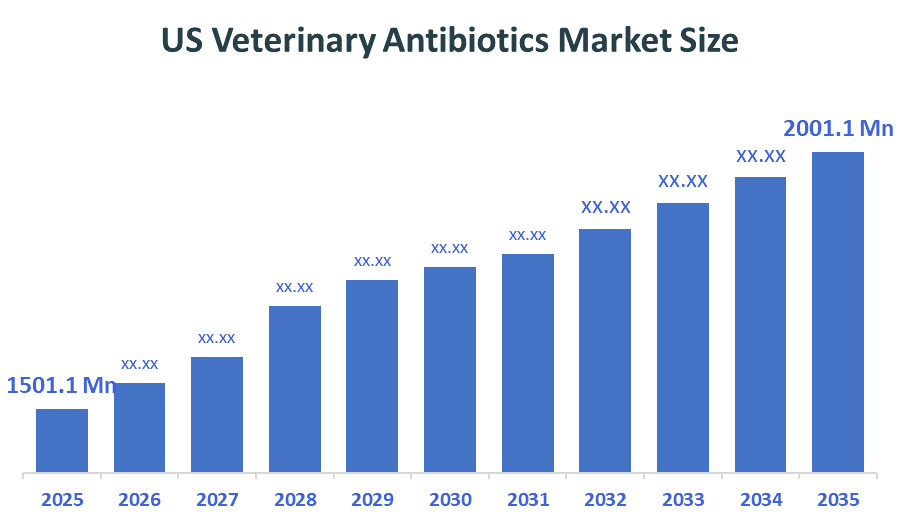
According to Decision Advisors, the US Veterinary Antibiotics Market Size is expected to grow from USD 1501.1 Million in 2025 to USD 2001.1 Million by 2035, at a CAGR of 2.92% during the forecast period 2025-2035. The US Veterinary Antibiotics Market is projected to grow significantly over the next decade. The market is driven by increasing demand for animal protein, rising pet ownership, and growing awareness regarding animal health and disease prevention.
Market Overview/Introduction
The US Veterinary Antibiotics Market is defined as the sale of antimicrobial agents such as tetracyclines, penicillins, and macrolides used to treat bacterial infections in livestock and companion animals. The market is shifting from high-volume growth toward high-value, judicious use models. It’s no longer just about selling pills in bulk, it’s shifting toward smart care for our animals. This market covers everything from the medicine used to keep farm animals healthy to the treatments we give our pets for common infections. The government is also stepping in to make things safer. To stop superbugs (antibiotic resistance), the FDA recently changed the rules so that almost all major antibiotics now require a vet’s prescription. Big names in the industry like Zoetis and Elanco are following suit by focusing on animal-only drugs that don’t interfere with human medicine and creating programs to help owners safely dispose of old meds. Looking ahead, the big trend isn't just more medicine it's better technology. We’re moving toward rapid tests that tell a vet exactly which drug to use, along with a surge in natural alternatives like probiotics and vaccines to keep animals healthy from the start.
Notable Insights: -
- By product type, the tetracyclines segment dominated the market in 2025, accounting for approximately 30% of market share, and is projected to grow at a substantial CAGR during the forecast period.
- By distribution channel, the veterinary hospitals segment dominated the market in 2025, accounting for approximately 55% of market share, and is projected to grow at a substantial CAGR during the forecast period.
- The compound annual growth rate of the US veterinary antibiotics market is 2.92%.
- The market is likely to achieve a valuation of USD 2001.1 Million by 2035.
What is the role of technology in grooming the market?
Technological advancements are significantly shaping the US veterinary antibiotics market. Innovations in drug delivery systems, such as long-acting injectables and medicated feed additives, have improved treatment efficiency and compliance. Additionally, diagnostic technologies like rapid pathogen detection and antimicrobial susceptibility testing enable veterinarians to prescribe targeted antibiotic therapies, reducing misuse. The integration of data analytics and digital health platforms in veterinary practices helps monitor treatment outcomes and antibiotic usage patterns. Furthermore, research into alternatives such as probiotics, vaccines, and immunomodulators is gaining traction, aiming to reduce reliance on antibiotics and combat antimicrobial resistance.
Market Drivers
The U.S. veterinary antibiotics market is caught in a fascinating tug-of-war between the industrial reality of our food system and the deep love we have for our pets. On one side, we have the massive livestock industry, where antibiotics are essentially a must have tool to keep animals healthy in the high-pressure world of large-scale meat and dairy production. On the other side, there’s a real emotional shift happening in American homes, we’ve stopped seeing cats and dogs as just pets and started treating them like family members. This humanization means owners are often willing to open their wallets for premium, life-saving treatments that were once reserved for people.
Study on the Supply, Demand, Distribution, and Market Environment of the US Veterinary Antibiotics Market
The US veterinary antibiotics market is supported by a well-established ecosystem. On the supply side, major pharmaceutical companies and generic drug manufacturers ensure a steady availability of products. Demand is driven by both livestock producers and pet owners, with livestock accounting for a larger share.
Distribution channels include veterinary hospitals, retail pharmacies, and online platforms, ensuring wide accessibility. The market environment is influenced by strict regulatory policies, increasing awareness of antimicrobial resistance, and ongoing research initiatives. However, regulatory restrictions and pressure to reduce antibiotic use in livestock present challenges.
Price Analysis and Consumer Behaviour Analysis
The pricing of veterinary antibiotics in the US varies based on drug class, formulation, and brand. Generic antibiotics are generally more affordable, while patented or advanced formulations command higher prices. Consumer behavior differs between livestock producers and pet owners. Livestock producers focus on cost-effectiveness and bulk purchasing, while pet owners prioritize quality, safety, and veterinarian recommendations. Increasing awareness of antibiotic resistance is influencing purchasing decisions, with a gradual shift toward alternative treatments and preventive care.
Market Segmentation
The US Veterinary Antibiotics Market share is classified into product type, animal type, route of administration and distribution channel.
- The tetracyclines segment dominated the market in 2025, accounting for approximately 30% of market share, and is projected to grow at a substantial CAGR during the forecast period.
Based on the product type, the US veterinary antibiotics market is divided into tetracyclines, penicillins, macrolides, sulfonamides, and others. Among these, the tetracyclines segment dominated the market in 2025, accounting for approximately 30% of market share, and is projected to grow at a substantial CAGR during the forecast period. Tetracyclines dominate due to their broad-spectrum activity, cost-effectiveness, and extensive use in both livestock and companion animals. These antibiotics are particularly preferred in large-scale livestock production for disease prevention and treatment. However, macrolides and penicillins are gaining traction due to their effectiveness against specific bacterial infections and improved safety profiles. Recent developments include the introduction of advanced formulations and combination therapies aimed at enhancing efficacy and reducing antimicrobial resistance.
- The livestock animals segment accounted for the largest share in 2025 and is anticipated to grow at a significant CAGR during the forecast period.
Based on the animal type, the US veterinary antibiotics market is divided into livestock animals and companion animals. Among these, the livestock animals segment accounted for the largest share in 2025 and is anticipated to grow at a significant CAGR during the forecast period. Veterinary antibiotics are extensively used in livestock to treat and prevent infectious diseases, ensuring productivity and food safety. The rising demand for meat, milk, and other animal-derived products is a key factor driving this segment. Additionally, companion animals are emerging as a fast-growing segment due to increasing pet ownership and rising expenditure on pet healthcare. Recent trends highlight the growing emphasis on responsible antibiotic use and preventive care in both livestock and companion animal segments.
- The veterinary hospitals segment dominated the market in 2025, accounting for approximately 55% of market share, and is projected to grow at a substantial CAGR during the forecast period.
Based on the distribution channel, the US Veterinary Antibiotics Market is divided into veterinary hospitals, retail pharmacies, and online pharmacies. Among these, the veterinary hospitals segment dominated the market in 2025, accounting for approximately 55% of market share, and is projected to grow at a substantial CAGR during the forecast period. Veterinary hospitals dominate due to the availability of professional diagnosis, prescription-based treatments, and advanced animal healthcare services. These facilities are the primary point of care for both livestock and companion animals, ensuring appropriate antibiotic usage. Retail and online pharmacies are gradually expanding, driven by convenience, competitive pricing, and increasing digital adoption among pet owners. Recent developments include the growth of e-commerce platforms and tele-veterinary services, further enhancing accessibility to veterinary medications.
Recent Development
- In October 2025, Elanco Animal Health announced the commercial launch of Credelio Quattro, a next-generation oral veterinary treatment for dogs, following its approval by the U.S. FDA. The product is a monthly chewable tablet designed to protect against multiple parasitic infections, including fleas, ticks, heartworm disease, and intestinal worms. This launch represents a significant advancement in combination therapies, offering broad-spectrum protection in a single dose and improving treatment compliance among pet owners.
- In July 2025, Elanco Animal Health entered into a strategic partnership with a leading veterinary clinic network in the United States to promote the use of advanced antibiotic therapies, including ceftiofur, in companion animals. This collaboration focuses on improving awareness, accessibility, and adoption of effective treatment options, while also supporting veterinarians with clinical education and stewardship programs.
Competitive Analysis
The report offers the appropriate analysis of the key organisations/companies involved within the US veterinary antibiotics market, along with a comparative evaluation primarily based on their product offering, business overviews, geographic presence, enterprise strategies, segment market share, and SWOT analysis. The report also provides an elaborative analysis focusing on the current news and developments of the companies, which includes product development, innovations, joint ventures, partnerships, mergers & acquisitions, strategic alliances, and others. This allows for the evaluation of the overall competition within the market.
Top Key Companies in the US Veterinary Antibiotics Market
- Zoetis
- Merck Animal Health
- Elanco
- Boehringer Ingelheim
- Ceva Sante Animale
Key Target Audience
- Market Players
- Investors
- End-users
- Government Authorities
- Consulting and Research Firm
- Venture capitalists
- Value-Added Resellers (VARs)
Market Segment
This study forecasts revenue at the United Kingdom, regional, and country levels from 2020 to 2035. Decision Advisors has segmented the US veterinary antibiotics market based on the below-mentioned segments.
US Veterinary Antibiotics Market, By Product Type
- Tetracyclines
- Penicillins
- Macrolides
- Sulfonamides
- Others
US Veterinary Antibiotics Market, By Animal Type
- Livestock Animals
- Companion Animals
US Veterinary Antibiotics Market, By Route of Administration
- Oral
- Injectable
- Topical
US Veterinary Antibiotics Market, By Distribution Channel
- Veterinary Hospitals
- Retail Pharmacies
- Online Pharmacies
Frequently Asked Questions (FAQ)
Q. How does climate change impact the demand for veterinary antibiotics in the US?
A. Climate change can influence the spread of infectious diseases among animals by altering environmental conditions, increasing the risk of bacterial outbreaks. This may lead to higher demand for veterinary antibiotics, particularly in livestock exposed to changing weather patterns and emerging pathogens.
Q. What role do feed additives play in reducing antibiotic dependency in livestock?
A. Feed additives such as probiotics, prebiotics, and enzymes help improve gut health and immunity in animals, reducing the need for antibiotics. Their growing adoption is part of a broader strategy to promote sustainable livestock farming and minimize antimicrobial resistance.
Q. How are small-scale farmers adapting to stricter antibiotic regulations in the US?
A. Small-scale farmers are increasingly adopting preventive healthcare practices, including vaccination programs, improved hygiene, and biosecurity measures. They are also relying more on veterinary guidance to ensure compliance with evolving antibiotic usage regulations.
Q. What impact does export demand for animal products have on antibiotic usage?
A. Export demand, especially from countries with strict food safety standards, encourages US producers to limit antibiotic residues in animal products. This drives the adoption of regulated antibiotic use, withdrawal periods, and alternative disease management strategies.
Check Licence
Choose the plan that fits you best: Single User, Multi-User, or Enterprise solutions tailored for your needs.
We Have You Covered
- 24/7 Analyst Support
- Clients Across the Globe
- Tailored Insights
- Technology Tracking
- Competitive Intelligence
- Custom Research
- Syndicated Market Studies
- Market Overview
- Market Segmentation
- Growth Drivers
- Market Opportunities
- Regulatory Insights
- Innovation & Sustainability
Report Details
| Scope | Country |
| Pages | 210 |
| Delivery | PDF & Excel via Email |
| Language | English |
| Release | Apr 2026 |
| Access | Download from this page |