
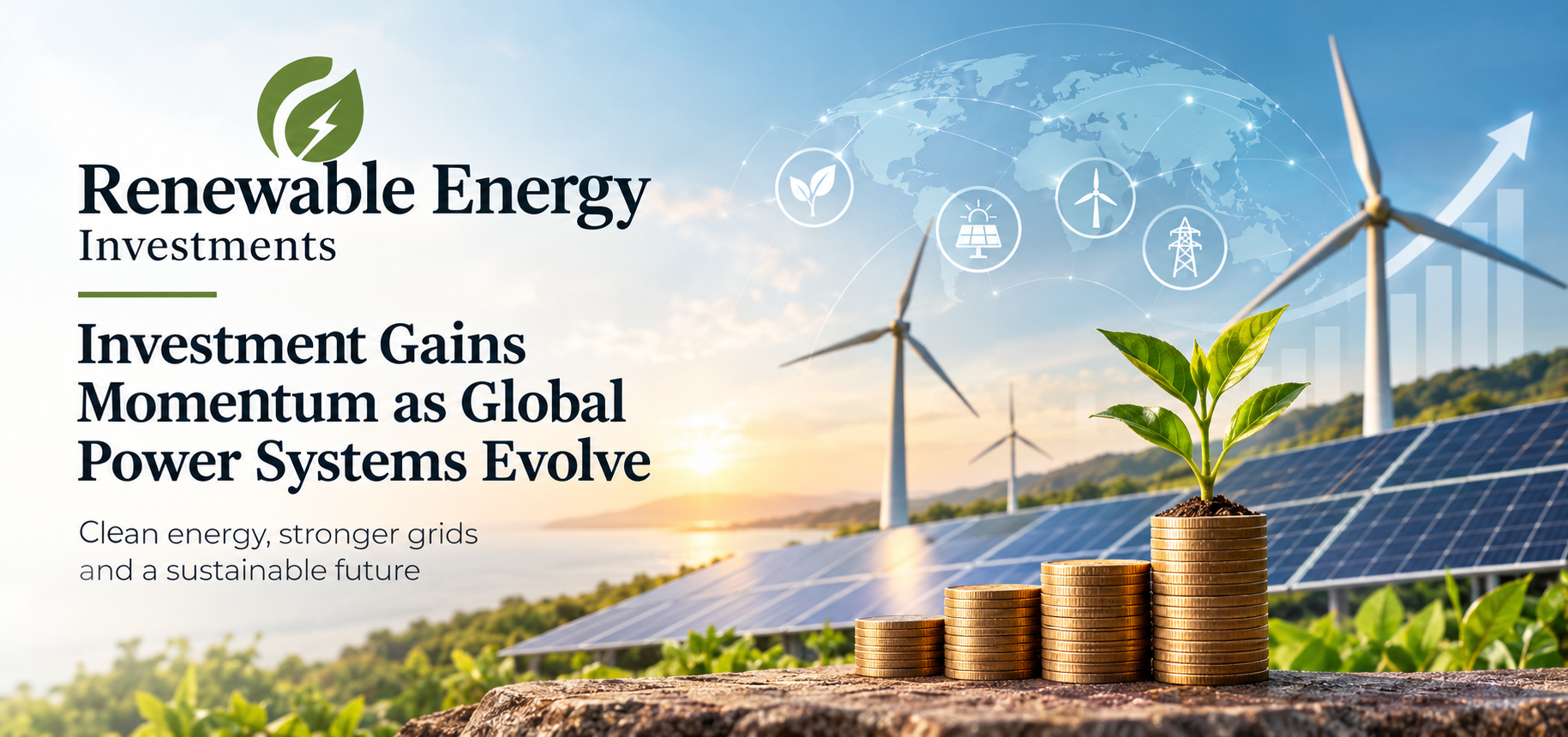
Renewable energy investment continues to gain momentum as governments and businesses work to expand clean power capacity and improve energy security. Solar and wind projects, battery storage, grid modernization and energy efficiency are emerging as key priorities in the global transition toward a lower-carbon energy system.
GLOBAL NEWS REPORT: Capital Acceleration Shifts Toward Clean Energy & Grid Modernization
GLOBAL DESK — Investments in renewable energy continue to accelerate rapidly as sovereign nations and global corporations seek to bolster energy security while scaling back reliance on carbon-intensive fossil fuel generation.
Driven by technological breakthroughs, plummeting storage costs, and rising power demand from AI and industrial electrification, clean energy infrastructure has transitioned from an emerging sector into the primary pillar of global power planning.
Key Industry Dynamics & Sector Impact
| Sector Focus Area | Market Drivers | Strategic Capabilities |
| Solar & Wind Generation | Record additions, improved capacity factors, and falling technology costs. | Utility-scale solar PV, floating solar arrays (floatovoltaics), and next-generation onshore/offshore wind turbines. |
| Battery Energy Storage (BESS) | Lowest recorded LCOE storage costs, high variable renewable penetration, and co-located project demand. | Peak shaving, frequency regulation, short-duration backup, and long-duration energy storage (LDES). |
| Grid Modernization | High interconnect queues, transmission bottlenecks, and decentralization. | Smart high-voltage direct current (HVDC) lines, Virtual Power Plants (VPPs), and dynamic load management systems. |
| Corporate Procurement | Scope 1 & 2 carbon targets, data center power demands, and power price risk mitigation. | Corporate Power Purchase Agreements (PPAs), direct clean energy contracts, and on-site efficiency investments. |
Global Energy Transition System Architecture
                  ┌──────────────────────────────────────────────┐
                  │       Modernized Grid Infrastructure         │
                  └──────────────────────┬───────────────────────┘
                                         │
        ┌────────────────────────────────┼────────────────────────────────┐
        │                                │                                │
┌───────▼────────┐              ┌────────▼───────┐               ┌────────▼────────┐
│ Renewable Power│              │ Storage Buffer │               │ Demand Response │
│ Solar & Wind   │  ──────────► │ Battery (BESS) │  ──────────►  │ Smart Grids &   │
│ Generation     │              │ & LDES Platforms│              │ Corporate Loads │
└────────────────┘              └────────────────┘               └─────────────────┘
-
Generation Layer: Solar PV and onshore/offshore wind supply bulk low-carbon electricity, accounting for the vast majority of global power generation expansion.
-
Buffering & Storage Layer: Battery energy storage systems absorb excess electricity during peak output and dispatch power during low-generation or high-demand periods to maintain grid stability.
-
Transmission & Distribution Layer: Upgraded HVDC lines, digital transformers, and automated substations carry power across long distances while mitigating grid congestion.
-
Demand & Procurement Layer: Commercial and industrial consumers utilize direct corporate PPAs, smart building controls, and energy efficiency solutions to optimize power usage.
Core Drivers of Global Market Transformation
-
Grid Flexibility & Stability: Battery storage systems act as vital shock absorbers, balancing intermittent power supply with real-time consumer demand and protecting grids from severe power disruptions.
-
Infrastructure Modernization: Utility providers are prioritizing major capital outlays to expand high-voltage transmission lines, connect remote renewable farms, and upgrade aging distribution hubs.
-
Corporate Sustainability Integration: Businesses are actively moving beyond offsetting strategies to secure long-term, direct clean power purchase agreements that stabilize energy overheads.
-
Energy Security Priorities: Countries are heavily allocating capital into domestic clean energy supplies to reduce vulnerability to international energy market price shocks.Strategic Outlook
As the global power ecosystem continues its evolution, the integration of renewable generation, battery storage, grid modernization, and industrial efficiency will remain the core structural engine driving international energy security, economic growth, and environmental sustainability.