
Global 3D Motion Capture Market
 |
Author:
Kunal M
|
Pages:
245
|
Author:
Kunal M
|
Pages:
245
Global 3D Motion Capture Market Size, Share, By Type (Hardware, Software, Services), System (Optical 3D MoCap Systems, and Non-Optical 3D MoCap Systems), By Capture Technology (Marker-Based, and Marker-Less) and By Region (North America, Europe, Asia-Pacific, Latin America, Middle East, and Africa), Analysis and Forecast 2026-2035.
CAGR
13.6%
REVENUE 2025
USD Million 301.5
FORECAST 2035
USD Million 1079.2
REPORT COVERAGE
Global
Market Snapshot
- Market Size (2025): USD 301.5 Million
- Projected Market Size (2035): USD 1079.2 Million
- Compound Annual Growth Rate (CAGR): 13.6%
- Largest Regional Market: North America
- Fastest Growing Region: Asia Pacific
- 3rd Largest Region: Europe
- Base Year: 2025
- Historical Period: 2020–2024
- Forecast Period: 2026–2035
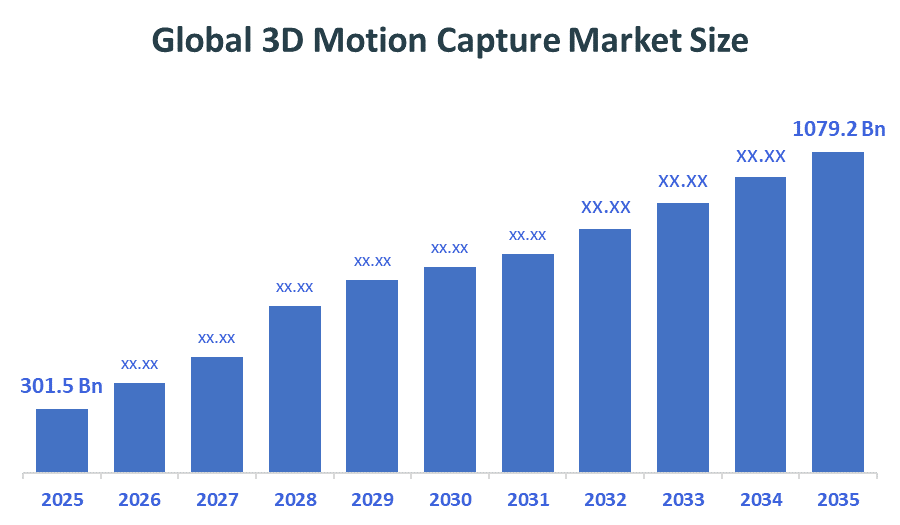
According to Decision Advisors, the Global 3D Motion Capture Market Size is expected to grow from USD 301.5 Million in 2025 to USD 1079.2 Million by 2035, at a CAGR of 13.6% during the forecast period 2026-2035. Global 3D Motion Capture Market is projected to grow significantly over the next decade due to rising demand in gaming, film, virtual reality, and sports analytics. Technological advancements in high-precision sensors, AI-driven software, and real-time animation, coupled with expanding applications in healthcare, robotics, and immersive media, are driving market adoption globally.
Market Overview/ Introduction
The Global 3D Motion Capture Market includes systems that capture physical movements and transform them into digital data for various purposes. The systems use hardware components which include cameras and sensors together with software that processes motion and provides additional services to achieve accurate movement recording across multiple fields, which include entertainment and gaming, virtual reality, sports analysis and healthcare and robotics. The market is growing because there is an increasing need for animated content of superior quality, together with immersive media experiences and all technologies that use artificial intelligence to assist in capturing motion. The market growth is driven by government programs, support creative industries, together with research funding and technology adoption. vicon, optitrack, motion analysis, and codamotion are developing new motion capture systems which provide accurate performance measurement throughout different application areas. These technologies deliver dependable performance across different test conditions because they enable precise tracking both in studio environments and outdoor settings. The system supports virtual reality and augmented reality platforms together with animation processes and biomechanical evaluation, which results in its widespread use across different fields.
Notable Insights: -
- North America holds the largest regional market share approximately 39% in the global 3D motion capture market.
- Asia Pacific is the fastest growing region in the global 3D motion capture market.
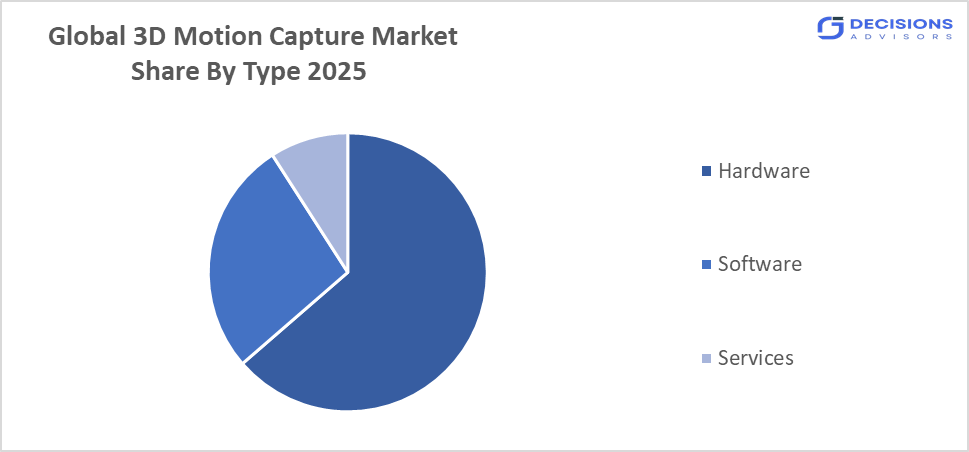
- By type, the hardware segment held a dominant position with 48% in terms of market share in 2025.
- By system, the optical 3D MoCap systems segment is the dominating accounting for over 58% of the global market share in 2025.
- The compound annual growth rate of the global 3D motion capture market is 13.6%.
- The market is likely to achieve a valuation of USD 1079.2 Million by 2035.
What is the role of technology in grooming the market?
The 3D motion capture market expands through technological advancements, which enhance accuracy and efficiency while making the technology easier to use. AI and machine learning enable faster and more precise motion data processing and real-time animation. Sensor fusion and IoT technology together create simple setup processes while delivering precise results across sports, healthcare and robotics applications. Cloud computing enables users to store and share data while rendering content for virtual reality and augmented reality, and immersive media. The combination of automation and advanced motion algorithms achieves a 15% reduction in manual work and post-processing duration while blockchain technology protects the security and authenticity of motion data. The entertainment industry, gaming sector, healthcare field and industrial market will adopt these developments more widely.
How are recent developments helping the market?
Recent developments are driving growth in the 3D motion capture market by enhancing system performance and adoption. Advanced optical, inertial, and hybrid systems offer up to 30% faster setup and improved accuracy, supporting real-time animation. Integration with VR/AR and gaming engines has increased adoption in entertainment by 25%. Sports analytics and healthcare applications benefit from motion tracking, improving rehabilitation outcomes by 18%. Cloud-based platforms reduce post-processing time by 20%, while automated motion algorithms cut manual effort by 15%. These innovations collectively expand usage across gaming, film, healthcare, sports, and industrial sectors.
Market Drivers
The 3D motion capture market is expanding due to rising demand across entertainment, gaming, healthcare, sports, and robotics sectors. Adoption of VR/AR and virtual production technologies is boosting usage in film and gaming, with adoption increasing by 25%, contributing over USD 270 million in 2025 revenue. Sports analytics and performance tracking applications are expanding, improving athlete assessment and rehabilitation efficiency by 18%, impacting a market value of around USD 110 million. Technological advancements such as AI, sensor fusion, and hybrid systems have enhanced precision and reduced setup times by 30%, enabling faster deployment. Healthcare applications reduce manual intervention by 15%, further increasing adoption. Growing interest in immersive media and interactive experiences supports sustained market growth toward USD 1,079 million by 2035.
Restrain
The main restraints on the global 3D Motion Capture Market include high equipment costs and technical complexity, requiring specialized operators. Challenges in integrating systems with existing workflows limit adoption, particularly for smaller studios and organizations. Frequent maintenance and calibration add to operational expenses. Furthermore, limited awareness in developing regions, data security concerns, and software compatibility issues hinder broader deployment, restricting market expansion despite increasing demand across industries.
Competitive Analysis:
The report offers the appropriate analysis of the key organizations/companies involved within the 3D motion capture market, along with a comparative evaluation primarily based on their product of offering, business overviews, geographic presence, enterprise strategies, segment market share, and SWOT analysis. The report also provides an elaborative analysis focusing on the current news and developments of the companies, which includes product development, innovations, joint ventures, partnerships, mergers & acquisitions, strategic alliances, and others. This allows for the evaluation of the overall competition within the market.
Top Companies in Global 3D Motion Capture Market
- Vicon Motion Systems
- Xsens Technologies
- OptiTrack
- Rokoko
- Motion Analysis Corporation
- Qualisys AB
- PhaseSpace Inc.
- Animazoo
- Perception Neuron (Noitom)
- Noraxon USA
- OptiSense
- AiQ Smart Clothing
- Zigntrack
Government Initiatives
|
Country |
Key Government Initiatives |
|
UK |
UK tax incentives for film, TV and VFX spending have increased relief rates and removed caps, encouraging studios to base post?production and motion capture work in the UK, boosting technology adoption. |
|
US |
The U.S. government allocated over?500?million to advance digital content creation technologies, including motion capture, supporting innovation and adoption in media, entertainment, and related tech sectors. |
|
China |
China’s Made in China 2025 policy prioritizes AI, robotics, smart manufacturing and digital technologies, with targeted subsidies and innovation programs to advance high?tech sectors supporting motion capture and related applications. |
Study on the Supply, Demand, Distribution, and Market Environment of Global 3D Motion Capture Market
The global 3D motion capture market shows equal development through its supply systems and demand patterns, distribution methods, and overall market conditions. Supply is driven by key technology providers offering advanced hardware and integrated software solutions. The entertainment industry and gaming industry, healthcare sector, sports sector and industrial sector show rising demand because they need real-time motion tracking and immersive applications. The distribution channels use direct sales and system integrators, and digital platforms to reach customers worldwide. The market environment exists because of fast technological developments, rising VR and AR investment and growing use of robotics and healthcare technologies. The high costs and technical complexity of the system together create barriers to system adoption especially in developing markets, according to the current situation.
Price Analysis and Consumer Behaviour Analysis
The pricing structure in the 3D motion capture market is significantly influenced by system complexity and technology type. Advanced optical systems can exceed USD 100,000 per setup, making them premium-priced solutions mainly adopted by large studios and research institutions. Hardware accounts for over 53% of total market revenue, indicating higher spending on core equipment compared to software and services. From a consumer behavior perspective, demand is driven by high-precision requirements in entertainment, gaming, and healthcare, with media & entertainment contributing over 52% of total demand. Buyers increasingly prefer integrated solutions with real-time analytics and cloud capabilities, prioritizing performance, accuracy, and long-term operational efficiency over initial cost.
Market Segmentation
The 3D motion capture market share is classified into type, system, and capture technology
- The hardware segment dominated the market in 2025, and is projected to grow at a substantial CAGR of approximately 48% during the forecast period.
Based on the type, the 3D motion capture market is divided into hardware, software, services. Among these, the hardware segment dominated the market in 2025, and is projected to grow at a substantial CAGR of approximately 48% during the forecast period. It is because of the high cost of cameras, sensors, and capture systems. These components are essential for accurate motion tracking and data acquisition, resulting in higher revenue contribution compared to software and services segments.
- The optical 3D MoCap systems segment accounted for the largest share in 2025, and is anticipated to grow at a significant CAGR of approximately 58 % during the forecast period.
Based on the system, the 3D motion capture market is divided into optical 3D MoCap systems, and non-optical 3D MoCap systems. Among these, the optical 3D MoCap systems segment accounted for the largest share in 2025, and is anticipated to grow at a significant CAGR of approximately 58 % during the forecast period. It is dominating due to their superior accuracy, high-resolution tracking, and ability to capture complex movements in real time. They are widely used in film production, gaming, and biomechanics, where precision is critical. Additionally, advancements in camera technology and software integration further strengthen their market preference.
- The marker-based segment dominated the market in 2025, and is projected to grow at a substantial CAGR during the forecast period.
Based on the capture technology, the 3D motion capture market is divided into marker-based, and marker-less. Among these, the marker-based segment dominated the market in 2025, and is projected to grow at a substantial CAGR during the forecast period. This is because they provide highly accurate and reliable motion tracking using reflective markers, making them ideal for applications requiring precision such as film production, gaming, and biomechanics. They minimize tracking errors, perform well in controlled environments, and are widely adopted in professional studios and research institutions.
Strategies to Implement for Growth of the Market in Non-Leading Regions
Non-leading regions can achieve growth through three methods, which include cost optimization, localisation, and strategic partnerships. The company needs to develop motion capture systems that small studios and new users can use because they require both affordable and scalable solutions. Local partners and system integrators will help the company achieve better market distribution through their distribution networks. The company will achieve better user adoption through its training programs and workshop sessions, which increase user knowledge. The company needs to invest in cloud-based systems and user-friendly applications because these technologies will help customers overcome technical challenges. The company will create demand by focusing on high-growth industries, which include gaming, healthcare and sports analytics. Digital technology adoption will accelerate through government partnerships, which provide incentives for adoption, while regional production and service centers will decrease expenses and enhance service availability.
Regional Segment Analysis of the 3D Motion Capture Market
- North America (U.S., Canada, Mexico)
- Europe (Germany, France, U.K., Italy, Spain, Rest of Europe)
- Asia-Pacific (China, Japan, India, Rest of APAC)
- South America (Brazil and the Rest of South America)
- The Middle East and Africa (UAE, South Africa, Rest of MEA)
North America is anticipated to hold the largest share of the 3D motion capture market over the predicted timeframe.
North America is anticipated to hold the largest share of the 3D motion capture market over the predicted timeframe, accounting for approximately 39% of the global market. The region’s dominance is driven by strong presence of major film studios, gaming companies, and advanced technology providers. The United States leads the region, contributing over 80% of regional revenue, supported by high adoption in entertainment, sports analytics, and healthcare applications. Increasing investment in virtual production, VR/AR technologies, and biomechanics research further strengthens market growth. Additionally, well-established infrastructure and early adoption of advanced motion capture systems continue to support North America’s leading position.
Asia Pacific is expected to grow at a rapid CAGR in the 3D motion capture market during the forecast period.
Asia Pacific is expected to grow at a rapid CAGR of approximately 15% in the 3D motion capture market during the forecast period, driven by expanding gaming, animation, and virtual production industries. Countries such as China, Japan, South Korea, and India are investing heavily in digital content creation and immersive technologies. Government support for animation studios and increasing adoption of AR/VR are further accelerating demand. A recent development includes rising investments in virtual production hubs and motion capture integration in gaming engines across the region in 2025, enhancing real-time content creation capabilities and strengthening regional market growth
Europe is the 3rd largest region to grow in the 3D motion capture market during the region.
Europe is the third largest region in the 3D motion capture market, accounting for approximately 27% of the global share. Growth is driven by strong adoption in film production, gaming, and biomechanics research across countries such as the UK, Germany, and France. The region benefits from established animation studios, increasing use in sports science, and healthcare applications like rehabilitation. Additionally, government support for digital innovation and research initiatives, along with rising demand for VR/AR technologies, continues to support steady market expansion across Europe.
Future Market Trends in Global 3d Motion Capture Market: -
1. Rise of Marker-less Motion Capture
Marker-less motion capture systems are gaining adoption due to reduced setup complexity and elimination of wearable markers. Powered by AI and computer vision, these systems enable real-time tracking in dynamic environments. They are increasingly used in gaming, sports analytics, and remote applications, improving flexibility and reducing operational time and costs.
2. Integration with AI and Machine Learning
AI and machine learning enhance motion capture by improving tracking accuracy, reducing noise, and enabling predictive motion analysis. These technologies automate data processing and support real-time decision-making. Their integration expands applications in healthcare diagnostics, robotics training, and advanced animation, making systems more efficient and scalable across industries.
3. Growth of VR/AR and Metaverse Applications
The expansion of VR, AR, and metaverse platforms is driving demand for real-time motion capture systems. These technologies rely on accurate human motion tracking to create immersive digital experiences. Increasing investments in virtual production, gaming, and digital environments are significantly boosting adoption of motion capture solutions globally.
4. Expansion in Healthcare and Biomechanics
Motion capture is increasingly used in healthcare for rehabilitation, physiotherapy, and biomechanics analysis. It enables precise tracking of patient movements, improving diagnosis and treatment outcomes. The technology supports personalized therapy plans and remote monitoring, enhancing efficiency and driving adoption across hospitals, research institutions, and sports medicine applications.
Recent Development
- In March?2026, Annapurna Studios and Mihira Visual Labs launched the A&M MoCap Lab in Hyderabad, India’s most advanced motion and performance capture facility supporting large?scale film, VFX, and animation production.
- In February?2026, Chinese robotics firms staged large?scale humanoid robot performances-over 200 synchronized robots danced, acted and mimicked human movement, illustrating advanced 3D motion coordination and market expansion into live entertainment robotics.
- In April?2025, Southwest Research Institute introduced BEAMoCap, a markerless 3D motion capture system that converts video into animation without suits, enhancing workflow efficiency and advancing the 3D motion capture market.
- In March 2024, DeepMotion launched SayMotion, an AI?driven platform that turns text prompts into detailed 3D animations, simplifying animation creation and expanding motion capture technology use cases
Market Segment
This study forecasts revenue at global, regional, and country levels from 2020 to 2035. Decision Advisors has segmented the 3D motion capture market based on the below-mentioned segments:
Global 3D Motion Capture Market, By Type
- Hardware
- Software
- Services
Global 3D Motion Capture Market, By System
- Optical 3D MoCap Systems
- Non-Optical 3D MoCap Systems
Global 3D Motion Capture Market, By Capture Technology
- Marker-Based
- Marker-Less
Global 3D Motion Capture Market, By Regional Analysis
- North America
- US
- Canada
- Mexico
- Europe
- Germany
- UK
- France
- Italy
- Spain
- Russia
- Rest of Europe
- Asia Pacific
- China
- Japan
- India
- South Korea
- Australia
- Rest of Asia Pacific
- South America
- Brazil
- Argentina
- Rest of South America
- Middle East & Africa
- UAE
- Saudi Arabia
- Qatar
- South Africa
- Rest of the Middle East & Africa
Frequently Asked Questions (FAQ)
Q. How does motion capture contribute to digital twin development?
A. Motion capture enables real-time human and object movement replication, which is essential for creating accurate digital twins used in industrial simulations, training environments, and smart manufacturing systems.
Q. What factors influence the choice between optical and inertial systems?
A. The choice depends on accuracy requirements, environment conditions, budget constraints, and mobility needs, with optical preferred for precision and inertial for portability and outdoor use.
Q. How is motion capture used in workforce training and simulation?
A. It is used to simulate real-world scenarios, improve safety training, and enhance skill development in industries such as defense, healthcare, and manufacturing.
Q. What challenges do companies face in scaling motion capture solutions?
A. Challenges include data processing requirements, integration with existing systems, high storage needs, and maintaining accuracy across large-scale deployments.
Check Licence
Choose the plan that fits you best: Single User, Multi-User, or Enterprise solutions tailored for your needs.
We Have You Covered
- 24/7 Analyst Support
- Clients Across the Globe
- Tailored Insights
- Technology Tracking
- Competitive Intelligence
- Custom Research
- Syndicated Market Studies
- Market Overview
- Market Segmentation
- Growth Drivers
- Market Opportunities
- Regulatory Insights
- Innovation & Sustainability
Report Details
| Scope | Global |
| Pages | 245 |
| Delivery | PDF & Excel via Email |
| Language | English |
| Release | Apr 2026 |
| Access | Download from this page |