
Global Boil-In-Bag Market
 |
Author:
Anurag B
|
Pages:
210
|
Author:
Anurag B
|
Pages:
210
Global Boil In Bag Market Size, Share, By Material Type (Plastic, Aluminum Foil, and Others) By Packaging Size (Less than 150x240 mm, 150x240 to 240x380 mm, 240x380 to 380x500 mm, and Above 380x500 mm) By Application (Frozen Food, Ready to Eat Meals, Meat and Poultry, Seafood, Bakery and Confectionery, and Others) By Distribution Channel (Retail and Institutional) and By Region (North America, Europe, Asia Pacific, Latin America, and Middle East and Africa), Analysis and Forecast 2026 ? 2035
CAGR
5.49%
REVENUE 2025
USD Billion 22.92
FORECAST 2035
USD Billion 39.12
REPORT COVERAGE
Global
Market Snapshot
- Global Boil-in-Bag Market Size (2025): USD 22.92 Billion
- Global Boil-in-Bag Projected Market Size (2035): USD 39.12 Billion
- Global Boil-in-Bag Compound Annual Growth Rate (CAGR): 5.49%
- Largest Regional Market: Asia-Pacific
- Fastest Growing Region: North America
- 3rd Largest Region: Europe
- Base Year: 2025
- Historical Period: 2021 to 2024
- Forecast Period: 2026 to 2035
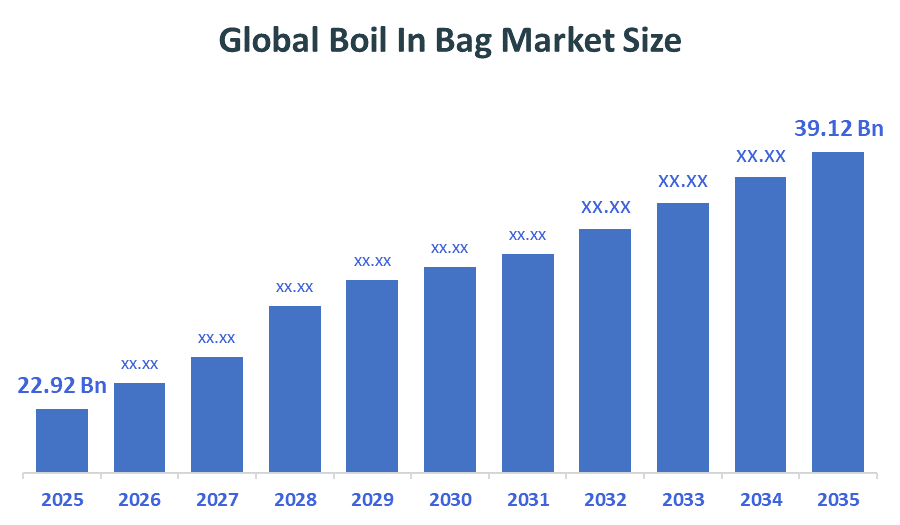
According to Decision Advisors, the global boil-in-bag market size is expected to grow from USD 22.92 billion in 2025 to USD 39.12 billion by 2035, with a CAGR of 5.49% during the forecast period from 2026 to 2035. This industry is on a steady growth path since efficient storage and cooking solutions have become an absolute necessity for city residents and food service industries across the world, mainly due to the growing need for quick cooking and controlled servings. The current developments in the field of multi-layer co-extrusion and barrier polymer films ensure that the devices can offer stable heat retention and taste retention performance during continuous boiling, successfully bridging the difference between the conventional frozen meals and gourmet ready-to-eat products. With their cost-effectiveness relative to other storage techniques such as hard containers and cooking in large quantities, boil in bags are now extensively used in the process of updating the food store shelves and catering businesses in leading countries.
Market Overview / Introduction
The boiling in bag solutions represent a set of flexible packaging solutions that offer immediacy when it comes to preparation and reheating of different kinds of food products through sealing of the ingredients in pouches that resist extreme heat. The boil in bag solution serves as an intermediate step in the storage and presentation of raw food products since they are packaged in containers that can retain the product within the system without using too much kitchenware. The modern systems come with cutting-edge features that include micro-perforation venting and BPA-free composite material to ensure nutrient retention with minimal risk of contamination during the heating process. The development of the modern systems can be traced back to the invention of basic plastic sleeves for storing rice and vegetables which have been upgraded to become efficient cooking devices with features including high puncture resistance, vacuum seal capability, and suitability for high-volume industrial food processing operations. One of the major factors that will fuel growth in the Global Boil In Bag Market will be the increasing demand for ready-made meals and portion control in households and the hospitality industry.
- The Indian food & beverages packaging market is expected to cross $86 billion by 2029 owing to the fast-paced urbanization, high demand for readymade packaged foods and an increased demand for safe packaging. This development will directly drive growth of Boil In Bag packaging solutions.
- The retort and boiling process using bags as the packaging material ensures a long shelf-life period of up to one year for the meals that are ready to be eaten, while at the same time being able to sustain high temperatures of 121 degrees Celsius.
Notable Insights: -
- North America is the largest regional market in terms of market share in the global Boil in Bag market due to the high consumption of ready-to-eat foods
- The Asia Pacific region is becoming the fastest-growing region due to its fast pace of urbanisation, higher disposable income, and an increase in demand for packaged and processed foods.
- The global boil-in-bag market is growing at a compound annual growth rate of approximately 5.49% during the forecast period from 2026 to 2035, supported by increasing demand for convenient cooking solutions and sustainable packaging
- The market is projected to grow from USD 22.92 billion in 2025 to USD 39.12 billion by 2035, which is expanding at a rapid pace because of the rise in ready-to-eat food consumption globally
What is the Role of Technology in Shaping the Market?
Technological innovations are revolutionizing the sector of boil in bag packaging with regard to the innovations being made in thermal resistance, strength, and automation in relation to packaging performance. Modern day flexible packaging systems are not just basic plastic sachets, but more advanced barrier packaging solutions which are able to preserve food safety over a long period of time owing to their capacity to use high quality food safe polymers and oxygen scavenger films together with automation systems for filling.
How are Recent Developments Helping the Market?
Some of the advancements, like the application of lasers for venting steam, the adoption of high-quality and recyclable composite material, and sealing that can be used by sous-vide methods, have been instrumental in supporting the market to grow. There has been a development of modular pouches that allow the inclusion of various food types, including seafood and even thick grains, without leaking when subjected to extended periods of high temperatures. Through the use of co-extruded films, these devices will have the ability to independently resist the pressure from steam that expands within them, ensuring that there is an ideal cooking environment that will avoid any loss of nutrients or flavors. This feature is likely to facilitate large scale production and kitchen management operations. Further, through smart indicators and temperature sensitive ink, faster detection of the state of cooking will become possible.
Market Drivers
The international bubble within the bag industry is expanding with the mounting involvement of food companies and retail corporations in sustainable packaging options and shelf-ready meals standards in response to the evolving needs of today's consumers. Contemporary pouch systems have been increasingly favoured on the market due to the possibility of combining several purposes, including vacuum storage, quick heating, and convenient opening mechanics, within one tough and portable unit. Meanwhile, the rising tendency towards hectic urban living styles has driven the demand for effective meal preparation equipment, which can solve the challenge of moving to portion-based eating habits among smaller households or in areas where the use of conventional kitchen utensils is limited. The rising awareness of healthy lifestyles and the desire for preservative-free gourmet meals have prompted food service proprietors to employ these devices for consistent protection of ingredient integrity and maintenance of premium product identities.
Restraints
The growth of the international market for boil in bag is constrained by the difficulty associated with making sure that the recyclable multi-layer film packaging can easily go through standard waste channels because of the bond between various polymers used and the food residues. The cost associated with manufacturing customized high clarity barrier resins and using special high speed vacuum sealing techniques, as well as the cost required to integrate special retort sterilization process, make this technology difficult to adopt by small local food producers.
Competitive Analysis:
The report offers the appropriate analysis of the key organisations/companies involved within the boil-in-bag market, along with a comparative evaluation primarily based on their product offerings, business overviews, geographic presence, enterprise strategies, segment market share, and SWOT analysis. The report also provides an elaborate analysis focusing on the current news and developments of the companies, which includes product development, innovations, joint ventures, partnerships, mergers & acquisitions, strategic alliances, and others. This allows for the evaluation of the overall competition within the market.
Top 10 Companies in the Global Boil-In-Bag Market
- ProAmpac LLC
- Amcor PLC
- Sealed Air Corporation
- Mondi Group
- Berry Global Group, Inc.
- Huhtamaki Oyj
- Constantia Flexibles
- Synpac Limited
- M & Q Packaging Ltd
- Universal Plastic Bag Manufacturing Co.
Government Initiatives
|
Country |
Key Government Initiatives |
|
EU |
The European Union implemented the Packaging and Packaging Waste Regulation in February 2025, requiring all packaging to become recyclable or reusable by 2030, strengthening sustainability goals across the packaging industry |
|
India |
Under the Extended Producer Responsibility framework introduced in 2022, over 2,600 plastic waste processors have been registered in India, collectively processing more than 10 million tonnes of plastic packaging waste through recycling and recovery systems, strengthening the country’s circular economy in packaging |
|
US |
THE US FDA Human Foods Program has recognised more than 9 phthalates that have been approved for use in food contact material and is undertaking risk assessments on chemicals of great concern, such as phthalates and BHA, according to the 2026 strategic priority. |
Study on the Supply, Demand, Distribution, and Market Environment
Success in the business of boil-in-bags is contingent on balancing the efficiency of running operations using maximum thermal stability and the increasing requirement for continuous, smart-powered food management. The supply of the product is driven by an emphasis on manufacturing polymers that have high strength and thermal resistance, along with the development of barrier films that allow for instant protection, free from the delays associated with conventional food processing. The demand is generated through the move towards self-sustaining convenience food systems, including advanced temperature sensors within the packaging material to initiate the preparation process and alert commercial kitchens, as well as the requirement for effective structural monitoring in areas experiencing drastic changes in lifestyles. Products are delivered through profitable food service contracts, large retail distribution programs, and partnerships with global hospitality and culinary innovation organisations.
Price Analysis and Consumer Behaviour Analysis
The costs of the boil-in-bags will depend on the span of the structural frame, heat resistance rating, and barrier efficiency. Those packages employing multilayer co-extrusion process design and featuring innovative oxygen scavenger detectors along with vacuum seals are relatively costly. On the other hand, there are more affordable modular flat bags and smaller stand-up ones for household kitchens, which represent an excellent example of an opportunity for localized and supplementary food preparation and storage services in a compact urban environment. The consumer demand for durable and economical items is evident; thus, manufacturers will be expected to focus on producing devices that provide independence, integration into a kitchen setup, and proper portion positioning. There seems to be a trend towards modular material payloads that enable the timely updates of packaging hardware according to the new requirements of sustainability and international food regulations.
Market Segmentation
The Global Boil-In-Bag Market share is classified into material type, packaging size, application, and distribution channel.
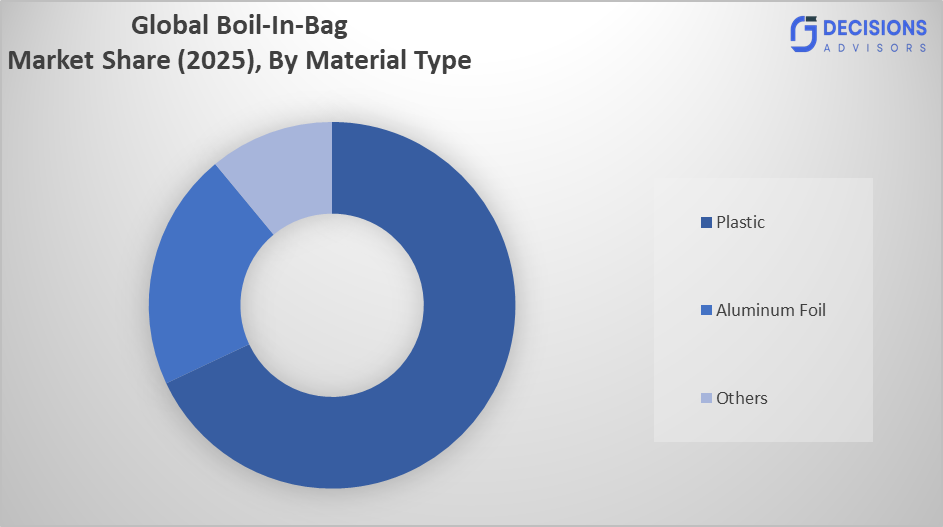
Plastic segment holds the largest share, contributing approximately 68% of the market in 2025.
Based on the material type, the global boil-in-bag market is divided into plastic, aluminum foil, and others. Among these, the plastic segment holds the largest share, contributing approximately 68% of the market in 2025. Their dominance is owed to superior thermal stability, excellent moisture barrier properties, and the ability to withstand high temperatures during boiling or sous-vide processes without degrading. Aluminum foil and other composite materials constitute the other significant parts of the market, which remain important due to their high puncture resistance and established use in protecting long-shelf-life gourmet products and light-sensitive ingredients.
150x240 to 240x380 mm segment accounts for the largest share, representing over 45% of the global market in 2025.
Based on the packaging size, the global boil-in-bag market is divided into Less than 150x240 mm, 150x240 to 240x380 mm, 240x380 to 380x500 mm, and above 380x500 mm. Among these, the 150x240 to 240x380 mm segment accounts for the largest share, representing over 45% of the global market in 2025. These dimensions are critical for maintaining the standard portion sizes of family meals, improving retail shelf efficiency, and reducing food waste through the adoption of modern, right-sized flexible packaging. On the other hand, the Above 380x500 mm segment has emerged as a rapidly growing application, thanks to the increasing demand from commercial kitchens and the refurbishment of meal prep systems in institutional catering and hospitality sectors.
Ready to Eat Meals dominate the global market, accounting for approximately 41% of the total revenue in 2025.
Based on the application, the global boil-in-bag market is divided into frozen food, ready to eat meals, meat and poultry, seafood, bakery and confectionery, and others. Among these, the ready to eat meals dominate the global market, accounting for approximately 41% of the total revenue in 2025. This segment is preferred by consumers who require large-scale convenience solutions and professional culinary quality for busy modern lifestyles. The Seafood category is seeing a sharp increase in use, especially by health-conscious individuals who value the nutrient retention and the convenience of mess-free preparation for delicate proteins and high-value frozen assets.
Retail segment represents the primary revenue stream, accounting for approximately 58% of the total market share in 2025.
Based on the Distribution Channel, the global boil-in-bag market is divided into retail and institutional. Among these, the retail segment represents the primary revenue stream, accounting for approximately 58% of the total market share in 2025. The retail sector leads the market, driven by the expansion of supermarket chains, hypermarkets, and e-commerce platforms that prioritize easy-to-cook meal kits. The Institutional sector is also showing robust growth, particularly as schools, hospitals, and large-scale cafeterias adopt boil-in-bag technology to streamline high-volume service, maintain strict hygiene standards, and ensure consistent flavor profiles across large batches.
Strategies to Implement for Growth of the Market in Non-Leading Regions
The potential for growth within the boil in bag industry in emerging regions could be increased through the deployment of efficient modular packaging platforms for local food processors, as well as regional agencies tasked with food security management. Programs aimed at achieving nutritional resilience by governments, coupled with the expansion of high-strength food safety standards, contribute substantially toward demand within regions with traditional retail structures that pose significant challenges to the distribution of massive frozen food inventory on the ground. Further support through increasing investments in training local packaging technicians, as well as setting up regional material testing facilities, will facilitate the adoption of sustainable cooking solutions and smart-reheat meal response systems.
Regional Segment Analysis of the Global Boil In Bag Market
- North America (U.S., Canada, Mexico)
- Europe (Germany, France, U.K., Italy, Spain, Rest of Europe)
- Asia-Pacific (China, Japan, India, South Korea, Rest of APAC)
- Latin America (Brazil and the Rest of Latin America)
- The Middle East and Africa (UAE, South Africa, Rest of MEA)
Asia-Pacific is projected to be the fastest-growing region over the forecast period. This region is anticipated to witness a growth rate of around 7.2% CAGR, maintaining a dominant market share within the global industry. In 2025, Asia-Pacific already accounts for approximately 34.8% of global revenue. This is owing to the fast-developing food retail infrastructure, coupled with the growing demand for modern meal protection in countries such as China, India, and Japan. Other reasons for the same include greater investments made toward sustainable packaging design in the region, state-supported indigenous research and development projects for low-cost recyclable pouches, and widespread adoption of high-barrier polymer strategies.
North America is expected to hold a significant share of the boil in bag market during the forecast period. This region holds approximately 28.5% share of global revenue in 2025, thanks to its highly sophisticated infrastructure related to convenience retail, along with the extensive adoption of shelf-stable technology in both national food security goals and high-value gourmet meal applications. The largest part of this region’s revenues comes from the United States, as there is a lot of spending at the corporate level in food innovation programs for automated filling adoption, along with local research related to microwave-safe composite systems. Over-the-horizon upgrades to health safety codes and the early adoption of smart-labeled systems in retail retrofit operations have played key roles here.
Europe is anticipated to hold a substantial share, contributing approximately 24.1% of the global market share. There is a competitive advantage in the region owing to clusters of material science innovation and financing for sustainable protection of the environment, as well as food waste management research. There is also a comparative advantage with countries like Germany, the United Kingdom, and the Netherlands, which are highly skilled at precision engineering for high-performance multi-layer pouches. Moreover, the rigorous regulatory standards that they have regarding plastic reduction and urban circularity further gives them a comparative advantage. The presence of big manufacturing firms, along with improved environmental awareness systems, has also helped introduce advanced boil in bags slowly but steadily.
Recent Developments
- In April 2026, India’s Government set a legal requirement for having at least 40% of recycled PET in food-grade packages from FY 2026–27 onwards and plans to raise the threshold level to 60% by FY 2028–29 with an estimated capacity of 17-plus recycling plants of about 3 lakh tonnes.
- In January 2026, Mondi plc invested more than $686 million in expanding and strategically improving its production processes for sustainable paper-based food packaging in order to lessen its dependency on plastic materials.
- In November 2025, Sealed Air entered into a significant acquisition deal that was worth around $10.3 billion, thereby making its mark in the food packaging and protective packaging market space.
Market Segmentation
This study forecasts revenue at global, regional, and country levels from 2021 to 2035. Decision Advisor has segmented the global boil-in-bag market is segmented based on the following categories:
Global Boil-In-Bag Market, By Material Type
- Plastic
- Aluminum Foil
- Others
Global Boil-In-Bag Market, By Packaging Size
- Less than 150x240 mm
- 150x240 to 240x380 mm
- 240x380 to 380x500 mm
- Above 380x500 mm
Global Boil-In-Bag Market, By Application
- Frozen Food
- Ready to Eat Meals
- Meat and Poultry
- Seafood
- Bakery and Confectionery
- Others
Global Boil-In-Bag Market, By Distribution Channel
- Retail
- Institutional
Global Boil-In-Bag Market, By Regional Analysis
- North America
- United States
- Canada
- Mexico
- Europe
- Germany
- United Kingdom
- France
- Italy
- Spain
- Russia
- Rest of Europe
- Asia Pacific
- China
- Japan
- India
- South Korea
- Australia
- Rest of Asia Pacific
- Latin America
- Brazil
- Argentina
- Rest of Latin America
- Middle East & Africa
- United Arab Emirates
- Saudi Arabia
- Qatar
- South Africa
- Rest of Middle East & Africa
Frequently Asked Questions (FAQ)
What is a boil-in-bag, and why is it important?
A boil in bag is a specialized flexible packaging system designed to regulate or withstand high thermal exposure by sealing food products for safe reheating or cooking directly in boiling water. These systems are essential for maintaining food safety and nutritional integrity during culinary processes, protecting high-value ingredients from flavor loss, and ensuring operational continuity in fast-paced urban settings. As global consumer lifestyles shift toward time-saving solutions and portion control, these pouches play a critical role in the transition toward efficient and waste-minimizing food preparation.
What factors are driving the growth of the boil-in-bag market?
The market growth can be attributed to the massive investments made in advanced material science by packaging agencies, the rising requirements for convenient meal-prep systems, and the widespread adoption of heat-resistant polymer barriers. The development in this area also owes to the increased interest in reducing domestic food waste and the implementation of strict food safety regulations regarding material migration in high-temperature zones.
Which material type dominates the boil in bag market?
Plastic represents the largest and most influential segment of the market due to its exceptional thermal reliability, the capability to maintain an airtight seal under pressure, and its versatility in adapting to various food textures and shapes. This material has significant potential when used in long-term retail distribution projects and in professional kitchens striving for immediate, consistent meal quality.
Which applications are widely used in this market?
Ready to eat meals and frozen food are the most prominent applications due to the acute necessity to maintain stable flavor profiles and provide reliable preservation for pre-cooked items and large-scale meal kits. The growing trend of home-based gourmet cooking has further accelerated the integration of advanced boil in bag units into these sectors to optimize preparation speed and long-term shelf stability.
Check Licence
Choose the plan that fits you best: Single User, Multi-User, or Enterprise solutions tailored for your needs.
We Have You Covered
- 24/7 Analyst Support
- Clients Across the Globe
- Tailored Insights
- Technology Tracking
- Competitive Intelligence
- Custom Research
- Syndicated Market Studies
- Market Overview
- Market Segmentation
- Growth Drivers
- Market Opportunities
- Regulatory Insights
- Innovation & Sustainability
Report Details
| Scope | Global |
| Pages | 210 |
| Delivery | PDF & Excel via Email |
| Language | English |
| Release | Apr 2026 |
| Access | Download from this page |