
China Smartphone Camera Lenses Market
 |
Pages:
190
|
Pages:
190
China Smartphone Camera Lenses Market Size, Share, By Product Type (Plastic Lenses, Glass Lenses, and Hybrid Lenses), By Application (Front Camera and Rear Camera), and By Technology (Standard Lenses, Wide-Angle Lenses, Telephoto Lenses, and Periscope Lenses), Analysis and Forecast 2026 ? 2035
REPORT COVERAGE
Country
Market Snapshot
- Market Size (2025): USD 7.69 Billion
- Market Size (2035): USD 27.31 Billion
- Compound Annual Growth Rate (CAGR): 13.51%
- Base Year: 2025
- Historical Period: 2020–2024
- Forecast Period: 2026–2035
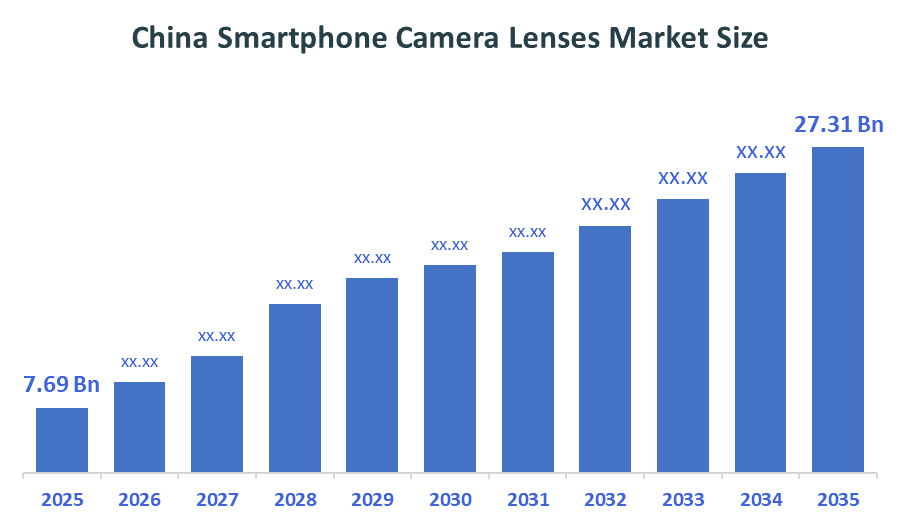
According to Decision Advisors, the China smartphone camera lenses market size is expected to grow from USD 7.69 billion in 2025 to USD 27.31 billion by 2035, at a CAGR of 13.51% during the forecast period 2026–2035. The Chinese mobile optics sector is projected to expand significantly over the next decade due to the rapid transition toward multi-lens camera systems, rising consumer demand for professional-grade mobile photography, and the integration of sophisticated glass-plastic hybrid lens technology. Additionally, the flourishing domestic creator economy and substantial investments in R&D for periscope zoom and AI-driven optical stabilisation are further supporting market growth across the country.
Market Overview/Introduction
The smartphone camera lens market in China involves engineering, high-precision manufacturing, and the integration of optical lens sets into mobile devices. These optical components, often categorised as lens elements, are essential for capturing light and directing it onto the image sensor. They are highly sought after for their ability to deliver DSLR-like photography in a compact, mobile form factor. The product offerings in this market include various specialised optics such as wide-angle, ultra-wide, macro, and telephoto lenses. These components are used to meet the surging consumer demand for portrait modes, high-optical zoom, and cinematic video capabilities in modern handsets. There has been a clear move towards glass-plastic hybrid lenses and the use of periscope zoom modules. Additionally, free-form aspheric lenses are gaining traction due to their ability to correct wide-angle distortion and improve corner-to-corner image sharpness. Moreover, the incorporation of AI-driven computational photography and hardware-level optical image stabilisation (OIS) has changed the dynamics of the mobile imaging experience. The Chinese market has seen a transition from basic single-camera setups to sophisticated multi-lens systems that utilise liquid lens technology, which mimics the human eye’s focus speed and versatility. Manufacturers and smartphone OEMs are increasingly investing in these high-layer (7P or 8P) lens assemblies to differentiate their flagship products and capture a larger share of the premium device segment.
- China remains the primary global command centre for smartphone lens production, housing major industry leaders like Sunny Optical and AAC Technologies.
- Multi-lens configurations now dominate the Chinese market, with over 54% of new device shipments featuring triple or quad-rear camera systems.
- Roughly 61% of lenses currently integrated into Chinese smartphones are 13MP or higher, as the megapixel race pushes demand for lenses that can support 50MP to 200MP sensors.
Notable Insights
- China continues to be the central powerhouse for the Asia-Pacific region, which holds over 64% of the global smartphone lens output. In 2024, the combined production from China and neighbouring tech hubs exceeded 2.6 billion lens units.
- Glass-plastic hybrid lenses have become the new industry standard, capturing nearly 48% of the market share in 2025. These hybrids are favoured for providing superior thermal stability and clarity compared to traditional all-plastic designs.
- Multi-camera setups are now a baseline requirement, with more than 54% of new smartphone shipments featuring at least three or four rear lenses. Wide or primary lenses still lead revenue at 42.36%, but telephoto optics are the fastest-growing segment.
- High-tier flagship devices are increasingly adopting 7P (seven-element) and 8P lens structures. The integration of Periscope Zoom technology has seen a 33% increase in adoption, enabling mobile devices to achieve up to 10x true optical zoom.
- The explosion of short-form video content and professional vlogging has forced manufacturers to prioritise front-facing selfie cameras, which now account for approximately 38% of total lens demand.
What is the Role of Technology in Grooming the Market?
The primary catalyst for expansion in the China smartphone camera lenses market is rapid technological evolution, which is shifting the industry toward professional-grade mobile imaging. Innovations such as periscope telephoto structures and glass-plastic hybrid lens assemblies have made it possible to achieve high-performance zoom and superior thermal stability within slim device profiles. In the consumer segment, the adoption of liquid lens technology and free-form aspheric designs allows users to capture microscopic details and ultra-wide shots without the distortion typical of traditional optics. This not only elevates the mobile photography experience but also improves hardware efficiency through AI-compatible optical designs that optimise image data for real-time processing, making high-end lens modules a vital feature for modern handsets.
Market Drivers
The China smartphone camera lens industry is propelled by an intense domestic megapixel race and a nationwide push for premium device differentiation. Growing demand for sophisticated multi-camera arrays, where triple or quad-lens systems have become a standard, is a significant factor. Furthermore, the massive rise of the short-form video and influencer economy has made advanced front-facing and cinematic lenses a top priority for manufacturers. The presence of a robust local supply chain and heavy R&D investments by domestic tech giants into 7P and 8P lens structures also provides a consistent stream of demand for cutting-edge optical solutions.
Restraints
Despite the strong growth, the market faces hurdle such as the extreme engineering complexity required to miniaturise high-performance lenses without increasing phone thickness. The high cost of precision glass moulding and the technical challenges associated with achieving high yields for complex hybrid lenses can act as a barrier for some manufacturers. Additionally, while the premium segment is thriving, intense pricing pressure in the budget and mid-range smartphone tiers can force suppliers to use lower-cost plastic optics, which may limit the overall revenue potential in high-volume, cost-sensitive market segments.
Strategies to Implement for Growth of the Market
To maintain their competitive edge, lens producers are focusing on developing universal lens modules that can be easily integrated across various smartphone models to reduce manufacturing overhead. Strategic collaborations with iconic global camera brands are essential for building brand prestige and attracting photography enthusiasts. Companies are also increasing their focus on the automotive and AR/VR sectors to diversify their optical portfolios beyond just mobile devices. Investing in automated AI-driven defect detection systems and sustainable manufacturing processes will further strengthen the market position as the industry looks toward high-precision and eco-friendly production standards.
Market Segmentation
The China smartphone camera lenses market is categorised by product type, application, and technology.
The hybrid lenses segment dominated the market in 2025 and is projected to grow at a substantial CAGR of approximately 14.2% during the forecast period.
Based on the product type, the smartphone camera lens market is divided into plastic lenses, glass lenses, and hybrid lenses. The hybrid lenses segment dominated the market in 2025 and is projected to grow at a substantial CAGR of approximately 14.2% during the forecast period. This is primarily due to its superior optical performance, excellent thermal stability, and ability to deliver high-resolution imagery in slim smartphone profiles, making it the preferred choice for premium flagship devices. It has a strong demand in both high-end and mid-range mobile sectors due to its balance of cost-efficiency and high light transmission. The dominance is driven by the rapid shift toward 50MP and 100MP+ sensors in the Chinese market and a growing consumer preference for mobile photography that rivals professional DSLR quality.
The rear camera application segment accounted for the largest share in 2025 and is anticipated to grow at a significant CAGR of approximately 13.8% during the forecast period.
Based on the application, the smartphone camera lens market is divided into front camera and rear camera. The rear camera application segment accounted for the largest share in 2025 and is anticipated to grow at a significant CAGR of approximately 13.8% during the forecast period. This dominance is attributed to the surge in multi-camera configurations and the popularity of sophisticated mobile imaging systems that require a combination of primary, ultra-wide, and macro-optics. Manufacturers prefer advanced rear-facing arrays for their ability to offer versatile shooting modes and enhanced depth sensing. The segment's growth is further bolstered by the rapid adoption of computational photography and the rising trend of professional-grade mobile videography among Chinese social media creators, positioning the rear-facing sector as the primary driver of market volume.
The periscope lenses technology segment dominated the market in 2025 and is projected to grow at a substantial CAGR of approximately 14.5% during the forecast period.
Based on the technology, the smartphone camera lens market is divided into standard lenses, wide-angle lenses, telephoto lenses, and periscope lenses. The periscope lenses technology segment dominated the market in 2025 and is projected to grow at a substantial CAGR of approximately 14.5% during the forecast period. This is primarily due to the intense competition among Chinese smartphone brands to offer superior optical zoom capabilities without increasing the physical thickness of the device. The ease of integrating folded optics and light-bending prisms into modern handset designs makes periscope modules highly efficient for long-range photography. While the wide-angle segment is expanding due to its necessity in everyday captures, the sheer volume of high-zoom flagship releases and technical innovation in domestic R&D centres ensures the continued dominance of the periscope lenses segment.
Recent Developments
- In June 2025, A leading Chinese optical manufacturer completed a strategic merger to integrate advanced software algorithms with hardware, enabling mass production of system-level AI camera modules for next-generation smartphones.
- In October 2024, Major players in the optical industry announced a breakthrough in glass-plastic hybrid lens technology, achieving a 95.8% year-on-year revenue increase by providing superior thermal stability for high-resolution mobile sensors.
- In March 2024, the introduction of ultra-thin, high-performance periscope telephoto lenses eliminating the need for bulky camera bumps and allowed 10x optical zoom to be integrated into slim, flagship device profiles.
Competitive Analysis
The report offers the appropriate analysis of the key organisations/companies involved within the China smartphone camera lenses market, along with a comparative evaluation primarily based on their product offering, business overviews, geographic presence, enterprise strategies, segment market share, and SWOT analysis. The report also provides an elaborate analysis focusing on the current news and developments of the companies, which includes product development, innovations, joint ventures, partnerships, mergers & acquisitions, strategic alliances, and others. This allows for the evaluation of the overall competition within the market.
Top Key Companies in the China Smartphone Camera Lenses Market
- Sunny Optical Technology (Group) Co., Ltd.
- Largan Precision Co., Ltd.
- AAC Technologies Holdings Inc.
- Genius Electronic Optical Co., Ltd.
- Kantatsu Co., Ltd. (Sharp Corporation)
- Asia Optical Co., Inc.
- Samsung Electro-Mechanics Co., Ltd.
- LG Innotek Co., Ltd.
- Others
Key Target Audience
- Smartphone OEMs and Device Manufacturers
- Optical Component Suppliers and Material Science Firms
- Semiconductor and Image Sensor Developers
- Social Media Influencers and Digital Content Creators
- Investors and Technology Venture Capitalists
- Government Telecommunications and R&D Authorities
- E-commerce Platforms and Electronics Distributors
- Supply Chain and Logistics Providers in the Tech Sector
Market Segmentation
This study forecasts revenue at the national and regional levels from 2020 to 2035. The report segmented the China smartphone camera lenses market based on the following segments:
China Smartphone Camera Lenses Market, By Product Type
- Plastic Lenses
- Glass Lenses
- Hybrid Lenses (Glass-Plastic)
China Smartphone Camera Lenses Market, By Application
- Front Camera
- Rear Camera
China Smartphone Camera Lenses Market, By Technology
- Standard Lenses
- Wide-Angle Lenses
- Telephoto Lenses
- Periscope Lenses
Frequently Asked Questions (FAQ)
How is the content creator trend driving the China smartphone lens market?
The explosion of short-form video platforms is a major catalyst. Creators prioritise devices with professional-grade optics that support 4K recording and cinematic depth. This demand for high-performance imaging increases market value as cameras become the primary selling point for mobile upgrades.
Why is China a leading market for smartphone camera lenses?
China dominates due to its massive domestic handset production and an established ecosystem of high-precision optical manufacturers in cities like Shenzhen. Strategic government support for electronics R&D also ensures a rapid transition to advanced lens structures like 7P and 8P assemblies.
What are periscope lenses, and how do they help growth?
These folded-optic modules remove the need for thick camera bumps while providing long-range optical zoom. This innovation allows flagship phones to offer 5x to 10x lossless zoom in slim designs, significantly boosting demand among photography enthusiasts and premium buyers.
What is the role of hybrid lens technology in the market?
Consumer preference is shifting toward glass-plastic hybrid lenses that offer superior light transmission and thermal stability. These modules combine the durability of glass with the lightweight properties of plastic, becoming a premium standard for high-resolution 50MP to 200MP sensors.
How do government R&D initiatives impact the 2035 forecast?
National industrial policies are prioritising self-sufficiency in high-end optical components. This regulatory and financial support ensures the market will move toward sophisticated AI-integrated and liquid lens systems by 2035, maintaining a strong growth rate as the country’s digital infrastructure modernises.
Check Licence
Choose the plan that fits you best: Single User, Multi-User, or Enterprise solutions tailored for your needs.
We Have You Covered
- 24/7 Analyst Support
- Clients Across the Globe
- Tailored Insights
- Technology Tracking
- Competitive Intelligence
- Custom Research
- Syndicated Market Studies
- Market Overview
- Market Segmentation
- Growth Drivers
- Market Opportunities
- Regulatory Insights
- Innovation & Sustainability
Report Details
| Scope | Country |
| Pages | 190 |
| Delivery | PDF & Excel via Email |
| Language | English |
| Release | Apr 2026 |
| Access | Download from this page |