
Germany Xenon Lights Market
 |
Author:
Kunal M
|
Pages:
190
|
Author:
Kunal M
|
Pages:
190
Germany Xenon Lights Market Size, Share, By Product Type (Single-Beam Xenon, Bi-Xenon, and Xenon-Mercury), By Application (Headlamps, Fog Lights, Interior Lighting, and Signaling Lights), and By Technology (High-Intensity Discharge (HID), Adaptive Front-Lighting Systems (AFS), and Smart Ballast Systems), Analysis and Forecast 2026 ? 2035
CAGR
2.79%
REVENUE 2025
USD Million 218.32
FORECAST 2035
USD Million 287.54
REPORT COVERAGE
Country
Market Snapshot
- Germany Xenon Lights Market Size (2025): USD 218.32 Million
- Germany Xenon Lights Projected Market Size (2035): USD 287.54 Million
- Germany Xenon Lights Compound Annual Growth Rate (CAGR): 2.79%
- Base Year: 2025
- Historical Period: 2021–2024
- Forecast Period: 2026–2035
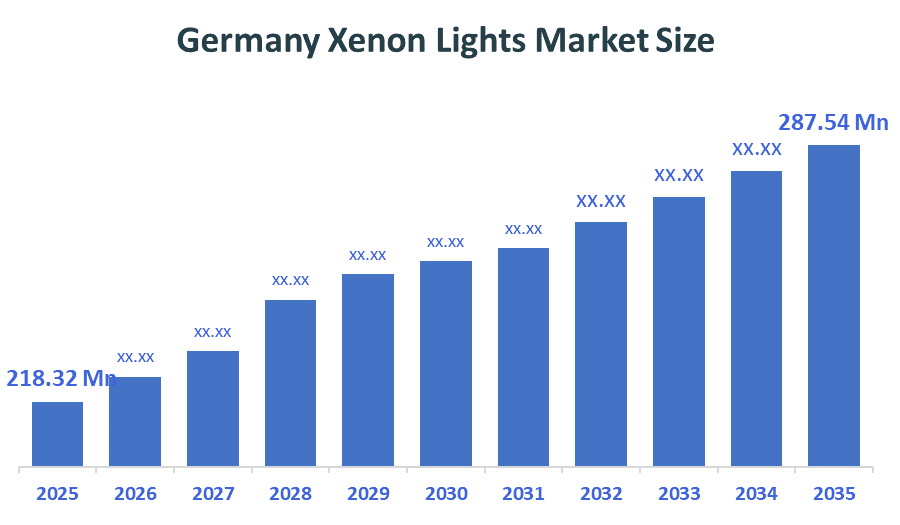
According to Decision Advisors, the Germany xenon lights market size is expected to grow from USD 218.32 million in 2025 to USD 287.54 million by 2035, at a CAGR of 2.79% during the forecast period 2026–2035. The German automotive lights market will sustain stable growth in the coming ten years because of the rising need for high-intensity discharge technology in the expensive automobile market and also in the replacement market. Even though new technologies are being developed, the already existing technology associated with xenon bulbs production and the need to promote road safety by producing very bright lights play an essential role in the growth of the industry. Additionally, the influence of auto makers and advanced headlights systems is a significant factor.
Market Overview/Introduction
The market for xenon lights in Germany concerns the design, manufacture, and assembly of HID lamp systems for automotive and industrial use. The use of specialised lighting units that produce powerful electric arcs via xenon gases is crucial for achieving brighter lighting than possible using conventional halogen bulbs. Xenon lights are in high demand because of their ability to produce bright lights while consuming less energy. Products available within this market sector include single-beam, bi-xenon, and xenon-mercury lamps. The products in this industry are sought after by consumers due to the need for better visibility, adaptive lighting features, and energy efficiency. An observable trend in the industry includes the development of advanced technologies like adaptive front-lighting systems (AFS) and ballasts for optimizing power consumption. High-purity xenon gas has also become popular as an alternative due to its use in semiconductors and satellite propulsion systems. Another emerging trend that can be observed is the integration of auto-levelling systems and electronic ignition starters. In Germany, there has been a shift from simple HID systems to complex intelligent lighting systems that make use of sophisticated light distribution systems to enhance road safety during night-time driving. Automotive manufacturers are now focusing more on manufacturing efficient discharge systems in order to keep up with the competitive high-performance lighting systems market. Germany remains a primary European hub for automotive lighting innovation, housing major industry leaders such as Osram, Hella, and Philips Automotive.
- Despite other technological advancements, Xenon HID still finds itself occupying an important niche within Germany's automotive industry, being utilised by about 18% of the premium car segment due to its distinct spectral characteristics and depth of field.
- Roughly 74% of xenon lighting demand in the country is driven by the automotive headlamp application, as the replacement market for high-performance bulbs remains robust among owners of luxury German automobile brands.
Notable Insights
- Germany is among the key sources behind Europe’s continuous consumption of HID technologies. In 2024, the country boasted a strong value chain in which large manufacturing capacities for its domestic luxury OEMs and a wide range of European aftermarkets are essential components.
- The bi-xenon headlight system has established itself as the standard technology for premium vehicles, taking roughly 57% of the xenon module market in 2025. This type of headlights is advantageous due to its capacity to operate as a low- and high-beam device simultaneously and provide an efficient design compared to older single-beam systems.
- Safety-related features form the core market requirement; as high-powered xenon headlamps have dominated the market in terms of revenue generation by far. Among other innovations, AFS is expected to grow the fastest due to a preference among German consumers for adaptive light control based on steering and driving conditions.
- The market will continue to be spurred on by the need for replacement components as well as specialised kits for retrofitting, where the auto aftermarket represents almost 40% of the total xenon lighting requirement.
What is the Role of Technology in Grooming the Market?
The key factor driving growth in the German xenon lights market is the advent of sophisticated electronics and adaptive optics. The current technological trend is moving towards intelligent lights that improve road safety through high-intensity discharge HID precision. Technologies like bi-xenon projector headlamps and adaptive ballast technology are making it possible to ensure high levels of luminosity and beam alignment in complex car structures. In the premium cars segment, the use of adaptive front lighting systems and dynamic levelling sensors provides for better light alignment based on steering angle and speed of movement. Apart from increasing the level of safety during night driving, this technology also extends hardware lifespan by regulating the electrical power supply with the help of microprocessors, thus making expensive modules an integral part of luxurious vehicles.
Market Drivers
The xenon lights production industry in Germany is propelled by the presence of Germany as one of the largest producers of luxury vehicles on the international scene and its strict adherence to safety norms. Another critical reason for the stability of the market stems from the need for replacements of the growing number of luxury vehicles present in the market. Specificity of needs of various industries as well as of the medical sector, where CRI of xenon lights is a critical requirement, guarantees the demand through the continuous flow of products. Efficient supply chains in Germany, home to many producers of top-notch gas-discharge lamps, are what make Germany competitive.
Restraints
Even though the company demonstrates stable operations, the market still suffers from obstacles like the rapid development of solid-state illumination methods, especially light-emitting diodes (LEDs), that consume less energy and can be seamlessly incorporated into electric vehicle (EV) systems. The expensive nature of producing pressurised quartz glass casings and the technical challenges surrounding the development of high-voltage spark generation systems might hinder market penetration among entry-level car manufacturers. On the other hand, while HID lamps continue to dominate the premium and niche markets, the introduction of strict environmental laws against mercury usage and the adoption of software-driven lighting systems could reduce the profitability in mass-produced vehicles.
Study on the Supply, Demand, Distribution, and Market Environment
The market for xenon headlights in Germany is a well-established one that revolves around the country's top-tier automobile industry. The sources of supply come from companies like Osram and Hella that have strong production capacities for HID parts and rare gases in facilities such as Leuna. The demand is stable as it is based on the need to replace old models of luxury cars, as well as medical and industrial applications. There are organised distribution networks within two primary distribution channels: OEM deals between car manufacturers and suppliers for premium car models, and a vast aftermarket channel using both conventional wholesale channels and electronic commerce.
Price Analysis and Consumer Behaviour Analysis
Price Analysis highlights the stratification of the market, where ordinary xenon lamps are stable-priced, but bi-xenon and adaptive lights require a premium due to sophisticated electronic ballasts and sensors. However, despite being more expensive than halogens at purchase, xenon is offered as a high-quality, affordable substitute for extremely costly laser and Matrix LED lighting. Consumer Behaviour in Germany suggests that customers there are highly aware of technical parameters and value safety, longevity, and prestige. Drivers are particularly loyal to original equipment brands to stay legal on the road and improve nighttime vision. Moreover, there is a niche segment of consumers consisting of owners of luxurious cars and classic restoration specialists who appreciate the distinct hue and depth provided by xenon lighting.
Market Segmentation
The Germany Xenon Lights Market is categorised by product type, application, and technology.
The bi-xenon segment dominated the market in 2025 and is projected to grow at a steady CAGR of approximately 3.1% during the forecast period.
Based on the product type, the xenon lights market is divided into single-beam xenon, bi-xenon, and xenon-mercury. The bi-xenon segment dominated the market in 2025 and is projected to grow at a steady CAGR of approximately 3.1% during the forecast period. Mainly, this can be attributed to its excellent optical capabilities, as it is able to offer both high beam and low beam capabilities from one light source, hence giving high spatial efficiency in today’s vehicle designs. There is a huge demand for this technology in the premium vehicles market since it can offer high-definition lights coupled with an aesthetic look. This predominance of LED light technology is due to the fast uptake of advanced light technologies in German luxury cars.
The headlamps application segment accounted for the largest share in 2025 and is anticipated to grow at a significant CAGR of approximately 2.9% during the forecast period.
Based on the application, the xenon lights market is divided into headlamps, fog lights, interior lighting, and signaling lights. The headlamps application segment accounted for the largest share in 2025 and is anticipated to grow at a significant CAGR of approximately 2.9% during the forecast period. Such dominance is owed to the importance that high-intensity discharge systems have in terms of visibility for drivers, as well as the need to comply with European road safety rules. The use of xenon headlamps is favoured because they allow for flexibility in beam design, as well as better peripheral vision. Growth in this category is also supported by the strength of the aftermarket car industry in Germany, where there is an increasing tendency to maintain high-quality standards within the current range of luxury cars.
The adaptive front-lighting systems (AFS) technology segment dominated the market in 2025 and is projected to grow at a substantial CAGR of approximately 3.4% during the forecast period.
Based on the technology, the xenon lights market is divided into high-intensity discharge (HID), adaptive front-lighting systems (AFS), and smart ballast systems. The adaptive front-lighting systems (AFS) technology segment dominated the market in 2025 and is projected to grow at a substantial CAGR of approximately 3.4% during the forecast period. It is mostly because of the cutthroat competition between German car brands in providing better active safety features by modifying the light beam using the angle and speed of the car. The simplicity involved in incorporating sensors and electronic controls into contemporary lighting systems makes AFS more effective when driving through challenging roads. Although HID is still essential in any setup since it is the backbone of AFS technology, the large number of advanced car models and innovations in the country’s engineering facilities make the AFS market segment dominant.
Recent Developments
- In June 2025, a major German industrial gas producer, Linde plc, completed the expansion of one of the world's largest noble gas purification plants in Leuna, specifically aimed at securing a stable supply of high-purity xenon for the European automotive and semiconductor sectors.
- In October 2024, prominent players in the German automotive industry, such as HELLA GmbH & Co. KGaA and OSRAM GmbH, introduced a breakthrough in bi-xenon projector technology, achieving a 220% increase in brightness compared to standard legal requirements while reducing energy consumption through optimised electronic starters.
- In May 2024, a global industrial group, Lumileds, completed the acquisition of a specialised automotive lighting business in Germany, strengthening its aftermarket distribution network. The move is expected to improve supply chain efficiency by 20% and expand the availability of xenon retrofit kits across key European markets.
- In March 2024, manufacturers such as OSRAM GmbH and Philips introduced next-generation mercury-free xenon HID systems, achieving up to 15% higher energy efficiency while meeting stricter EU environmental norms. These systems also deliver over 3,000 lumens of brightness and enhanced beam range, supporting premium automotive lighting standards.
Competitive Analysis
The report offers the appropriate analysis of the key organisations/companies involved within the Germany xenon lights market, along with a comparative evaluation primarily based on their product offering, business overviews, geographic presence, enterprise strategies, segment market share, and SWOT analysis. The report also provides an elaborate analysis focusing on the current news and developments of the companies, which includes product development, innovations, joint ventures, partnerships, mergers & acquisitions, strategic alliances, and others. This allows for the evaluation of the overall competition within the market.
Top Key Companies in the Germany Xenon Lights Market
- Osram GmbH
- HELLA GmbH & Co. KGaA
- Koninklijke Philips N.V.
- Valeo S.A.
- ZKW Group GmbH
- Magneti Marelli S.p.A.
- Bosch Limited
- Lumileds Holding B.V.
- Others
Key Target Audience
- Market Players
- Investors
- End-users
- Government Authorities
- Consulting and Research Firm
- Venture capitalists
- Value-Added Resellers (VARs)
Market Segmentation
This study forecasts revenue at the national and regional levels from 2020 to 2035. The report segmented the Germany Xenon Lights Market based on the following segments:
Germany Xenon Lights Market, By Product Type
- Single-Beam Xenon
- Bi-Xenon
- Xenon-Mercury
Germany Xenon Lights Market, By Application
- Headlamps
- Fog Lights
- Interior Lighting
- Signaling Lights
Germany Xenon Lights Market, By Technology
- High-Intensity Discharge (HID)
- Adaptive Front-Lighting Systems (AFS)
- Smart Ballast Systems
Frequently Asked Questions (FAQ)
How is the demand for premium safety features driving the Germany xenon lights market?
The stress placed on having good road safety in Europe acts as a significant driving force. The need to have a high-intensity discharge system for its daylight-type brightness and clear contrast among German drivers plays a huge role in boosting the product’s worth as a feature of safety.
Why is Germany a leading market for xenon lighting technology?
Germany is dominant because it is the center of excellence for luxury vehicle engineering in the world and a community of top-notch manufacturers of car lights such as Osram and Hella. The emphasis on precision engineering and stringent laws make Germany a consistent market for HID and adaptive headlamps.
What are Adaptive Front-Lighting Systems (AFS), and how do they help growth?
This system enables the light module to tilt its direction and intensity of xenon light according to the position of the steering wheel and speed of the car. It helps in improving visibility while turning or in adverse weather conditions without affecting oncoming drivers.
What is the role of bi-xenon technology in the market?
There has been an increasing trend towards bi-xenon technology that provides the dual capability to generate both low and high beam using one unit of light. The module not only has better spatial efficiency but also offers optimal lighting. It is commonly used in German premium cars.
How do environmental regulations impact the 2035 forecast?
The industrial policies of Europe favor the conversion to mercury-free xenon and energy-saving ballasts. The government’s backing guarantees that the market would shift towards more environmentally-friendly and efficient discharge lamps by 2035. Growth will be sustained as the country’s auto infrastructure adapts to the new manufacturing standards.
Check Licence
Choose the plan that fits you best: Single User, Multi-User, or Enterprise solutions tailored for your needs.
We Have You Covered
- 24/7 Analyst Support
- Clients Across the Globe
- Tailored Insights
- Technology Tracking
- Competitive Intelligence
- Custom Research
- Syndicated Market Studies
- Market Overview
- Market Segmentation
- Growth Drivers
- Market Opportunities
- Regulatory Insights
- Innovation & Sustainability
Report Details
| Scope | Country |
| Pages | 190 |
| Delivery | PDF & Excel via Email |
| Language | English |
| Release | Apr 2026 |
| Access | Download from this page |