
US Remote Mobile Payment Market
 |
Author:
Nikita K
|
Pages:
210
|
Author:
Nikita K
|
Pages:
210
US Remote Mobile Payment Market Size, Share, By Type (NFC Payments, QR Code Payments, In-App Payments, Mobile Wallets), By Application (Retail, E-commerce, Transportation, Hospitality, Utilities, Others), and By End-User (Consumers, Enterprises, Government), Analysis and Forecast 2026 - 2035.
CAGR
12.95%
REVENUE 2025
USD Billion 9264.19
FORECAST 2035
USD Billion 31310.68
REPORT COVERAGE
Country
Market Snapshot
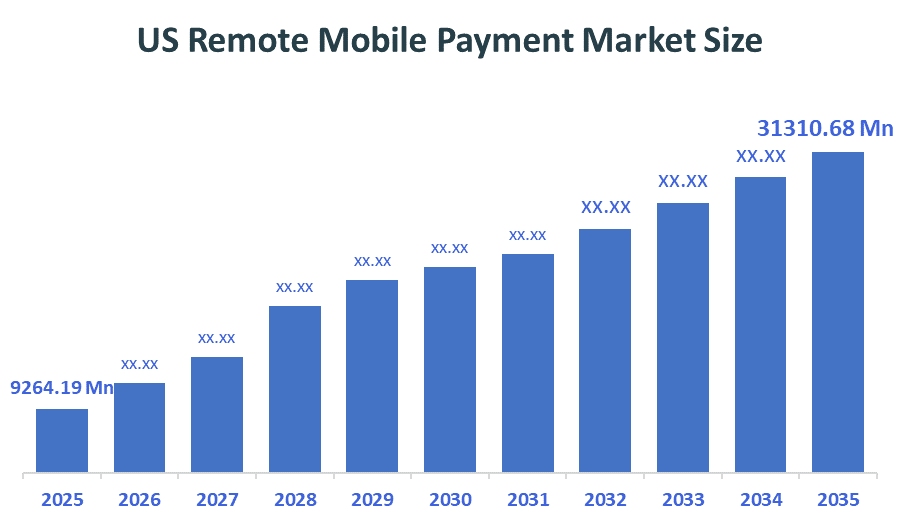
- US Remote Mobile Payment Market Size (2025): USD 9264.19Million
- Projected US Remote Mobile Payment Market Size (2035): USD 31310.68 Million
- Compound Annual Growth Rate (CAGR): 12.95%
- Base Year: 2025
- Historical Period: 2021 - 2024
- Forecast Period: 2026 - 2035
Market Overview/Introduction
The US Remote Mobile Payment Market includes digital platforms enabling transactions through mobile wallets and QR codes, in-app payments and peer-to-peer networks. The market expands because of the rising demand for smartphones, e-commerce grows, and people seek secure cashless payment methods, which fintech companies like Apple Inc., Google LLC and PayPal Holdings Inc provide. Government initiatives establish FedNow digital payment modernization programs that enhance both real-time settlement capabilities and transaction security. Companies for Apple Inc., Google LLC and PayPal Holdings Inc invest their resources into AI-driven fraud detection APIs and digital wallet systems. Future growth supported by embedded finance, AI payments and wider adoption of digital currencies.
Notable Insights: -
- By type, the mobile wallets segment held a dominant position with 45% in terms of market share in 2025.
- By end-user, the consumer segment is the dominating accounting for over 69% of the UK market share in 2025.
- The compound annual growth rate of the US remote mobile payment market is 12.95%.
- The market is likely to achieve a valuation of USD 31310.68 Million by 2035.
What is role of technology in grooming the market?
Technological advancements are transforming the US remote mobile payment market by improving speed, security, and user experience. Innovations such as NFC-enabled payments, QR code systems, blockchain-based transaction verification, AI-driven fraud detection, and biometric authentication are enhancing transaction safety and efficiency. Mobile payment platforms are increasingly powered by cloud infrastructure and real-time data processing, enabling seamless integration across devices and services. Fintech companies are embedding payment APIs into retail, ride-hailing, and subscription platforms to support frictionless payments. Growing adoption of digital ecosystems by consumers and enterprises is accelerating cashless transactions, strengthening financial inclusion, and positioning the market for sustained expansion through 2035 across the United States.
Market Drivers
The US Remote Mobile Payment Market is experiencing growth because more people are using smartphones, and digital commerce is expanding, which leads consumers to choose contactless payment methods that offer speed and security rather than cash payments. Fintech platforms such as Stripe, Inc. and PayPal Holdings, Inc., along with banking apps and super apps, drive digital payment adoption throughout various sectors. The government initiatives that back financial digitization together with their robust cybersecurity systems, create a more secure environment for mobile payments. The demand for smooth international transactions, subscription services and digital ecosystems drives market growth while more US businesses adopt remote mobile payment systems.
Restrain
The market faces challenges such as cybersecurity risks, data privacy concerns, and increasing cases of digital fraud. Limited digital literacy among certain population groups also slows adoption in some segments. High dependency on internet connectivity and smartphone access creates infrastructure-related limitations. Moreover, regulatory fragmentation across payment systems and compliance requirements increases operational complexity for service providers.
Strategies to Implement for Growth of the Market
To accelerate growth in the US remote mobile payment market, companies are strengthening security through AI-based fraud detection, encryption, and multi-factor authentication. Wider deployment of QR-based payments and NFC infrastructure is improving transaction accessibility and convenience across retail and service sectors. Fintech firms are also forming strategic partnerships with banks, retailers, and technology providers to expand ecosystem integration and user reach. In addition, the development of super apps combining payments, banking, and financial services is enhancing customer engagement. Investments in blockchain-based settlement systems and real-time payment networks are further improving transparency, efficiency, and speed, supporting long-term digital payment ecosystem expansion.
Study on the Supply, Demand, Distribution, and Market Environment
Demand for US remote mobile payment solutions is driven by consumers, enterprises, and government-led digital initiatives promoting cashless transactions and financial digitization. Supply is primarily provided by fintech companies, banks, and digital wallet providers offering secure and integrated payment ecosystems. Distribution occurs through mobile applications, online platforms, point-of-sale (POS) systems, and embedded payment APIs across retail, e-commerce, and service industries. The market is highly competitive, characterized by continuous innovation, rapid technology upgrades, and strong adoption of AI, cloud computing, and real-time payment systems. Increasing collaboration between financial institutions and technology providers is further enhancing efficiency, scalability, and overall market expansion.
Price Analysis and Consumer Behaviour Analysis
Remote mobile payment services in the US are generally low-cost or free for consumers, with revenue generated through merchant transaction fees, interchange charges, subscription models, and value-added fintech services. Consumers prioritize convenience, speed, security, and seamless user experience over pricing, with cashback rewards, loyalty programs, and instant settlement features strongly influencing adoption and engagement. Businesses prefer scalable, secure, and easily integrable payment solutions that connect with e-commerce platforms, POS systems, and embedded finance ecosystems. Overall, increasing competition among fintech providers is improving service quality, reducing transaction friction, and expanding digital payment acceptance across retail, online, and service-based industries nationwide.
Market Segmentation
The US Remote Mobile Payment Market share is classified into type, application and end-user.
- The mobile wallets segment dominated the market in 2025, and is projected to grow at a substantial CAGR of approximately 45% during the forecast period.
Based on the type, the US Remote Mobile Payment Market is divided into NFC Payments, QR Code Payments, In-App Payments, and Mobile Wallets. Among these, the mobile wallets segment dominates the market in 2025, and is projected to grow at a substantial CAGR of approximately 45% during the forecast period. This is driven by high smartphone penetration, seamless banking integration, strong security features, and increasing adoption of contactless payment systems across retail and digital platforms, mobile wallets have become the preferred payment method in the US Remote Mobile Payment Market.
- The retail segment dominated the market in 2025, and is projected to grow at a substantial CAGR during the forecast period.
Based on the application, the US remote mobile payment market is divided into retail, e-commerce, transportation, hospitality, utilities, and others. Among these, the retail segment dominated the market in 2025, and is projected to grow at a substantial CAGR during the forecast period. The growth is driven by rising online shopping activity, increasing digital payment adoption, and strong consumer preference for fast, secure, and frictionless checkout experiences, the retail and e-commerce segment continues to dominate the US Remote Mobile Payment Market, supported by rapid digital transformation
- The consumers segment accounted for the largest share in 2025, and is anticipated to grow at a significant CAGR of approximately 69% during the forecast period.
Based on the end-user, the US remote mobile payment market is divided into consumers, enterprises, and government. Among these, the consumers segment accounted for the largest share in 2025, and is anticipated to grow at a significant CAGR of approximately 69% during the forecast period. This is due to widespread smartphone usage, rising adoption of digital wallets, and increasing preference for fast, secure, and convenient cashless transactions across retail, e-commerce, and peer-to-peer payment ecosystems nationwide.
Recent Development
- In March 2026, major US retail chain Publix Super Markets discontinued its proprietary Publix Pay mobile payment service, shifting focus toward third-party digital wallets such as Apple Pay and Google Pay to enhance checkout convenience and interoperability across stores.
- In July 2025, PayPal Holdings, Inc. expanded its cross-border payment interoperability through the “PayPal World” initiative, enabling seamless wallet-to-wallet transactions across global networks such as UPI and Tenpay, strengthening international mobile payment connectivity.
Competitive Analysis
The report offers the appropriate analysis of the key organisations/companies involved within the US remote mobile payment market, along with a comparative evaluation primarily based on their product offering, business overviews, geographic presence, enterprise strategies, segment market share, and SWOT analysis. The report also provides an elaborative analysis focusing on the current news and developments of the companies, which includes product development, innovations, joint ventures, partnerships, mergers & acquisitions, strategic alliances, and others. This allows for the evaluation of the overall competition within the market.
Top Key Companies in US Remote Mobile Payment Market
- Apple Inc.
- Google LLC
- PayPal Holdings, Inc.
- Stripe, Inc.
- Block, Inc. (Cash App)
- Mastercard
- Visa Inc.
- Samsung Electronics (Samsung Pay)
- American Express
- Fiserv, Inc.
Key Target Audience
- Market Players
- Investors
- End-users
- Government Authorities
- Consulting and Research Firm
- Venture capitalists
- Value-Added Resellers (VARs)
Market Segment
This study forecasts revenue at the US, regional, and country levels from 2020 to 2035. Decision Advisors has segmented the US remote mobile payment market based on the below-mentioned segments
US Remote Mobile Payment Market, By Type
- NFC Payments
- QR Code Payments
- In-App Payments
- Mobile Wallets
US Remote Mobile Payment Market, By Application
- Retail
- E-commerce
- Transportation
- Hospitality
- Utilities
- Others
US Remote Mobile Payment Market, By End-User
- Consumers
- Enterprises
- Government
Frequently Asked Questions (FAQ)
Q. How do remote mobile payment systems handle transaction failures?
A. Most platforms use automatic retry mechanisms and smart routing systems that redirect failed transactions through alternate payment gateways, minimizing disruption and improving successful payment completion rates.
Q. How is competition shaping innovation in the US remote mobile payment market?
A. Intense competition among fintech firms and banks is accelerating innovation in embedded finance, real-time payments, and API-driven ecosystems, leading to continuous improvements in speed, security, and user experience.
Q. What factors influence merchant adoption of remote mobile payment solutions?
A. Merchant adoption is primarily influenced by transaction cost efficiency, settlement speed, integration flexibility with POS systems, and the ability to support omnichannel retail experiences.
Q. How is data analytics transforming mobile payment services?
A. Real-time transaction data analytics is helping providers optimize fraud detection, personalize user offers, improve credit risk assessment, and enhance overall payment system efficiency.
Check Licence
Choose the plan that fits you best: Single User, Multi-User, or Enterprise solutions tailored for your needs.
We Have You Covered
- 24/7 Analyst Support
- Clients Across the Globe
- Tailored Insights
- Technology Tracking
- Competitive Intelligence
- Custom Research
- Syndicated Market Studies
- Market Overview
- Market Segmentation
- Growth Drivers
- Market Opportunities
- Regulatory Insights
- Innovation & Sustainability
Report Details
| Scope | Country |
| Pages | 210 |
| Delivery | PDF & Excel via Email |
| Language | English |
| Release | Apr 2026 |
| Access | Download from this page |